FAA-H-8083-25C · Source PDF page 269
Aircraft Performance
Takeoff and Landing Performance · PHAK page 11-13
Searchable transcription
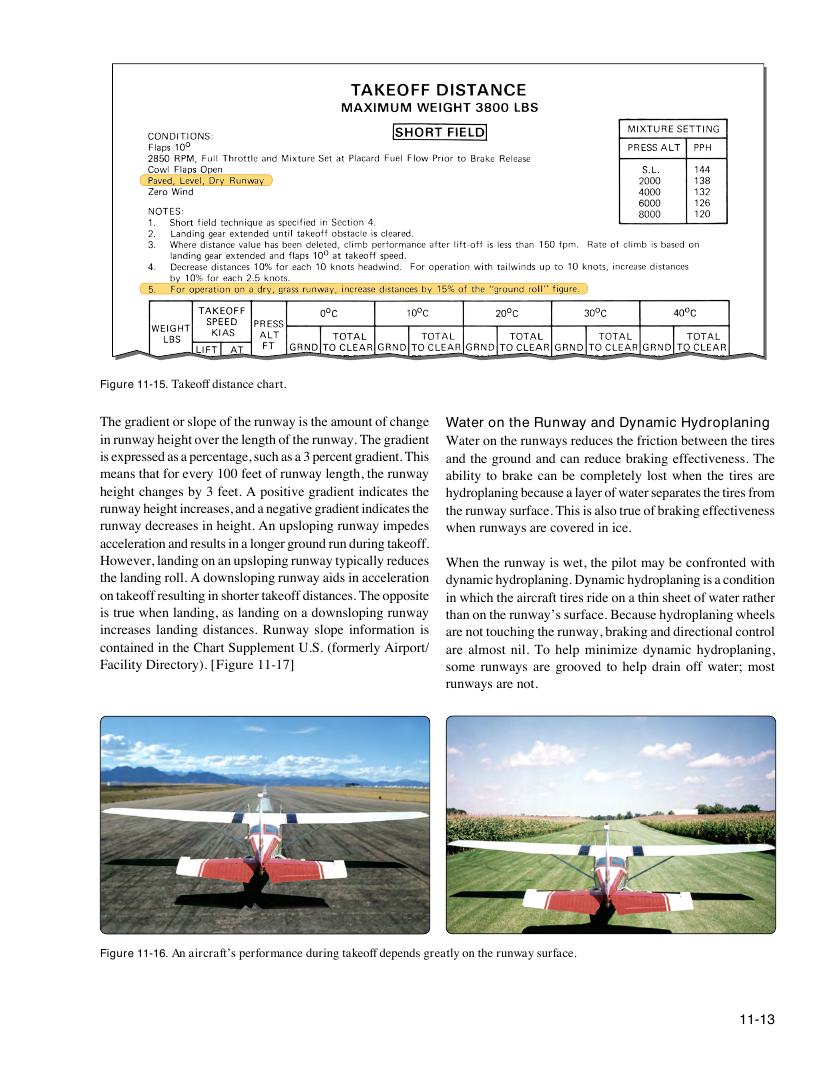
Figure 11-15. Takeoff distance chart.
The gradient or slope of the runway is the amount of change Water on the Runway and Dynamic Hydroplaning
in runway height over the length of the runway. The gradient Water on the runways reduces the friction between the tires
is expressed as a percentage, such as a 3 percent gradient. This and the ground and can reduce braking effectiveness. The
means that for every 100 feet of runway length, the runway ability to brake can be completely lost when the tires are
height changes by 3 feet. A positive gradient indicates the hydroplaning because a layer of water separates the tires from
runway height increases, and a negative gradient indicates the the runway surface. This is also true of braking effectiveness
runway decreases in height. An upsloping runway impedes when runways are covered in ice.
acceleration and results in a longer ground run during takeoff.
However, landing on an upsloping runway typically reduces When the runway is wet, the pilot may be confronted with
the landing roll. A downsloping runway aids in acceleration dynamic hydroplaning. Dynamic hydroplaning is a condition
on takeoff resulting in shorter takeoff distances. The opposite in which the aircraft tires ride on a thin sheet of water rather
is true when landing, as landing on a downsloping runway than on the runway’s surface. Because hydroplaning wheels
increases landing distances. Runway slope information is are not touching the runway, braking and directional control
contained in the Chart Supplement U.S. (formerly Airport/ are almost nil. To help minimize dynamic hydroplaning,
Facility Directory). [Figure 11-17] some runways are grooved to help drain off water; most
runways are not.
Figure 11-16. An aircraft’s performance during takeoff depends greatly on the runway surface.
11-13