FAA-H-8083-25C · Source PDF page 298
Weather Theory
Atmospheric Stability · PHAK page 12-14
Searchable transcription
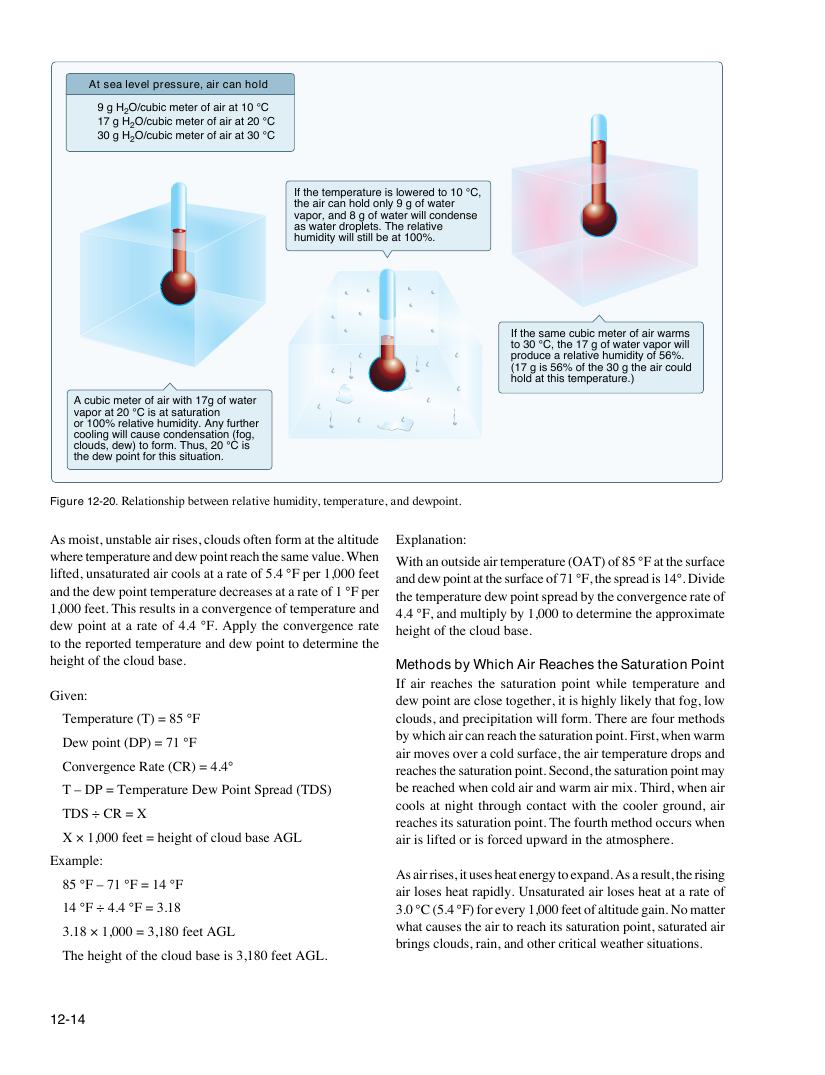
At sea level pressure, air can hold
9 g H O/cubic meter of air at 10 °C
2
17 g H O/cubic meter of air at 20 °C
2
30 g H O/cubic meter of air at 30 °C
2
If the temperature is lowered to 10 °C,
the air can hold only 9 g of water
vapor, and 8 g of water will condense
as water droplets. The relative
humidity will still be at 100%.
If the same cubic meter of air warms
to 30 °C, the 17 g of water vapor will
produce a relative humidity of 56%.
(17 g is 56% of the 30 g the air could
hold at this temperature.)
A cubic meter of air with 17g of water
vapor at 20 °C is at saturation
or 100% relative humidity. Any further
cooling will cause condensation (fog,
clouds, dew) to form. Thus, 20 °C is
the dew point for this situation.
Figure 12-20. Relationship between relative humidity, temperature, and dewpoint.
As moist, unstable air rises, clouds often form at the altitude Explanation:
where temperature and dew point reach the same value. When
With an outside air temperature (OAT) of 85 °F at the surface
lifted, unsaturated air cools at a rate of 5.4 °F per 1,000 feet
and dew point at the surface of 71 °F, the spread is 14°. Divide
and the dew point temperature decreases at a rate of 1 °F per
the temperature dew point spread by the convergence rate of
1,000 feet. This results in a convergence of temperature and
4.4 °F, and multiply by 1,000 to determine the approximate
dew point at a rate of 4.4 °F. Apply the convergence rate
height of the cloud base.
to the reported temperature and dew point to determine the
height of the cloud base.
Methods by Which Air Reaches the Saturation Point
If air reaches the saturation point while temperature and
Given:
dew point are close together, it is highly likely that fog, low
Temperature (T) = 85 °F clouds, and precipitation will form. There are four methods
by which air can reach the saturation point. First, when warm
Dew point (DP) = 71 °F
air moves over a cold surface, the air temperature drops and
Convergence Rate (CR) = 4.4° reaches the saturation point. Second, the saturation point may
T – DP = Temperature Dew Point Spread (TDS) be reached when cold air and warm air mix. Third, when air
cools at night through contact with the cooler ground, air
TDS ÷ CR = X
reaches its saturation point. The fourth method occurs when
X × 1,000 feet = height of cloud base AGL air is lifted or is forced upward in the atmosphere.
Example:
As air rises, it uses heat energy to expand. As a result, the rising
85 °F – 71 °F = 14 °F
air loses heat rapidly. Unsaturated air loses heat at a rate of
14 °F ÷ 4.4 °F = 3.18 3.0 °C (5.4 °F) for every 1,000 feet of altitude gain. No matter
what causes the air to reach its saturation point, saturated air
3.18 × 1,000 = 3,180 feet AGL
brings clouds, rain, and other critical weather situations.
The height of the cloud base is 3,180 feet AGL.
12-14