FAA-H-8083-25C · Source PDF page 299
Weather Theory
Atmospheric Stability · PHAK page 12-15
Searchable transcription
Dew and Frost allow the fog to form and intensify; above a speed of 15 knots,
On cool, clear, calm nights, the temperature of the ground the fog usually lifts and forms low stratus clouds. Advection
and objects on the surface can cause temperatures of the fog is common in coastal areas where sea breezes can blow
surrounding air to drop below the dew point. When this the air over cooler landmasses.
occurs, the moisture in the air condenses and deposits itself on
the ground, buildings, and other objects like cars and aircraft. Upslope fog occurs when moist, stable air is forced up sloping
This moisture is known as dew and sometimes can be seen land features like a mountain range. This type of fog also
on grass and other objects in the morning. If the temperature requires wind for formation and continued existence. Upslope
is below freezing, the moisture is deposited in the form of and advection fog, unlike radiation fog, may not burn off with
frost. While dew poses no threat to an aircraft, frost poses a the morning sun but instead can persist for days. They can
definite flight safety hazard. Frost disrupts the flow of air over also extend to greater heights than radiation fog.
the wing and can drastically reduce the production of lift. It
also increases drag, which when combined with lowered lift Steam fog, or sea smoke, forms when cold, dry air moves over
production, can adversely affect the ability to take off. An warm water. As the water evaporates, it rises and resembles
aircraft must be thoroughly cleaned and free of frost prior smoke. This type of fog is common over bodies of water
to beginning a flight. during the coldest times of the year. Low-level turbulence
and icing are commonly associated with steam fog.
Fog
Fog is a cloud that is on the surface. It typically occurs when Ice fog occurs in cold weather when the temperature is
the temperature of air near the ground is cooled to the air’s much below freezing and water vapor forms directly into ice
dew point. At this point, water vapor in the air condenses and crystals. Conditions favorable for its formation are the same
becomes visible in the form of fog. Fog is classified according as for radiation fog except for cold temperature, usually –25
to the manner in which it forms and is dependent upon the °F or colder. It occurs mostly in the arctic regions but is not
current temperature and the amount of water vapor in the air. unknown in middle latitudes during the cold season.
On clear nights, with relatively little to no wind present, Clouds
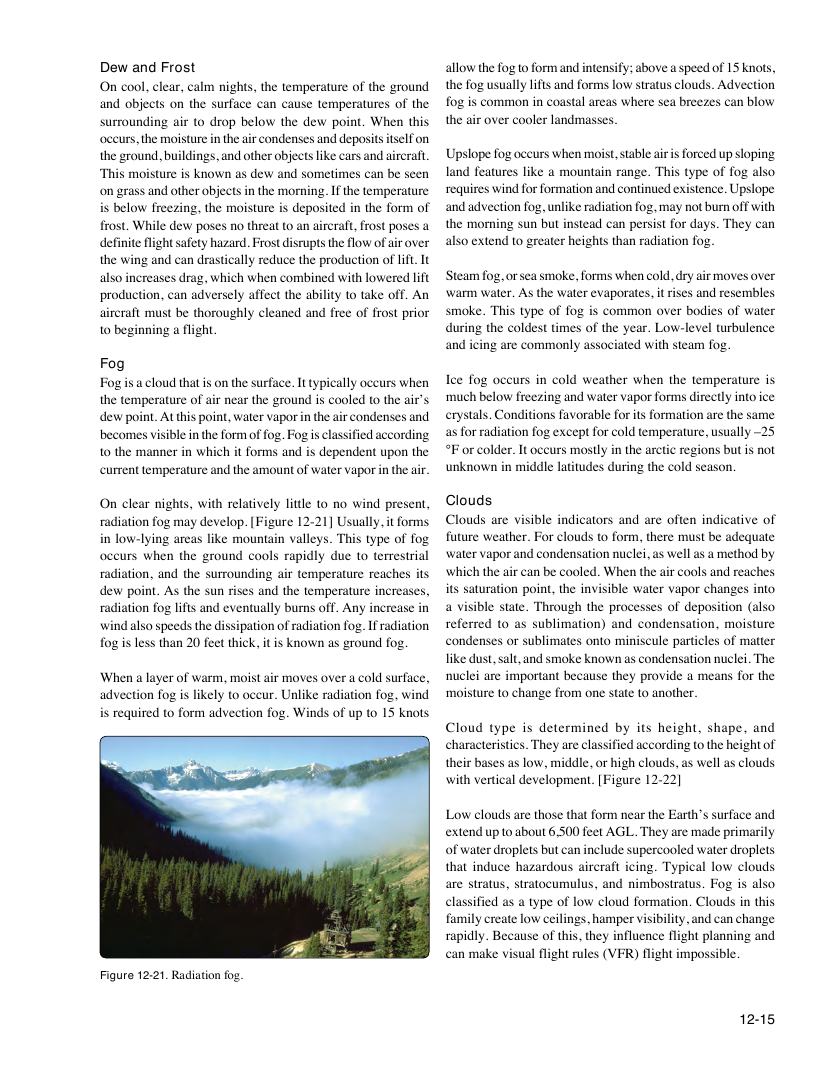
radiation fog may develop. [Figure 12-21] Usually, it forms Clouds are visible indicators and are often indicative of
in low-lying areas like mountain valleys. This type of fog future weather. For clouds to form, there must be adequate
occurs when the ground cools rapidly due to terrestrial water vapor and condensation nuclei, as well as a method by
radiation, and the surrounding air temperature reaches its which the air can be cooled. When the air cools and reaches
dew point. As the sun rises and the temperature increases, its saturation point, the invisible water vapor changes into
radiation fog lifts and eventually burns off. Any increase in a visible state. Through the processes of deposition (also
wind also speeds the dissipation of radiation fog. If radiation referred to as sublimation) and condensation, moisture
fog is less than 20 feet thick, it is known as ground fog. condenses or sublimates onto miniscule particles of matter
like dust, salt, and smoke known as condensation nuclei. The
When a layer of warm, moist air moves over a cold surface, nuclei are important because they provide a means for the
advection fog is likely to occur. Unlike radiation fog, wind moisture to change from one state to another.
is required to form advection fog. Winds of up to 15 knots
Cloud type is determined by its height, shape, and
characteristics. They are classified according to the height of
their bases as low, middle, or high clouds, as well as clouds
with vertical development. [Figure 12-22]
Low clouds are those that form near the Earth’s surface and
extend up to about 6,500 feet AGL. They are made primarily
of water droplets but can include supercooled water droplets
that induce hazardous aircraft icing. Typical low clouds
are stratus, stratocumulus, and nimbostratus. Fog is also
classified as a type of low cloud formation. Clouds in this
family create low ceilings, hamper visibility, and can change
rapidly. Because of this, they influence flight planning and
can make visual flight rules (VFR) flight impossible.
Figure 12-21. Radiation fog.
12-15