FAA-H-8083-25C · Source PDF page 288
Weather Theory
Measurement of Atmosphere Pressure · PHAK page 12-4
Searchable transcription
1
14.7
lb
12-4
hcnI
erauqS
1
hcnI
erauqS
1 7.4
lb
1 8 ,0 0 0 fe
e
t
1
8 , 0 0 0 f e e
t
1
hcnI
erauqS
1
hcnI
erauqS
1
S
e
a
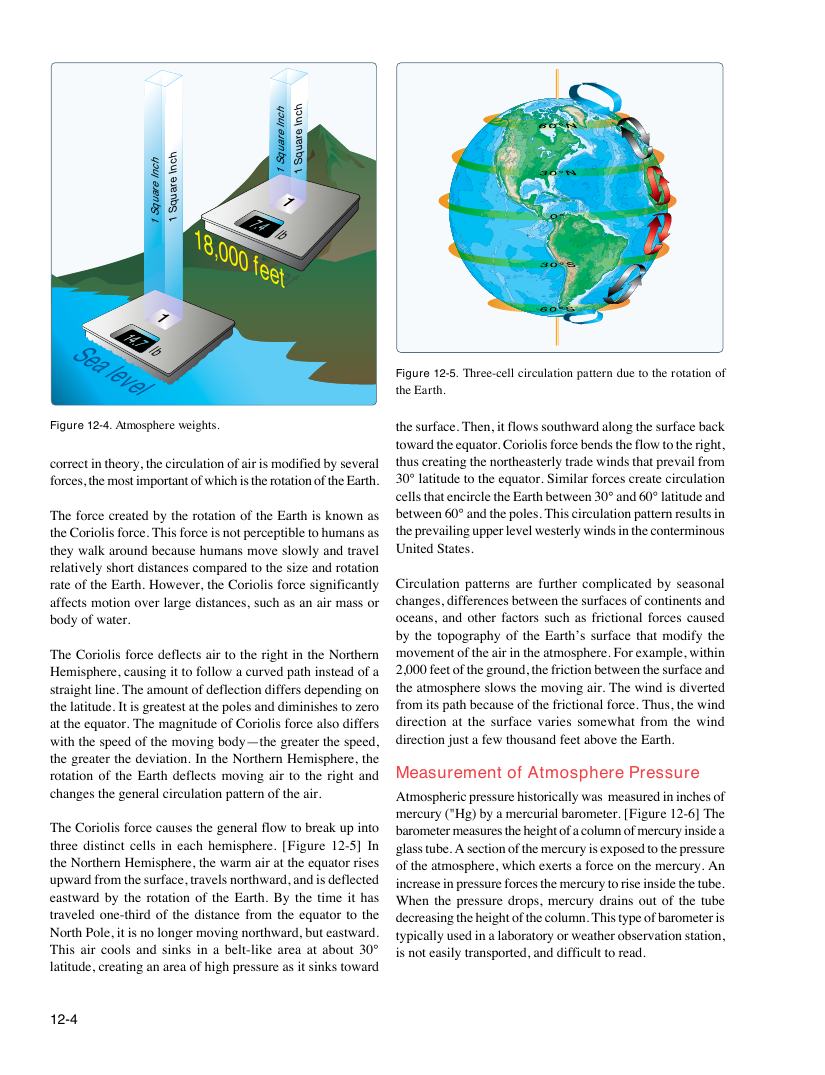
le v Figure 12-5. Three-cell circulation pattern due to the rotation of
e
l the Earth.
Figure 12-4. Atmosphere weights. the surface. Then, it flows southward along the surface back
toward the equator. Coriolis force bends the flow to the right,
correct in theory, the circulation of air is modified by several thus creating the northeasterly trade winds that prevail from
forces, the most important of which is the rotation of the Earth. 30° latitude to the equator. Similar forces create circulation
cells that encircle the Earth between 30° and 60° latitude and
The force created by the rotation of the Earth is known as between 60° and the poles. This circulation pattern results in
the Coriolis force. This force is not perceptible to humans as the prevailing upper level westerly winds in the conterminous
they walk around because humans move slowly and travel United States.
relatively short distances compared to the size and rotation
rate of the Earth. However, the Coriolis force significantly Circulation patterns are further complicated by seasonal
affects motion over large distances, such as an air mass or changes, differences between the surfaces of continents and
body of water. oceans, and other factors such as frictional forces caused
by the topography of the Earth’s surface that modify the
The Coriolis force deflects air to the right in the Northern movement of the air in the atmosphere. For example, within
Hemisphere, causing it to follow a curved path instead of a 2,000 feet of the ground, the friction between the surface and
straight line. The amount of deflection differs depending on the atmosphere slows the moving air. The wind is diverted
the latitude. It is greatest at the poles and diminishes to zero from its path because of the frictional force. Thus, the wind
at the equator. The magnitude of Coriolis force also differs direction at the surface varies somewhat from the wind
with the speed of the moving body—the greater the speed, direction just a few thousand feet above the Earth.
the greater the deviation. In the Northern Hemisphere, the
rotation of the Earth deflects moving air to the right and Measurement of Atmosphere Pressure
changes the general circulation pattern of the air. Atmospheric pressure historically was measured in inches of
mercury ("Hg) by a mercurial barometer. [Figure 12-6] The
The Coriolis force causes the general flow to break up into barometer measures the height of a column of mercury inside a
three distinct cells in each hemisphere. [Figure 12-5] In glass tube. A section of the mercury is exposed to the pressure
the Northern Hemisphere, the warm air at the equator rises of the atmosphere, which exerts a force on the mercury. An
upward from the surface, travels northward, and is deflected increase in pressure forces the mercury to rise inside the tube.
eastward by the rotation of the Earth. By the time it has When the pressure drops, mercury drains out of the tube
traveled one-third of the distance from the equator to the decreasing the height of the column. This type of barometer is
North Pole, it is no longer moving northward, but eastward. typically used in a laboratory or weather observation station,
This air cools and sinks in a belt-like area at about 30° is not easily transported, and difficult to read.
latitude, creating an area of high pressure as it sinks toward