FAA-H-8083-25C · Source PDF page 287
Weather Theory
Coriolis Force · PHAK page 12-3
Searchable transcription
1,000 feet of altitude gain, and the pressure decreases at a rate
of about one inch per 1,000 feet of altitude gain.
At the top of the troposphere is a boundary known as the
tropopause, which traps moisture and the associated weather
in the troposphere. The altitude of the tropopause varies with
latitude and with the season of the year; therefore, it takes
on an elliptical shape as opposed to round. Location of the
tropopause is important because it is commonly associated with
the location of the jet stream and possible clear air turbulence.
Above the tropopause are three more atmospheric levels. The
first is the stratosphere, which extends from the tropopause to
a height of about 160,000 feet (50 km). Little weather exists
in this layer and the air remains stable, although certain types
of clouds occasionally extend in it. Above the stratosphere
are the mesosphere and thermosphere, which have little
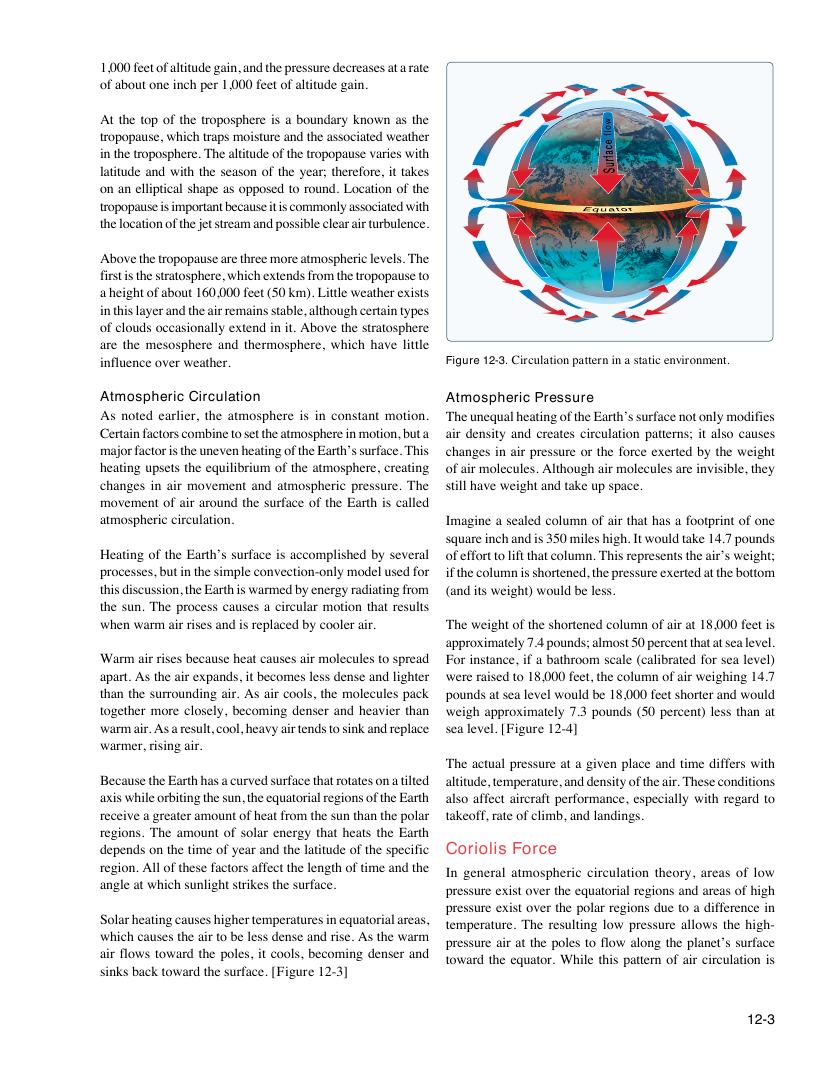
influence over weather. Figure 12-3. Circulation pattern in a static environment.
Atmospheric Circulation Atmospheric Pressure
As noted earlier, the atmosphere is in constant motion. The unequal heating of the Earth’s surface not only modifies
Certain factors combine to set the atmosphere in motion, but a air density and creates circulation patterns; it also causes
major factor is the uneven heating of the Earth’s surface. This changes in air pressure or the force exerted by the weight
heating upsets the equilibrium of the atmosphere, creating of air molecules. Although air molecules are invisible, they
changes in air movement and atmospheric pressure. The still have weight and take up space.
movement of air around the surface of the Earth is called
atmospheric circulation. Imagine a sealed column of air that has a footprint of one
square inch and is 350 miles high. It would take 14.7 pounds
Heating of the Earth’s surface is accomplished by several of effort to lift that column. This represents the air’s weight;
processes, but in the simple convection-only model used for if the column is shortened, the pressure exerted at the bottom
this discussion, the Earth is warmed by energy radiating from (and its weight) would be less.
the sun. The process causes a circular motion that results
when warm air rises and is replaced by cooler air. The weight of the shortened column of air at 18,000 feet is
approximately 7.4 pounds; almost 50 percent that at sea level.
Warm air rises because heat causes air molecules to spread For instance, if a bathroom scale (calibrated for sea level)
apart. As the air expands, it becomes less dense and lighter were raised to 18,000 feet, the column of air weighing 14.7
than the surrounding air. As air cools, the molecules pack pounds at sea level would be 18,000 feet shorter and would
together more closely, becoming denser and heavier than weigh approximately 7.3 pounds (50 percent) less than at
warm air. As a result, cool, heavy air tends to sink and replace sea level. [Figure 12-4]
warmer, rising air.
The actual pressure at a given place and time differs with
Because the Earth has a curved surface that rotates on a tilted altitude, temperature, and density of the air. These conditions
axis while orbiting the sun, the equatorial regions of the Earth also affect aircraft performance, especially with regard to
receive a greater amount of heat from the sun than the polar takeoff, rate of climb, and landings.
regions. The amount of solar energy that heats the Earth
depends on the time of year and the latitude of the specific Coriolis Force
region. All of these factors affect the length of time and the
In general atmospheric circulation theory, areas of low
angle at which sunlight strikes the surface.
pressure exist over the equatorial regions and areas of high
pressure exist over the polar regions due to a difference in
Solar heating causes higher temperatures in equatorial areas,
temperature. The resulting low pressure allows the high-
which causes the air to be less dense and rise. As the warm
pressure air at the poles to flow along the planet’s surface
air flows toward the poles, it cools, becoming denser and
toward the equator. While this pattern of air circulation is
sinks back toward the surface. [Figure 12-3]
12-3