FAA-H-8083-25C · Source PDF page 314
Aviation Weather Services
Service Outlets · PHAK page 13-4
Searchable transcription
2. FAA terminal Doppler weather radar (TDWR), recordings of meteorological and aeronautical information.
installed at some major airports around the country, TIBS provides area and route briefings, airspace procedures,
also aids in providing severe weather alerts and and special announcements. The recordings are automatically
warnings to ATC. Terminal radar ensures pilots updated as changes occur. It is designed to be a preliminary
are aware of wind shear, gust fronts, and heavy briefing tool and is not intended to replace a standard briefing
precipitation, all of which are dangerous to arriving from a FSS specialist. The TIBS service can only be accessed
and departing aircraft. by a touchtone phone. The phone numbers for the TIBS
service are listed in the Chart Supplement U.S. (formerly
3. The third type of radar commonly used in the detection
Airport/Facility Directory).
of precipitation is the FAA airport surveillance radar.
This radar is used primarily to detect aircraft, but it
Hazardous Inflight Weather Advisory Service
also detects the location and intensity of precipitation,
(HIWAS)
which is used to route aircraft traffic around severe
Hazardous Inflight Weather Advisory Service (HIWAS),
weather in an airport environment.
available in the 48 conterminous states, is an automated
4. Airborne radar is equipment carried by aircraft to
continuous broadcast of hazardous weather information
locate weather disturbances. The airborne radars
over selected VOR navigational aids (NAVAIDs). The
generally operate in the C or X bands (around 6
broadcasts include advisories such as AIRMETS, SIGMETS,
GHz or around 10 GHz, respectively) permitting
convective SIGMETS, and urgent PIREPs. The broadcasts
both penetration of heavy precipitation, required for
are automatically updated as changes occur. Pilots should
determining the extent of thunderstorms, and sufficient
contact a FSS or EFAS for additional information. VORs that
reflection from less intense precipitation.
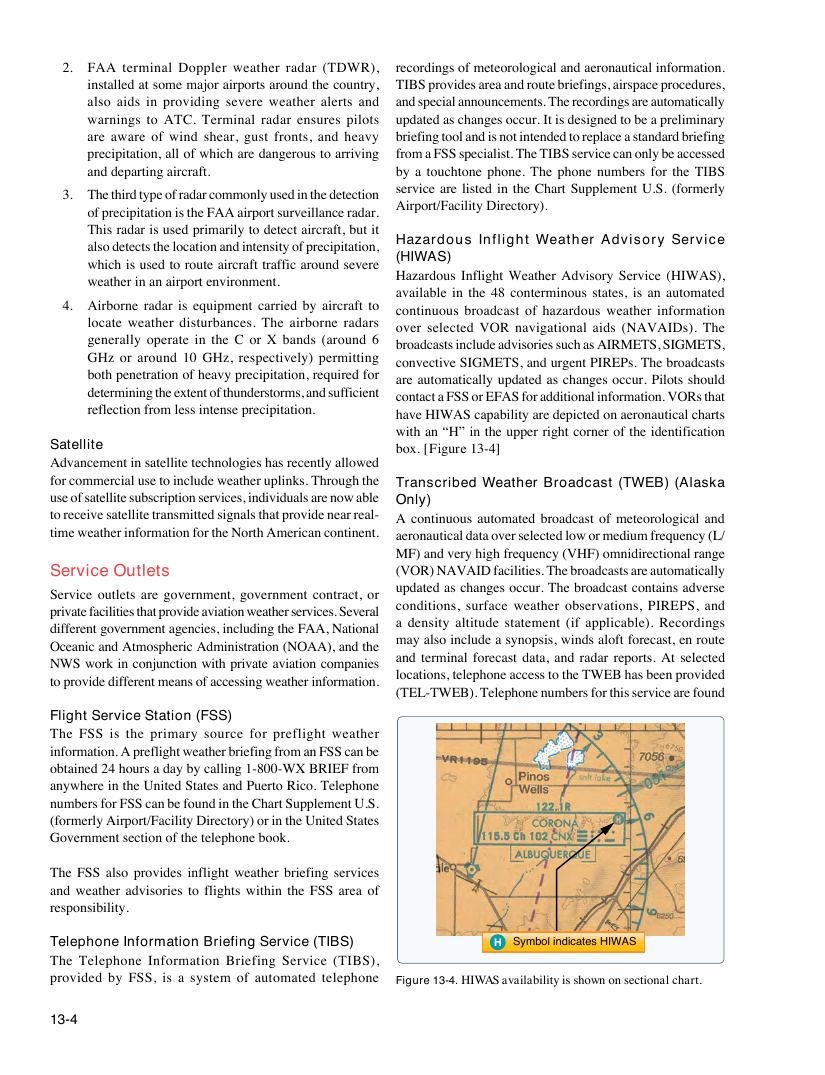
have HIWAS capability are depicted on aeronautical charts
with an “H” in the upper right corner of the identification
Satellite box. [Figure 13-4]
Advancement in satellite technologies has recently allowed
for commercial use to include weather uplinks. Through the
Transcribed Weather Broadcast (TWEB) (Alaska
use of satellite subscription services, individuals are now able Only)
to receive satellite transmitted signals that provide near real- A continuous automated broadcast of meteorological and
time weather information for the North American continent. aeronautical data over selected low or medium frequency (L/
MF) and very high frequency (VHF) omnidirectional range
Service Outlets (VOR) NAVAID facilities. The broadcasts are automatically
updated as changes occur. The broadcast contains adverse
Service outlets are government, government contract, or
conditions, surface weather observations, PIREPS, and
private facilities that provide aviation weather services. Several
a density altitude statement (if applicable). Recordings
different government agencies, including the FAA, National
may also include a synopsis, winds aloft forecast, en route
Oceanic and Atmospheric Administration (NOAA), and the
and terminal forecast data, and radar reports. At selected
NWS work in conjunction with private aviation companies
locations, telephone access to the TWEB has been provided
to provide different means of accessing weather information.
(TEL-TWEB). Telephone numbers for this service are found
Flight Service Station (FSS)
The FSS is the primary source for preflight weather
information. A preflight weather briefing from an FSS can be
obtained 24 hours a day by calling 1-800-WX BRIEF from
anywhere in the United States and Puerto Rico. Telephone
numbers for FSS can be found in the Chart Supplement U.S.
(formerly Airport/Facility Directory) or in the United States
Government section of the telephone book.
The FSS also provides inflight weather briefing services
and weather advisories to flights within the FSS area of
responsibility.
Telephone Information Briefing Service (TIBS) Symbol indicates HIWAS
The Telephone Information Briefing Service (TIBS),
provided by FSS, is a system of automated telephone Figure 13-4. HIWAS availability is shown on sectional chart.
13-4