FAA-H-8083-25C · Source PDF page 383
Airspace
Operating Rules and Pilot/Equipment Requirements · PHAK page 15-8
Searchable transcription
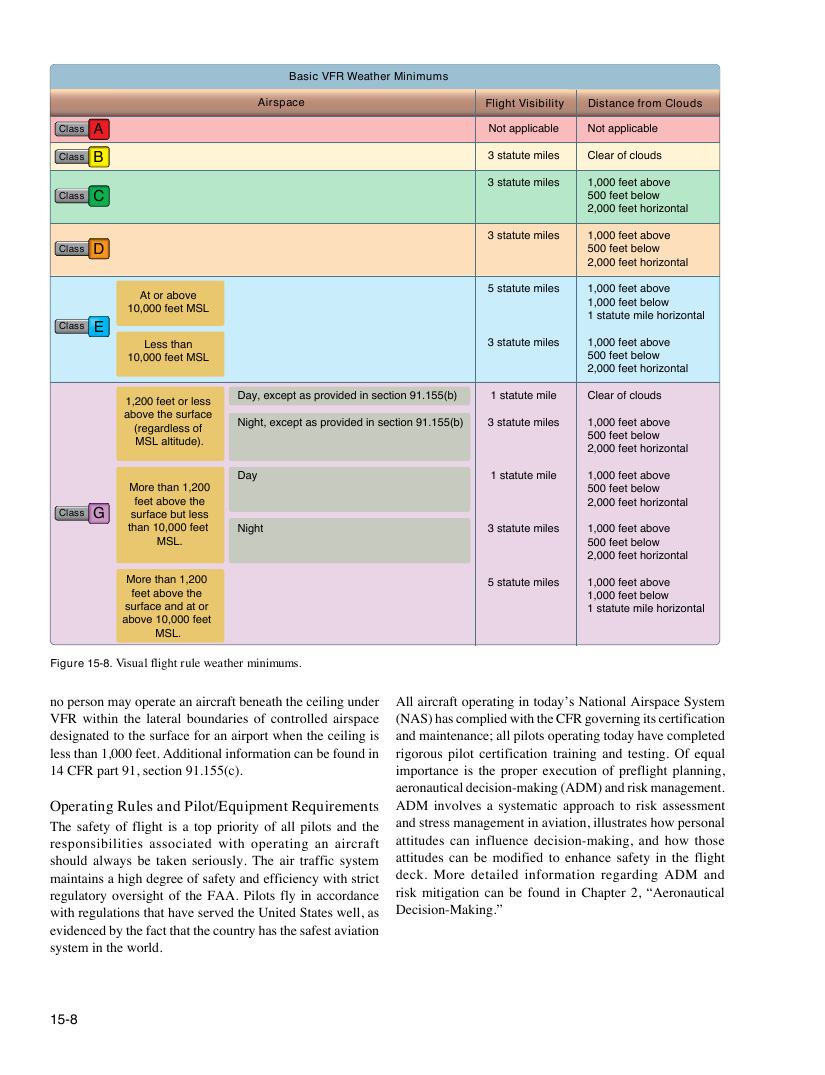
Basic VFR Weather Minimums
Airspace Flight Visibility Distance from Clouds
Class A Not applicable Not applicable
Class B 3 statute miles Clear of clouds
3 statute miles 1,000 feet above
C lass C 500 feet below
2,000 feet horizontal
3 statute miles 1,000 feet above
C lass D 500 feet below
2,000 feet horizontal
5 statute miles 1,000 feet above
At or above
1,000 feet below
10,000 feet MSL
1 statute mile horizontal
Class E
Less than 3 statute miles 1,000 feet above
10,000 feet MSL 500 feet below
2,000 feet horizontal
Day, except as provided in section 91.155(b) 1 statute mile Clear of clouds
1,200 feet or less
above the surface
Night, except as provided in section 91.155(b) 3 statute miles 1,000 feet above
(regardless of
500 feet below
MSL altitude).
2,000 feet horizontal
Day 1 statute mile 1,000 feet above
More than 1,200 500 feet below
feet above the 2,000 feet horizontal
Class G surface but less
than 10,000 feet Night 3 statute miles 1,000 feet above
MSL. 500 feet below
2,000 feet horizontal
More than 1,200 5 statute miles 1,000 feet above
feet above the 1,000 feet below
surface and at or 1 statute mile horizontal
above 10,000 feet
MSL.
Figure 15-8. Visual flight rule weather minimums.
no person may operate an aircraft beneath the ceiling under All aircraft operating in today’s National Airspace System
VFR within the lateral boundaries of controlled airspace (NAS) has complied with the CFR governing its certification
designated to the surface for an airport when the ceiling is and maintenance; all pilots operating today have completed
less than 1,000 feet. Additional information can be found in rigorous pilot certification training and testing. Of equal
14 CFR part 91, section 91.155(c). importance is the proper execution of preflight planning,
aeronautical decision-making (ADM) and risk management.
Operating Rules and Pilot/Equipment Requirements ADM involves a systematic approach to risk assessment
The safety of flight is a top priority of all pilots and the and stress management in aviation, illustrates how personal
responsibilities associated with operating an aircraft attitudes can influence decision-making, and how those
should always be taken seriously. The air traffic system attitudes can be modified to enhance safety in the flight
maintains a high degree of safety and efficiency with strict deck. More detailed information regarding ADM and
regulatory oversight of the FAA. Pilots fly in accordance risk mitigation can be found in Chapter 2, “Aeronautical
with regulations that have served the United States well, as Decision-Making.”
evidenced by the fact that the country has the safest aviation
system in the world.
15-8