FAA-H-8083-25C · Source PDF page 398
Navigation
Basic Calculations · PHAK page 16-11
Searchable transcription
Heading
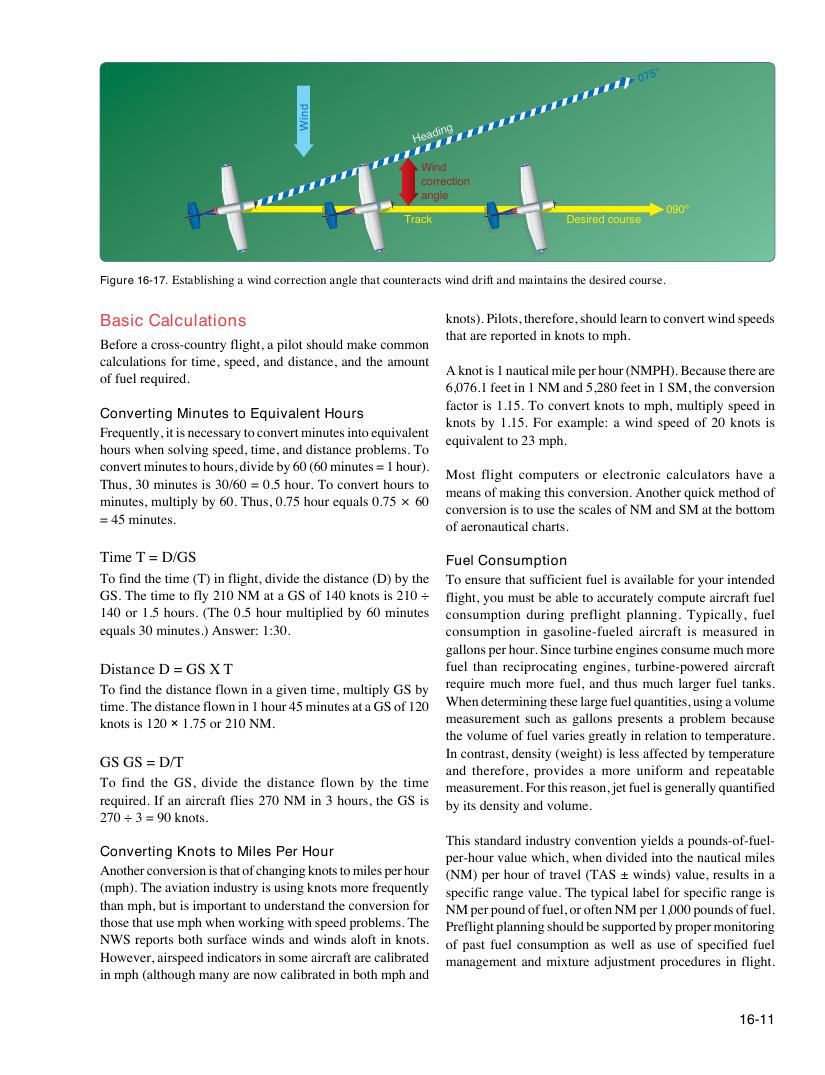
Figure 16-17. Establishing a wind correction angle that counteracts wind drift and maintains the desired course.
16-11
dniW
075°
Wind
correction
angle
090°
Track Desired course
Basic Calculations knots). Pilots, therefore, should learn to convert wind speeds
that are reported in knots to mph.
Before a cross-country flight, a pilot should make common
calculations for time, speed, and distance, and the amount
A knot is 1 nautical mile per hour (NMPH). Because there are
of fuel required.
6,076.1 feet in 1 NM and 5,280 feet in 1 SM, the conversion
factor is 1.15. To convert knots to mph, multiply speed in
Converting Minutes to Equivalent Hours
knots by 1.15. For example: a wind speed of 20 knots is
Frequently, it is necessary to convert minutes into equivalent
equivalent to 23 mph.
hours when solving speed, time, and distance problems. To
convert minutes to hours, divide by 60 (60 minutes = 1 hour).
Most flight computers or electronic calculators have a
Thus, 30 minutes is 30/60 = 0.5 hour. To convert hours to
means of making this conversion. Another quick method of
minutes, multiply by 60. Thus, 0.75 hour equals 0.75 × 60
conversion is to use the scales of NM and SM at the bottom
= 45 minutes.
of aeronautical charts.
Time T = D/GS
Fuel Consumption
To find the time (T) in flight, divide the distance (D) by the To ensure that sufficient fuel is available for your intended
GS. The time to fly 210 NM at a GS of 140 knots is 210 ÷ flight, you must be able to accurately compute aircraft fuel
140 or 1.5 hours. (The 0.5 hour multiplied by 60 minutes consumption during preflight planning. Typically, fuel
equals 30 minutes.) Answer: 1:30. consumption in gasoline-fueled aircraft is measured in
gallons per hour. Since turbine engines consume much more
Distance D = GS X T fuel than reciprocating engines, turbine-powered aircraft
require much more fuel, and thus much larger fuel tanks.
To find the distance flown in a given time, multiply GS by
When determining these large fuel quantities, using a volume
time. The distance flown in 1 hour 45 minutes at a GS of 120
measurement such as gallons presents a problem because
knots is 120 × 1.75 or 210 NM.
the volume of fuel varies greatly in relation to temperature.
In contrast, density (weight) is less affected by temperature
GS GS = D/T
and therefore, provides a more uniform and repeatable
To find the GS, divide the distance flown by the time
measurement. For this reason, jet fuel is generally quantified
required. If an aircraft flies 270 NM in 3 hours, the GS is
by its density and volume.
270 ÷ 3 = 90 knots.
This standard industry convention yields a pounds-of-fuel-
Converting Knots to Miles Per Hour
per-hour value which, when divided into the nautical miles
Another conversion is that of changing knots to miles per hour
(NM) per hour of travel (TAS ± winds) value, results in a
(mph). The aviation industry is using knots more frequently
specific range value. The typical label for specific range is
than mph, but is important to understand the conversion for
NM per pound of fuel, or often NM per 1,000 pounds of fuel.
those that use mph when working with speed problems. The
Preflight planning should be supported by proper monitoring
NWS reports both surface winds and winds aloft in knots.
of past fuel consumption as well as use of specified fuel
However, airspeed indicators in some aircraft are calibrated
management and mixture adjustment procedures in flight.
in mph (although many are now calibrated in both mph and