FAA-H-8083-25C · Source PDF page 400
Navigation
Dead Reckoning · PHAK page 16-13
Searchable transcription
A Plotter 170
160
150
350
340
1 40
33 0
3 1 2 3 0 0 310 1 20 30 2 0 1 0
1 1
3
0
2 0 9 2 0 0 0 2
1
0 2
0
1 8
0
9 0 1 0
D
0
EG
1 2
9
0 8 7
R
0
0 0
E E
3
S
5 1 2 0 7 6 0
8
0 3
0
4 0 1 6 2 3 0 5 3 0 0
7 0
1 5 2 0 4 0 60 2 30 2 5 2 0 0
210
4 0
200
190
30
20
10
NAUTICAL 5 MILES 10 15 20 25 30 35 40 45 50 55 60 65 70 75 80 NAUTICAL 85 MILES
INSTRUCTIONS FOR USE
SECTIONAL CHART SIDE - 1:500,000 1234 .... PWFRr l e aiot a hc md eo uht h r tou o cle l e eh c af o oo nv lulge or ir wn s e gi n t r t i p nu eo e r d ss en eiti go cot rrni et o h e nr o sl i o nt , a f eo tt e n r to u p p e cl r o ou ct pr oteve u er r r d su s en cs a tc ail la n e el d ,ed o gt w r v eu eit e hr is t n ar o u o rvre r oet h wn r o lt irp n r u to e h ei . n l c itn oine ug. r s rine e a dli d nir ees . ccatiolens ocfo fulingthetr.-clockwise. NAVIGATIONAL FLIGHT PLOTTER
0 STATUTE 5 MILES 10 15 20 25 30 35 40 45 50 55 60 65 70 75 80 85 90 95 100
TSD Alt: As Wind Wt. Bal Timer
Conv: Dist Vol Wt Wx
C
M
P
Mode On/Off Clr
Dist Vol Wt Wx ÷
: 7 8 9 x
Sto 4 5 6 −
Rcl 1 2 3 +
Bksp 0 . +/- =
C Electronic flight computer
B Mechanical flight computer
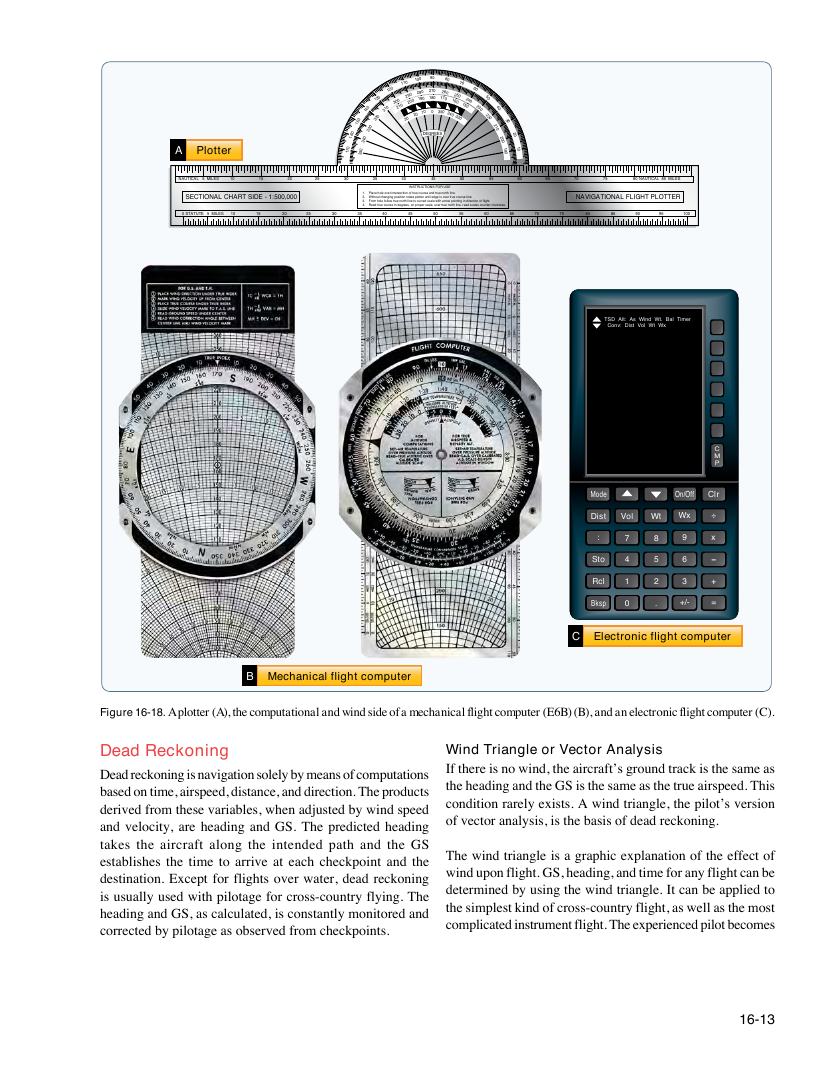
Figure 16-18. A plotter (A), the computational and wind side of a mechanical flight computer (E6B) (B), and an electronic flight computer (C).
Dead Reckoning Wind Triangle or Vector Analysis
If there is no wind, the aircraft’s ground track is the same as
Dead reckoning is navigation solely by means of computations
the heading and the GS is the same as the true airspeed. This
based on time, airspeed, distance, and direction. The products
condition rarely exists. A wind triangle, the pilot’s version
derived from these variables, when adjusted by wind speed
of vector analysis, is the basis of dead reckoning.
and velocity, are heading and GS. The predicted heading
takes the aircraft along the intended path and the GS
The wind triangle is a graphic explanation of the effect of
establishes the time to arrive at each checkpoint and the
wind upon flight. GS, heading, and time for any flight can be
destination. Except for flights over water, dead reckoning
determined by using the wind triangle. It can be applied to
is usually used with pilotage for cross-country flying. The
the simplest kind of cross-country flight, as well as the most
heading and GS, as calculated, is constantly monitored and
complicated instrument flight. The experienced pilot becomes
corrected by pilotage as observed from checkpoints.
16-13