FAA-H-8083-25C · Source PDF page 394
Navigation
Magnetic Variation · PHAK page 16-7
Searchable transcription
this course off the magnetic compass would not provide an
accurate course between the two points due to three elements
Easterly variation Westerly variation
that must be considered. The first is magnetic variation, the
second is compass deviation, and the third is wind correction.
All three must be considered for accurate navigation.
Magnetic Variation
As mentioned in the paragraph discussing variation, the
appropriate variation for the geographical location of
the flight must be considered and added or subtracted as
appropriate. If flying across an area where the variation
changes, then the values must be applied along the route of
flight appropriately. Once applied, this new course is called
the magnetic course.
Agonic line Magnetic Deviation
Because each aircraft has its own internal effect upon the
onboard compass systems from its own localized magnetic
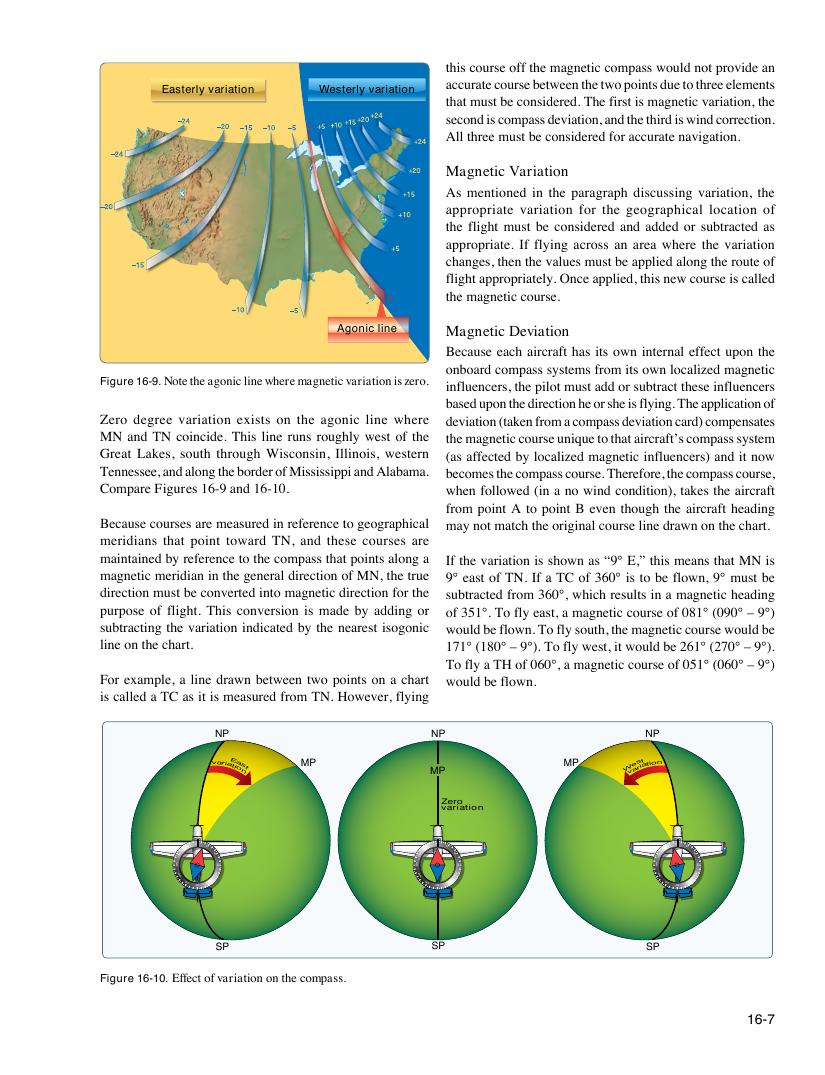
Figure 16-9. Note the agonic line where magnetic variation is zero. influencers, the pilot must add or subtract these influencers
based upon the direction he or she is flying. The application of
Zero degree variation exists on the agonic line where deviation (taken from a compass deviation card) compensates
MN and TN coincide. This line runs roughly west of the the magnetic course unique to that aircraft’s compass system
Great Lakes, south through Wisconsin, Illinois, western (as affected by localized magnetic influencers) and it now
Tennessee, and along the border of Mississippi and Alabama. becomes the compass course. Therefore, the compass course,
Compare Figures 16-9 and 16-10. when followed (in a no wind condition), takes the aircraft
from point A to point B even though the aircraft heading
Because courses are measured in reference to geographical may not match the original course line drawn on the chart.
meridians that point toward TN, and these courses are
maintained by reference to the compass that points along a If the variation is shown as “9° E,” this means that MN is
magnetic meridian in the general direction of MN, the true 9° east of TN. If a TC of 360° is to be flown, 9° must be
direction must be converted into magnetic direction for the subtracted from 360°, which results in a magnetic heading
purpose of flight. This conversion is made by adding or of 351°. To fly east, a magnetic course of 081° (090° – 9°)
subtracting the variation indicated by the nearest isogonic would be flown. To fly south, the magnetic course would be
line on the chart. 171° (180° – 9°). To fly west, it would be 261° (270° – 9°).
To fly a TH of 060°, a magnetic course of 051° (060° – 9°)
For example, a line drawn between two points on a chart would be flown.
is called a TC as it is measured from TN. However, flying
NP NP NP
v a r i a E tio as nt MP MP MP W v e a s ri t ation
Zero
variation
33 N 3 33 N 3 33 N 3
03 6 03 6 03 6
W E W E W E
24 12 24 12 24 12
21 S 15 21 S 15 21 S 15
SP SP SP
Figure 16-10. Effect of variation on the compass.
16-7