FAA-H-8083-25C · Source PDF page 395
Navigation
Effect of Wind · PHAK page 16-8
Searchable transcription
Remember, if variation is west, add; if east, subtract. One The aircraft is placed on a magnetic compass rose, the engine
method for remembering whether to add or subtract variation started, and electrical devices normally used (such as radio)
is the phrase “east is least (subtract) and west is best (add).” are turned on. Tailwheel-type aircraft should be jacked up into
flying position. The aircraft is aligned with MN indicated on
Deviation the compass rose and the reading shown on the compass is
Determining the magnetic heading is an intermediate step recorded on a deviation card. The aircraft is then aligned at
necessary to obtain the correct compass heading for the flight. 30° intervals and each reading is recorded. If the aircraft is to
To determine compass heading, a correction for deviation be flown at night, the lights are turned on and any significant
must be made. Because of magnetic influences within an changes in the readings are noted. If so, additional entries
aircraft, such as electrical circuits, radio, lights, tools, engine, are made for use at night. The accuracy of the compass can
and magnetized metal parts, the compass needle is frequently also be checked by comparing the compass reading with the
deflected from its normal reading. This deflection is called known runway headings.
deviation. The deviation is different for each aircraft, and
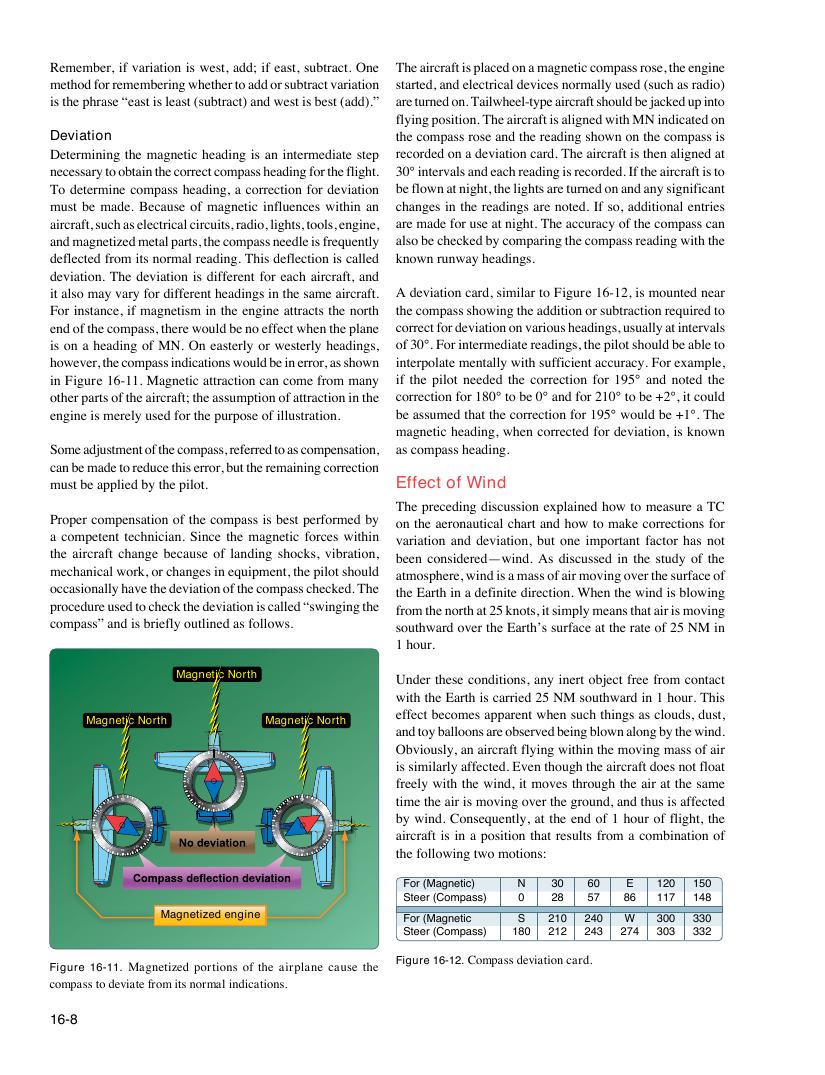
it also may vary for different headings in the same aircraft. A deviation card, similar to Figure 16-12, is mounted near
For instance, if magnetism in the engine attracts the north the compass showing the addition or subtraction required to
end of the compass, there would be no effect when the plane correct for deviation on various headings, usually at intervals
is on a heading of MN. On easterly or westerly headings, of 30°. For intermediate readings, the pilot should be able to
however, the compass indications would be in error, as shown interpolate mentally with sufficient accuracy. For example,
in Figure 16-11. Magnetic attraction can come from many if the pilot needed the correction for 195° and noted the
other parts of the aircraft; the assumption of attraction in the correction for 180° to be 0° and for 210° to be +2°, it could
engine is merely used for the purpose of illustration. be assumed that the correction for 195° would be +1°. The
magnetic heading, when corrected for deviation, is known
Some adjustment of the compass, referred to as compensation, as compass heading.
can be made to reduce this error, but the remaining correction
must be applied by the pilot. Effect of Wind
The preceding discussion explained how to measure a TC
Proper compensation of the compass is best performed by
on the aeronautical chart and how to make corrections for
a competent technician. Since the magnetic forces within
variation and deviation, but one important factor has not
the aircraft change because of landing shocks, vibration,
been considered—wind. As discussed in the study of the
mechanical work, or changes in equipment, the pilot should
atmosphere, wind is a mass of air moving over the surface of
occasionally have the deviation of the compass checked. The
the Earth in a definite direction. When the wind is blowing
procedure used to check the deviation is called “swinging the
from the north at 25 knots, it simply means that air is moving
compass” and is briefly outlined as follows.
southward over the Earth’s surface at the rate of 25 NM in
1 hour.
Magnetic North Under these conditions, any inert object free from contact
with the Earth is carried 25 NM southward in 1 hour. This
effect becomes apparent when such things as clouds, dust,
Magnetic North Magnetic North
and toy balloons are observed being blown along by the wind.
Obviously, an aircraft flying within the moving mass of air
33 N 3
03 6 is similarly affected. Even though the aircraft does not float
W E freely with the wind, it moves through the air at the same
03
33 N 3
6
24
21
S
15
12
03
33 N 3
6
t
b
i
y
m e
w
t
i
h
n
e
d .
a
C
ir
o
i
n
s
s
m
eq
o
u
v
e
in
n
g
tl y
o
,
v
a
e
t
r
t
t
h
h
e
e g
en
ro
d
u
o
n
f
d ,
1
a n
h
d
o u
t
r
h u
o
s
f
i
f
s
l i
a
g
f
h
fe
t,
c
t
t
h
ed
e
W E W E
aircraft is in a position that results from a combination of
24 12 24 12
21 S 15 21 S 15 the following two motions:
For (Magnetic) N 30 60 E 120 150
Steer (Compass) 0 28 57 86 117 148
Magnetized engine For (Magnetic S 210 240 W 300 330
Steer (Compass) 180 212 243 274 303 332
Figure 16-11. Magnetized portions of the airplane cause the
Figure 16-12. Compass deviation card.
compass to deviate from its normal indications.
16-8