FAA-H-8083-25C · Source PDF page 447
Aeromedical Factors
A A · PHAK page 17-25
Searchable transcription
• Select approach and departure routes that avoid
AAAA
highways and residential areas where illumination MMMMIIII
EEEE
can impair night vision. DDDD YYYY CCCC
RRRR
UUUU OOOO
GGGG
LLLL
Self-Imposed Stress GGGG SSSS
HHHH
YYYY PPPP
N f P th l i i i a l g g o t h h t c t s t , a a c n f n a l i c n d g a h m c u t o s a n e c n t a y s r n e o s l l e f b - t l e f h im - i m s im p t o o y p r s p e o e e s d f e o a d s f t t i s r g s e t t r u s r e i e s s n o s s g s r o s r b . a s y n S c d o k a m n n s o t l e r i w m e o s i f i n s t f t g n h u i e t l g h s h t e e h t a f f v a a n i c c s t t i d o o o a n r r y s s . PPPOOOOOO EEEE RRL XXXX CC HHHH C PPP OO AA HH O AA H UU NN YY UU N Y SS SS DD S SS D II TT I II TT I CCC TTT IIIIOO II AA OO I A OOO LL NN L NN NNN CCCC NNNN OOOO DDDD UUUU EE TT EE TT FF RR FF RR IIII IIII CCCC TTTT II II II II EE OO EE OO NNNN NNNN CCCC AAAA YY LL YY LL
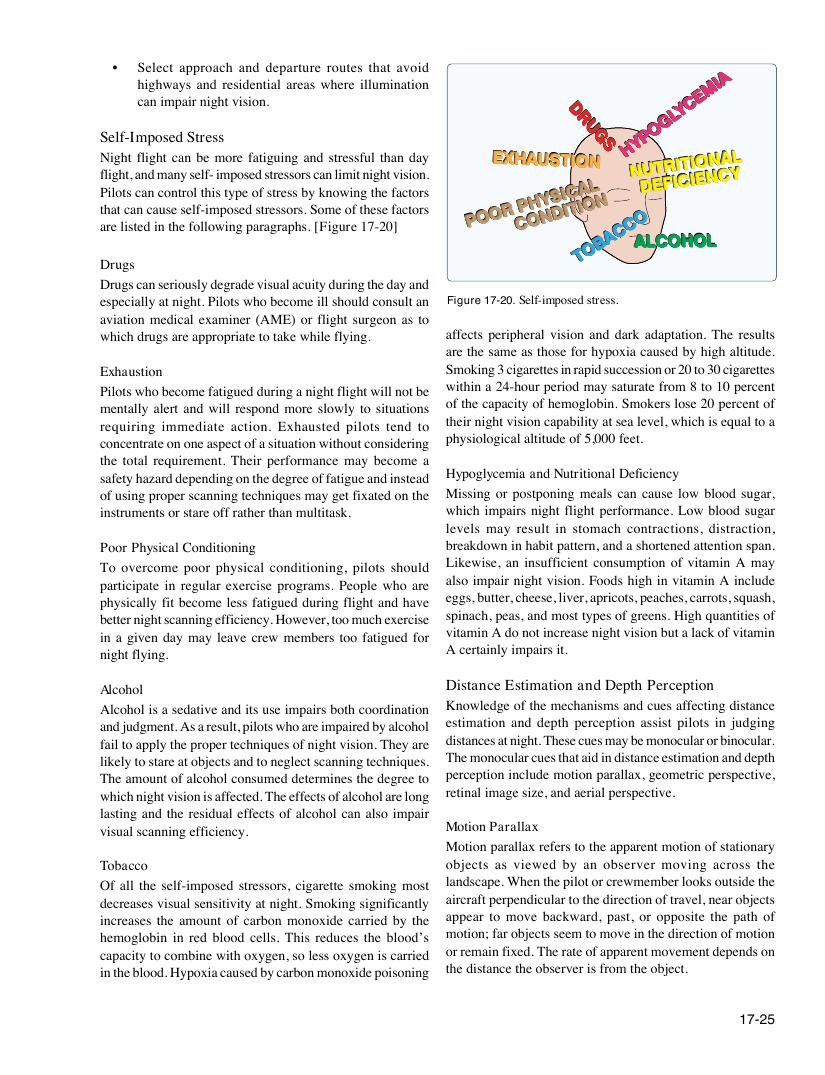
are listed in the following paragraphs. [Figure 17-20] CCCC
AAAA
BBBB AAAALLLLCCCCOOOOHHHHOOOOLLLL
OOOO
TTTT
Drugs
Drugs can seriously degrade visual acuity during the day and
especially at night. Pilots who become ill should consult an Figure 17-20. Self-imposed stress.
aviation medical examiner (AME) or flight surgeon as to
which drugs are appropriate to take while flying. affects peripheral vision and dark adaptation. The results
are the same as those for hypoxia caused by high altitude.
Exhaustion Smoking 3 cigarettes in rapid succession or 20 to 30 cigarettes
within a 24-hour period may saturate from 8 to 10 percent
Pilots who become fatigued during a night flight will not be
of the capacity of hemoglobin. Smokers lose 20 percent of
mentally alert and will respond more slowly to situations
their night vision capability at sea level, which is equal to a
requiring immediate action. Exhausted pilots tend to
physiological altitude of 5,000 feet.
concentrate on one aspect of a situation without considering
the total requirement. Their performance may become a
Hypoglycemia and Nutritional Deficiency
safety hazard depending on the degree of fatigue and instead
of using proper scanning techniques may get fixated on the Missing or postponing meals can cause low blood sugar,
instruments or stare off rather than multitask. which impairs night flight performance. Low blood sugar
levels may result in stomach contractions, distraction,
Poor Physical Conditioning breakdown in habit pattern, and a shortened attention span.
Likewise, an insufficient consumption of vitamin A may
To overcome poor physical conditioning, pilots should
also impair night vision. Foods high in vitamin A include
participate in regular exercise programs. People who are
eggs, butter, cheese, liver, apricots, peaches, carrots, squash,
physically fit become less fatigued during flight and have
spinach, peas, and most types of greens. High quantities of
better night scanning efficiency. However, too much exercise
vitamin A do not increase night vision but a lack of vitamin
in a given day may leave crew members too fatigued for
A certainly impairs it.
night flying.
Distance Estimation and Depth Perception
Alcohol
Knowledge of the mechanisms and cues affecting distance
Alcohol is a sedative and its use impairs both coordination
estimation and depth perception assist pilots in judging
and judgment. As a result, pilots who are impaired by alcohol
distances at night. These cues may be monocular or binocular.
fail to apply the proper techniques of night vision. They are
The monocular cues that aid in distance estimation and depth
likely to stare at objects and to neglect scanning techniques.
perception include motion parallax, geometric perspective,
The amount of alcohol consumed determines the degree to
retinal image size, and aerial perspective.
which night vision is affected. The effects of alcohol are long
lasting and the residual effects of alcohol can also impair
Motion Parallax
visual scanning efficiency.
Motion parallax refers to the apparent motion of stationary
Tobacco objects as viewed by an observer moving across the
landscape. When the pilot or crewmember looks outside the
Of all the self-imposed stressors, cigarette smoking most
aircraft perpendicular to the direction of travel, near objects
decreases visual sensitivity at night. Smoking significantly
appear to move backward, past, or opposite the path of
increases the amount of carbon monoxide carried by the
motion; far objects seem to move in the direction of motion
hemoglobin in red blood cells. This reduces the blood’s
or remain fixed. The rate of apparent movement depends on
capacity to combine with oxygen, so less oxygen is carried
the distance the observer is from the object.
in the blood. Hypoxia caused by carbon monoxide poisoning
17-25