FAA-H-8083-25C · Source PDF page 444
Aeromedical Factors
Night Blind Spot · PHAK page 17-22
Searchable transcription
5. When the page is about 16–18 inches from you, the
black X should disappear completely because it has
been imaged onto the blind spot of your right eye.
(Resist the temptation to move your right eye while
the black X is gone or else it reappears. Keep staring
at the airplane.)
6. As you continue to look at the airplane, keep moving
the page closer to you a few more inches, and the black
X will come back into view.
7. There is an interval where you are able to move the
page a few inches backward and forward, and the black
X will be gone. This demonstrates to you the extent
of your blind spot. Figure 17-16. Night vision.
8. You can try the same thing again, except this time with
your right eye covered stare at the black X with your expose the rods to the image. This can be done by looking 5°
left eye. Move the page in closer and the airplane will to 10° off center of the object to be seen. This can be tried in
disappear. a dim light in a darkened room. When looking directly at the
light, it dims or disappears altogether. When looking slightly
off center, it becomes clearer and brighter.
Another way to check your blind spot is to do a similar test
outside at night when there is a full moon. Cover your left
When looking directly at an object, the image is focused
eye, looking at the full moon with your right eye. Gradually
mainly on the fovea, where detail is best seen. At night, the
move your right eye to the left (and maybe slightly up or
ability to see an object in the center of the visual field is
down). Before long, all you will be able to see is the large
reduced as the cones lose much of their sensitivity and the
halo around the full moon; the entire moon itself will seem
rods become more sensitive. Looking off center can help
to have disappeared.
compensate for this night blind spot. Along with the loss of
Empty-Field Myopia
Empty-field myopia is a condition that usually occurs when
flying above the clouds or in a haze layer that provides
nothing specific to focus on outside the aircraft. This causes
the eyes to relax and seek a comfortable focal distance that
may range from 10 to 30 feet. For the pilot, this means
looking without seeing, which is dangerous. Searching out
and focusing on distant light sources, no matter how dim,
helps prevent the onset of empty-field myopia.
Cones active
Night Vision
There are many good reasons to fly at night, but pilots must
keep in mind that the risks of night flying are different than
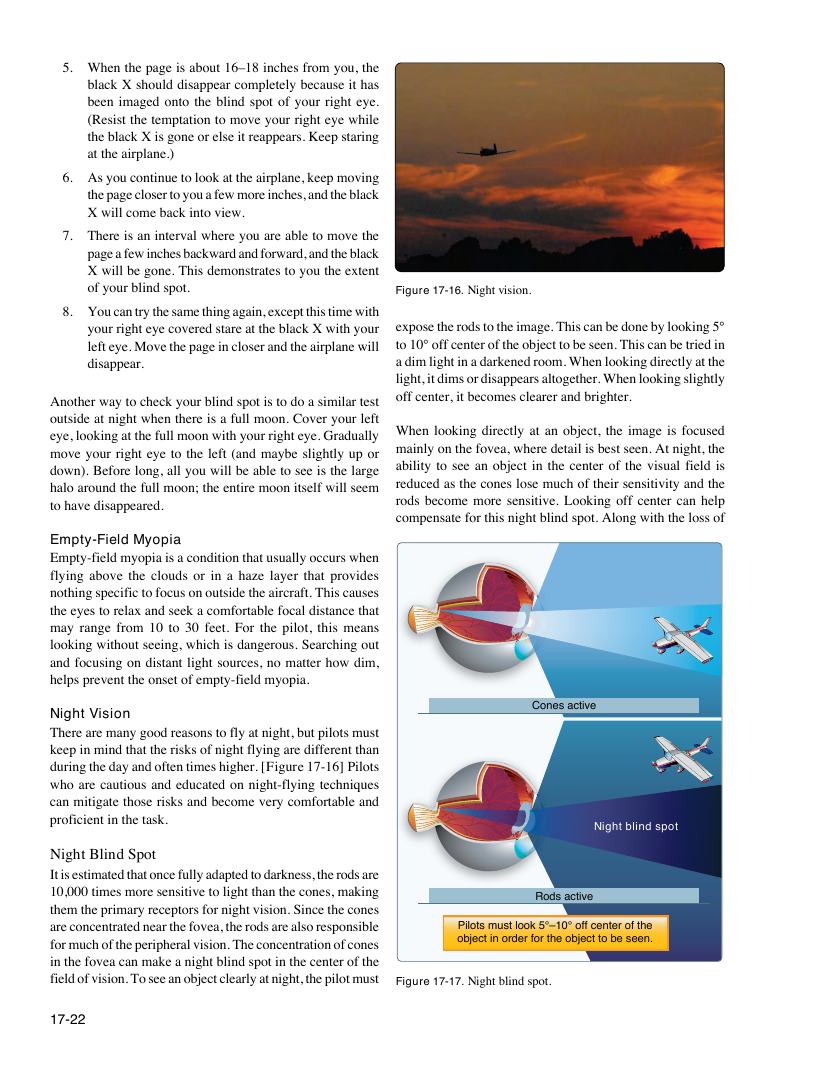
during the day and often times higher. [Figure 17-16] Pilots
who are cautious and educated on night-flying techniques
can mitigate those risks and become very comfortable and
proficient in the task.
Night blind spot
Night Blind Spot
It is estimated that once fully adapted to darkness, the rods are
10,000 times more sensitive to light than the cones, making
Rods active
them the primary receptors for night vision. Since the cones
are concentrated near the fovea, the rods are also responsible Pilots must look 5°–10° off center of the
for much of the peripheral vision. The concentration of cones object in order for the object to be seen.
in the fovea can make a night blind spot in the center of the
field of vision. To see an object clearly at night, the pilot must Figure 17-17. Night blind spot.
17-22