FAA-H-8083-25C · Source PDF page 429
Aeromedical Factors
Vestibular Illusions · PHAK page 17-7
Searchable transcription
Vestibular Illusions direction causing the disoriented pilot to return the aircraft
The Leans to its original turn. Because an aircraft tends to lose altitude
in turns unless the pilot compensates for the loss in lift,
A condition called the leans, is the most common illusion
the pilot may notice a loss of altitude. The absence of any
during flight and is caused by a sudden return to level flight
sensation of turning creates the illusion of being in a level
following a gradual and prolonged turn that went unnoticed by
descent. The pilot may pull back on the controls in an attempt
the pilot. The reason a pilot can be unaware of such a gradual
to climb or stop the descent. This action tightens the spiral
turn is that human exposure to a rotational acceleration of 2
and increases the loss of altitude; this illusion is referred to
degrees per second or lower is below the detection threshold
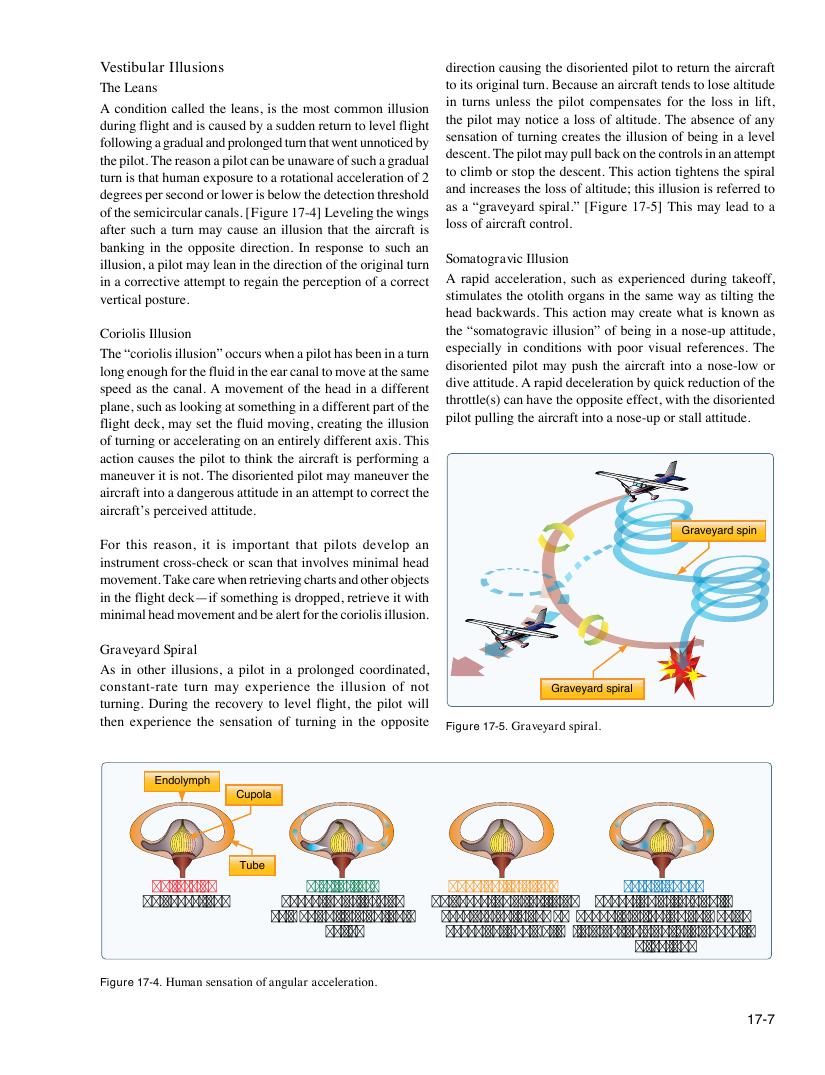
as a “graveyard spiral.” [Figure 17-5] This may lead to a
of the semicircular canals. [Figure 17-4] Leveling the wings
loss of aircraft control.
after such a turn may cause an illusion that the aircraft is
banking in the opposite direction. In response to such an
Somatogravic Illusion
illusion, a pilot may lean in the direction of the original turn
in a corrective attempt to regain the perception of a correct A rapid acceleration, such as experienced during takeoff,
vertical posture. stimulates the otolith organs in the same way as tilting the
head backwards. This action may create what is known as
Coriolis Illusion the “somatogravic illusion” of being in a nose-up attitude,
especially in conditions with poor visual references. The
The “coriolis illusion” occurs when a pilot has been in a turn
disoriented pilot may push the aircraft into a nose-low or
long enough for the fluid in the ear canal to move at the same
dive attitude. A rapid deceleration by quick reduction of the
speed as the canal. A movement of the head in a different
throttle(s) can have the opposite effect, with the disoriented
plane, such as looking at something in a different part of the
pilot pulling the aircraft into a nose-up or stall attitude.
flight deck, may set the fluid moving, creating the illusion
of turning or accelerating on an entirely different axis. This
action causes the pilot to think the aircraft is performing a
maneuver it is not. The disoriented pilot may maneuver the
aircraft into a dangerous attitude in an attempt to correct the
aircraft’s perceived attitude.
Graveyard spin
For this reason, it is important that pilots develop an
instrument cross-check or scan that involves minimal head
movement. Take care when retrieving charts and other objects
in the flight deck—if something is dropped, retrieve it with
minimal head movement and be alert for the coriolis illusion.
Graveyard Spiral
As in other illusions, a pilot in a prolonged coordinated,
constant-rate turn may experience the illusion of not Graveyard spiral
turning. During the recovery to level flight, the pilot will
then experience the sensation of turning in the opposite
Figure 17-5. Graveyard spiral.
Endolymph
Cupola
Tube
No turning Start of turn Constant rate turn Turn stopped
No sensation. Sensation of turning No sensation after fluid Sensation of turning in
as moving fluid deflects accelerates to same opposite direction as moving
hairs. speed as tube wall. fluid deflects hairs in opposite
direction.
Figure 17-4. Human sensation of angular acceleration.
17-7