FAA-H-8083-25C · Source PDF page 24
Introduction to Flying
Aeronautical Information Manual (AIM) · PHAK page 1-9
Searchable transcription
Flight Standards District Office (FSDO) Safety Team (FAASTeam) exemplifies this commitment.
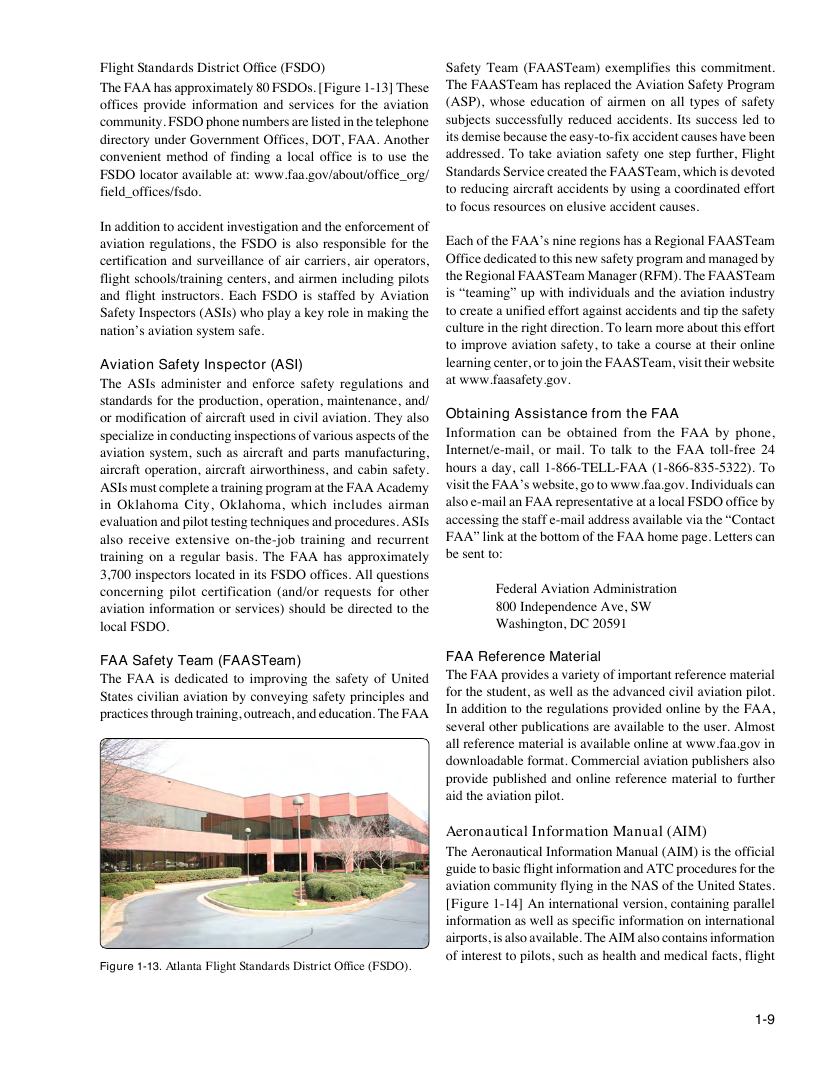
The FAA has approximately 80 FSDOs. [Figure 1-13] These The FAASTeam has replaced the Aviation Safety Program
offices provide information and services for the aviation (ASP), whose education of airmen on all types of safety
community. FSDO phone numbers are listed in the telephone subjects successfully reduced accidents. Its success led to
directory under Government Offices, DOT, FAA. Another its demise because the easy-to-fix accident causes have been
convenient method of finding a local office is to use the addressed. To take aviation safety one step further, Flight
FSDO locator available at: www.faa.gov/about/office_org/ Standards Service created the FAASTeam, which is devoted
field_offices/fsdo. to reducing aircraft accidents by using a coordinated effort
to focus resources on elusive accident causes.
In addition to accident investigation and the enforcement of
aviation regulations, the FSDO is also responsible for the Each of the FAA’s nine regions has a Regional FAASTeam
certification and surveillance of air carriers, air operators, Office dedicated to this new safety program and managed by
flight schools/training centers, and airmen including pilots the Regional FAASTeam Manager (RFM). The FAASTeam
and flight instructors. Each FSDO is staffed by Aviation is “teaming” up with individuals and the aviation industry
Safety Inspectors (ASIs) who play a key role in making the to create a unified effort against accidents and tip the safety
nation’s aviation system safe. culture in the right direction. To learn more about this effort
to improve aviation safety, to take a course at their online
Aviation Safety Inspector (ASI) learning center, or to join the FAASTeam, visit their website
The ASIs administer and enforce safety regulations and at www.faasafety.gov.
standards for the production, operation, maintenance, and/
or modification of aircraft used in civil aviation. They also Obtaining Assistance from the FAA
specialize in conducting inspections of various aspects of the Information can be obtained from the FAA by phone,
aviation system, such as aircraft and parts manufacturing, Internet/e-mail, or mail. To talk to the FAA toll-free 24
aircraft operation, aircraft airworthiness, and cabin safety. hours a day, call 1-866-TELL-FAA (1-866-835-5322). To
ASIs must complete a training program at the FAA Academy visit the FAA’s website, go to www.faa.gov. Individuals can
in Oklahoma City, Oklahoma, which includes airman also e-mail an FAA representative at a local FSDO office by
evaluation and pilot testing techniques and procedures. ASIs accessing the staff e-mail address available via the “Contact
also receive extensive on-the-job training and recurrent FAA” link at the bottom of the FAA home page. Letters can
training on a regular basis. The FAA has approximately be sent to:
3,700 inspectors located in its FSDO offices. All questions
concerning pilot certification (and/or requests for other Federal Aviation Administration
aviation information or services) should be directed to the 800 Independence Ave, SW
local FSDO. Washington, DC 20591
FAA Safety Team (FAASTeam) FAA Reference Material
The FAA provides a variety of important reference material
The FAA is dedicated to improving the safety of United
for the student, as well as the advanced civil aviation pilot.
States civilian aviation by conveying safety principles and
In addition to the regulations provided online by the FAA,
practices through training, outreach, and education. The FAA
several other publications are available to the user. Almost
all reference material is available online at www.faa.gov in
downloadable format. Commercial aviation publishers also
provide published and online reference material to further
aid the aviation pilot.
Aeronautical Information Manual (AIM)
The Aeronautical Information Manual (AIM) is the official
guide to basic flight information and ATC procedures for the
aviation community flying in the NAS of the United States.
[Figure 1-14] An international version, containing parallel
information as well as specific information on international
airports, is also available. The AIM also contains information
of interest to pilots, such as health and medical facts, flight
Figure 1-13. Atlanta Flight Standards District Office (FSDO).
1-9