FAA-H-8083-25C · Source PDF page 19
Introduction to Flying
History of the Federal Aviation · PHAK page 1-4
Searchable transcription
mass produced to serve as fighters, bombers, trainers, as well
1 New York 6 Iowa City 11 Rock Springs
as reconnaissance platforms.
2 Bellefonte 7 Omaha 12 Salt Lake City
3 Cleveland 8 North Platte 13 Elko
Aviation advocates continued to look for ways to use 4 Bryan 9 Cheyenne 14 Reno
airplanes. Airmail service was a popular idea, but the 5 Chicago 10 Rawlins 15 San Francisco
war prevented the Postal Service from having access to
a a i g r r p e l e a m ne e s n . t T i h n e 1 W 91 a 8 r . D T e h p e a r A tm rm en y t w an o d u l P d o u st s a e l t S h e e r v m ic a e il r s e e a r c v h i e c d e a to n 14 13 12 11 10 9 8 7 6 5 4 3 2 1
15
train its pilots in flying cross-country. The first airmail flight
was conducted on May 15, 1918, between New York and
Washington, DC. The flight was not considered spectacular;
the pilot became lost and landed at the wrong airfield. In
August of 1918, the United States Postal Service took control
of the airmail routes and brought the existing Army airmail
pilots and their planes into the program as postal employees.
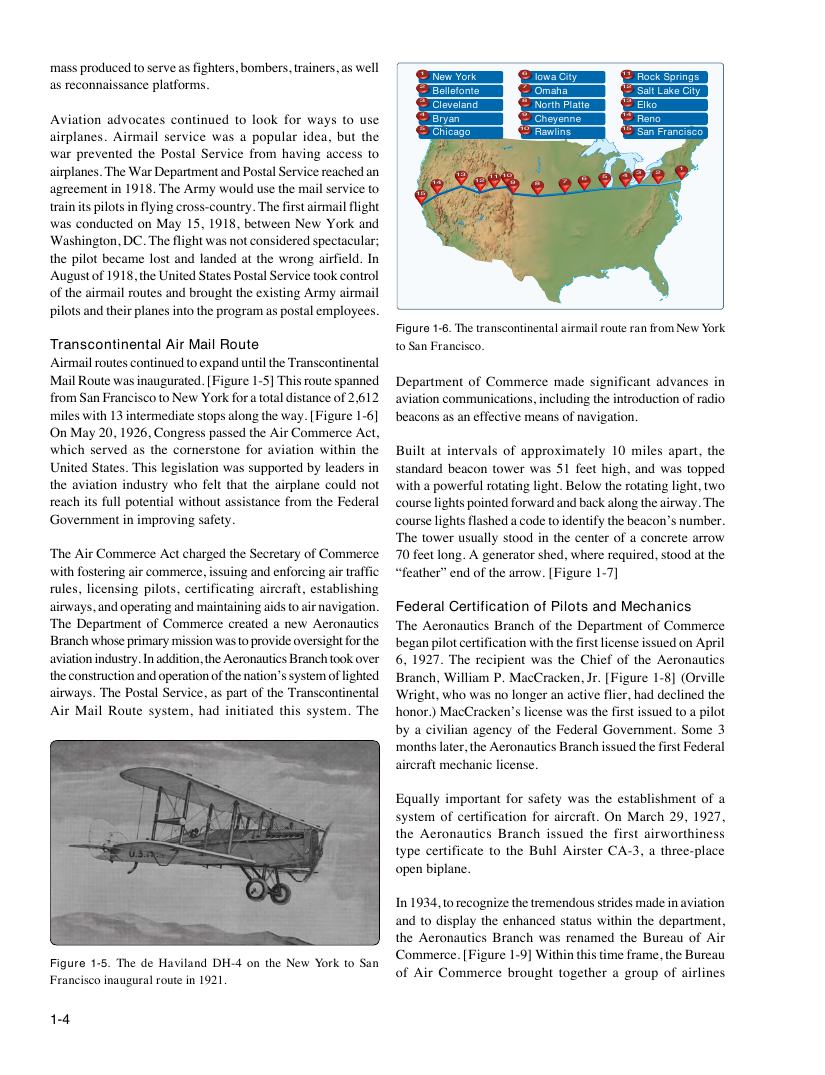
Figure 1-6. The transcontinental airmail route ran from New York
Transcontinental Air Mail Route to San Francisco.
Airmail routes continued to expand until the Transcontinental
Mail Route was inaugurated. [Figure 1-5] This route spanned Department of Commerce made significant advances in
from San Francisco to New York for a total distance of 2,612 aviation communications, including the introduction of radio
miles with 13 intermediate stops along the way. [Figure 1-6] beacons as an effective means of navigation.
On May 20, 1926, Congress passed the Air Commerce Act,
which served as the cornerstone for aviation within the Built at intervals of approximately 10 miles apart, the
United States. This legislation was supported by leaders in standard beacon tower was 51 feet high, and was topped
the aviation industry who felt that the airplane could not with a powerful rotating light. Below the rotating light, two
reach its full potential without assistance from the Federal course lights pointed forward and back along the airway. The
Government in improving safety. course lights flashed a code to identify the beacon’s number.
The tower usually stood in the center of a concrete arrow
The Air Commerce Act charged the Secretary of Commerce 70 feet long. A generator shed, where required, stood at the
with fostering air commerce, issuing and enforcing air traffic “feather” end of the arrow. [Figure 1-7]
rules, licensing pilots, certificating aircraft, establishing
airways, and operating and maintaining aids to air navigation. Federal Certification of Pilots and Mechanics
The Department of Commerce created a new Aeronautics The Aeronautics Branch of the Department of Commerce
Branch whose primary mission was to provide oversight for the began pilot certification with the first license issued on April
aviation industry. In addition, the Aeronautics Branch took over 6, 1927. The recipient was the Chief of the Aeronautics
the construction and operation of the nation’s system of lighted Branch, William P. MacCracken, Jr. [Figure 1-8] (Orville
airways. The Postal Service, as part of the Transcontinental Wright, who was no longer an active flier, had declined the
Air Mail Route system, had initiated this system. The honor.) MacCracken’s license was the first issued to a pilot
by a civilian agency of the Federal Government. Some 3
months later, the Aeronautics Branch issued the first Federal
aircraft mechanic license.
Equally important for safety was the establishment of a
system of certification for aircraft. On March 29, 1927,
the Aeronautics Branch issued the first airworthiness
type certificate to the Buhl Airster CA-3, a three-place
open biplane.
In 1934, to recognize the tremendous strides made in aviation
and to display the enhanced status within the department,
the Aeronautics Branch was renamed the Bureau of Air
Commerce. [Figure 1-9] Within this time frame, the Bureau
Figure 1-5. The de Haviland DH-4 on the New York to San
of Air Commerce brought together a group of airlines
Francisco inaugural route in 1921.
1-4