FAA-H-8083-25C · Source PDF page 21
Introduction to Flying
History of the Federal Aviation · PHAK page 1-6
Searchable transcription
Airport Program. This program was designed to promote the future. The DOT began operation on April 1, 1967. At
the establishment of civil airports throughout the country. this same time, the Federal Aviation Agency was renamed
to the Federal Aviation Administration (FAA).
The Federal Aviation Act of 1958
By mid-century, air traffic had increased and jet aircraft had The role of the CAB was assumed by the newly created
been introduced into the civil aviation arena. A series of National Transportation Safety Board (NTSB), which was
mid-air collisions underlined the need for more regulation charged with the investigation of all transportation accidents
of the aviation industry. Aircraft were not only increasing in within the United States.
numbers, but were now streaking across the skies at much
higher speeds. The Federal Aviation Act of 1958 established As aviation continued to grow, the FAA took on additional
a new independent body that assumed the roles of the CAA duties and responsibilities. With the highjacking epidemic
and transferred the rule making authority of the CAB to the of the 1960s, the FAA was responsible for increasing the
newly created Federal Aviation Agency (FAA). In addition, security duties of aviation both on the ground and in the air.
the FAA was given complete control of the common civil- After September 11, 2001, the duties were transferred to
military system of air navigation and ATC. The man who a newly created body called the Department of Homeland
was given the honor of being the first Administrator of the Security (DHS).
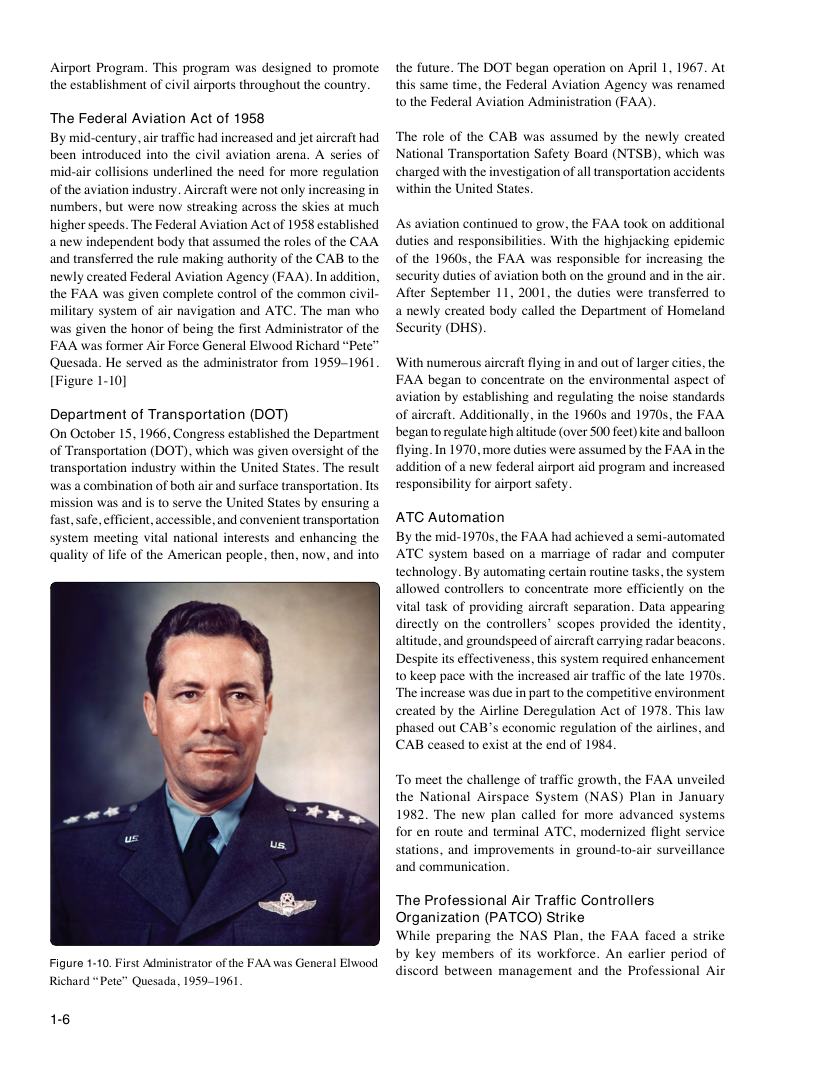
FAA was former Air Force General Elwood Richard “Pete”
Quesada. He served as the administrator from 1959–1961. With numerous aircraft flying in and out of larger cities, the
[Figure 1-10] FAA began to concentrate on the environmental aspect of
aviation by establishing and regulating the noise standards
Department of Transportation (DOT) of aircraft. Additionally, in the 1960s and 1970s, the FAA
On October 15, 1966, Congress established the Department began to regulate high altitude (over 500 feet) kite and balloon
of Transportation (DOT), which was given oversight of the flying. In 1970, more duties were assumed by the FAA in the
transportation industry within the United States. The result addition of a new federal airport aid program and increased
was a combination of both air and surface transportation. Its responsibility for airport safety.
mission was and is to serve the United States by ensuring a
fast, safe, efficient, accessible, and convenient transportation ATC Automation
system meeting vital national interests and enhancing the By the mid-1970s, the FAA had achieved a semi-automated
quality of life of the American people, then, now, and into ATC system based on a marriage of radar and computer
technology. By automating certain routine tasks, the system
allowed controllers to concentrate more efficiently on the
vital task of providing aircraft separation. Data appearing
directly on the controllers’ scopes provided the identity,
altitude, and groundspeed of aircraft carrying radar beacons.
Despite its effectiveness, this system required enhancement
to keep pace with the increased air traffic of the late 1970s.
The increase was due in part to the competitive environment
created by the Airline Deregulation Act of 1978. This law
phased out CAB’s economic regulation of the airlines, and
CAB ceased to exist at the end of 1984.
To meet the challenge of traffic growth, the FAA unveiled
the National Airspace System (NAS) Plan in January
1982. The new plan called for more advanced systems
for en route and terminal ATC, modernized flight service
stations, and improvements in ground-to-air surveillance
and communication.
The Professional Air Traffic Controllers
Organization (PATCO) Strike
While preparing the NAS Plan, the FAA faced a strike
by key members of its workforce. An earlier period of
Figure 1-10. First Administrator of the FAA was General Elwood
discord between management and the Professional Air
Richard “Pete” Quesada, 1959–1961.
1-6