FAA-H-8083-25C · Source PDF page 22
Introduction to Flying
The Role of the FAA · PHAK page 1-7
Searchable transcription
Traffic Controllers Organization (PATCO) culminated in a Howard Cannon. [Figure 1-11] There was stiff opposition to
1970 “sickout” by 3,000 controllers. Although controllers the bill—from the major airlines who feared free competition,
subsequently gained additional wage and retirement from labor unions who feared non-union employees, and
benefits, another period of tension led to an illegal strike in from safety advocates who feared that safety would be
August 1981. The government dismissed over 11,000 strike sacrificed. Public support was, however, strong enough to
participants and decertified PATCO. By the spring of 1984, pass the act. The act appeased the major airlines by offering
the FAA ended the last of the special restrictions imposed to generous subsidies and pleased workers by offering high
keep the airspace system operating safely during the strike. unemployment benefits if they lost their jobs as a result. The
most important effect of the act, whose laws were slowly
The Airline Deregulation Act of 1978 phased in, was on the passenger market. For the first time
Until 1978, the CAB regulated many areas of commercial in 40 years, airlines could enter the market or (from 1981)
aviation such as fares, routes, and schedules. The Airline expand their routes as they saw fit. Airlines (from 1982)
Deregulation Act of 1978, however, removed many of also had full freedom to set their fares. In 1984, the CAB
these controls, thus changing the face of civil aviation in the was finally abolished since its primary duty of regulating the
United States. After deregulation, unfettered free competition airline industry was no longer necessary.
ushered in a new era in passenger air travel.
The Role of the FAA
The CAB had three main functions: to award routes to
The Code of Federal Regulations (CFR)
airlines, to limit the entry of air carriers into new markets,
The FAA is empowered by regulations to promote aviation
and to regulate fares for passengers. Much of the established
safety and establish safety standards for civil aviation. The
practices of commercial passenger travel within the United
FAA achieves these objectives under the Code of Federal
States went back to the policies of Walter Folger Brown, the
Regulations (CFR), which is the codification of the general
United States Postmaster General during the administration
and permanent rules published by the executive departments
of President Herbert Hoover. Brown had changed the mail
and agencies of the United States Government. The
payments system to encourage the manufacture of passenger
regulations are divided into 50 different codes, called Titles,
aircraft instead of mail-carrying aircraft. His influence
that represent broad areas subject to Federal regulation.
was crucial in awarding contracts and helped create four
FAA regulations are listed under Title 14, “Aeronautics and
major domestic airlines: United, American, Eastern, and
Space,” which encompasses all aspects of civil aviation from
Transcontinental and Western Air (TWA). Similarly,
how to earn a pilot’s certificate to maintenance of an aircraft.
Brown had also helped give Pan American a monopoly on
Title 14 CFR Chapter 1, Federal Aviation Administration,
international routes.
is broken down into subchapters A through N as illustrated
in Figure 1-12.
The push to deregulate, or at least to reform the existing laws
governing passenger carriers, was accelerated by President
For the pilot, certain parts of 14 CFR are more relevant
Jimmy Carter, who appointed economist and former
than others. During flight training, it is helpful for the pilot
professor Alfred Kahn, a vocal supporter of deregulation, to
to become familiar with the parts and subparts that relate
head the CAB. A second force to deregulate emerged from
abroad. In 1977, Freddie Laker, a British entrepreneur who
owned Laker Airways, created the Skytrain service, which
offered extraordinarily cheap fares for transatlantic flights.
Laker’s offerings coincided with a boom in low-cost domestic
flights as the CAB eased some limitations on charter flights
(i.e., flights offered by companies that do not actually own
planes but leased them from the major airlines). The big air
carriers responded by proposing their own lower fares. For
example, American Airlines, the country’s second largest
airline, obtained CAB approval for “SuperSaver” tickets.
All of these events proved to be favorable for large-scale
deregulation. In November 1977, Congress formally
deregulated air cargo. In late 1978, Congress passed the
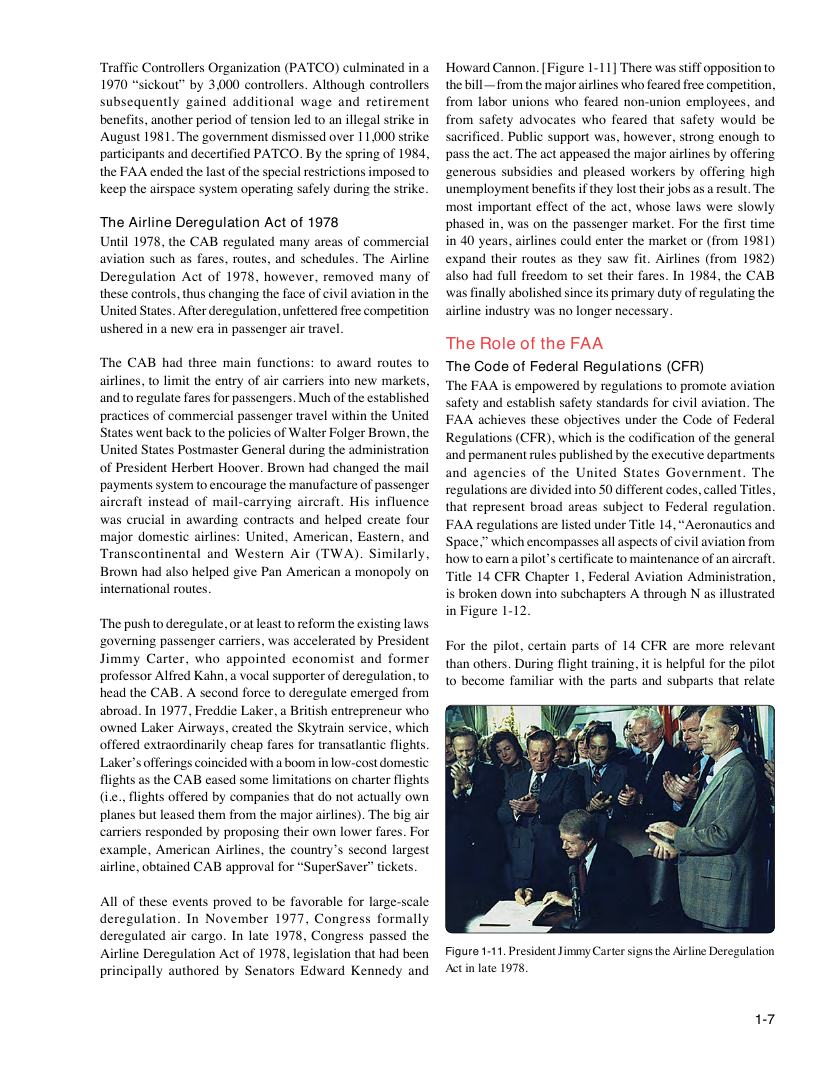
Airline Deregulation Act of 1978, legislation that had been Figure 1-11. President Jimmy Carter signs the Airline Deregulation
principally authored by Senators Edward Kennedy and Act in late 1978.
1-7