FAA-H-8083-25C · Source PDF page 76
Aircraft Construction
Alternate Types of Wings · PHAK page 3-5
Searchable transcription
Figure 3-6. Monoplane (left) and biplane (right).
Attached to the rear, or trailing edges, of the wings are two operation for which an aircraft is intended and is tailored
types of control surfaces referred to as ailerons and flaps. to specific types of flying. These design variations are
Ailerons extend from about the midpoint of each wing discussed in Chapter 5, Aerodynamics of Flight, which
outward toward the tip, and move in opposite directions to provides information on the effect controls have on lifting
create aerodynamic forces that cause the airplane to roll. surfaces from traditional wings to wings that use both flexing
Flaps extend outward from the fuselage to near the midpoint (due to billowing) and shifting (through the change of the
of each wing. The flaps are normally flush with the wing’s aircraft’s CG). For example, the wing of the weight-shift
surface during cruising flight. When extended, the flaps move control aircraft is highly swept in an effort to reduce drag
simultaneously downward to increase the lifting force of the and allow for the shifting of weight to provide controlled
wing for takeoffs and landings. [Figure 3-8] flight. [Figure 3-9] Handbooks specific to most categories
of aircraft are available for the interested pilot and can be
Alternate Types of Wings found on the Federal Aviation Administration (FAA) website
Alternate types of wings are often found on aircraft. The at www.faa.gov.
shape and design of a wing is dependent upon the type of
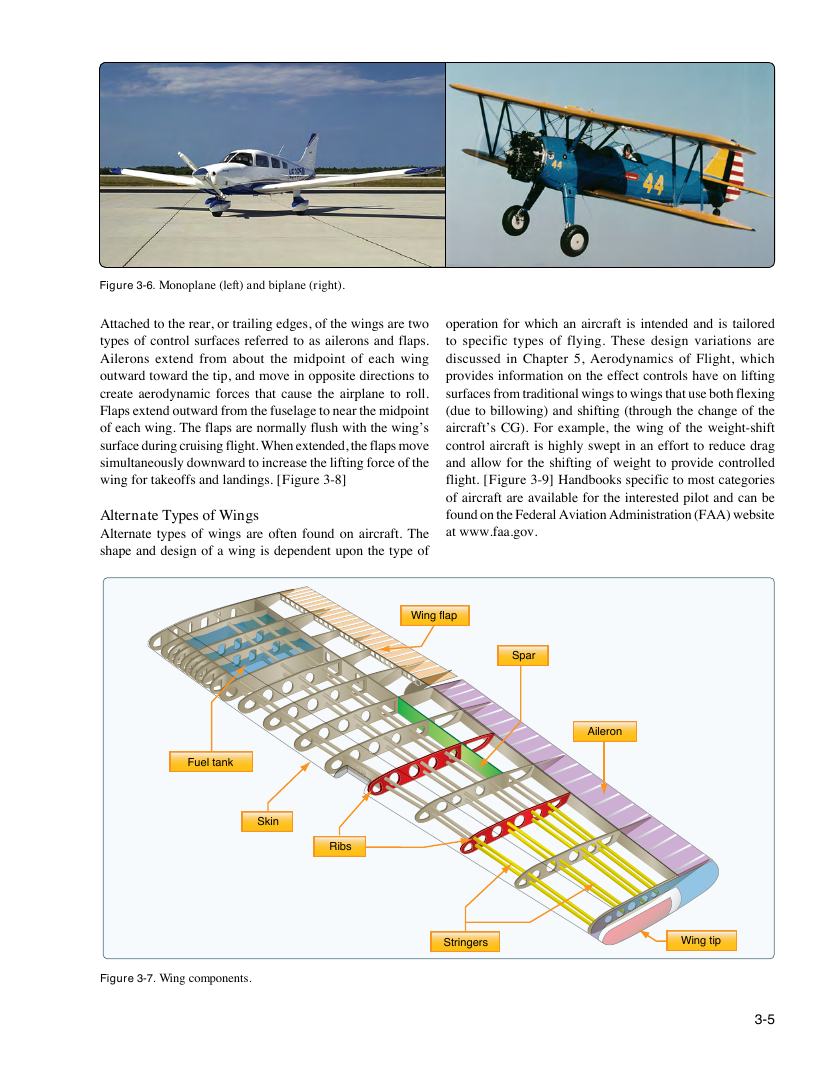
Wing flap
Spar
Aileron
Fuel tank
Skin
Ribs
Stringers Wing tip
Figure 3-7. Wing components.
3-5