FAA-H-8083-25C · Source PDF page 78
Aircraft Construction
Alternate Types of Wings · PHAK page 3-7
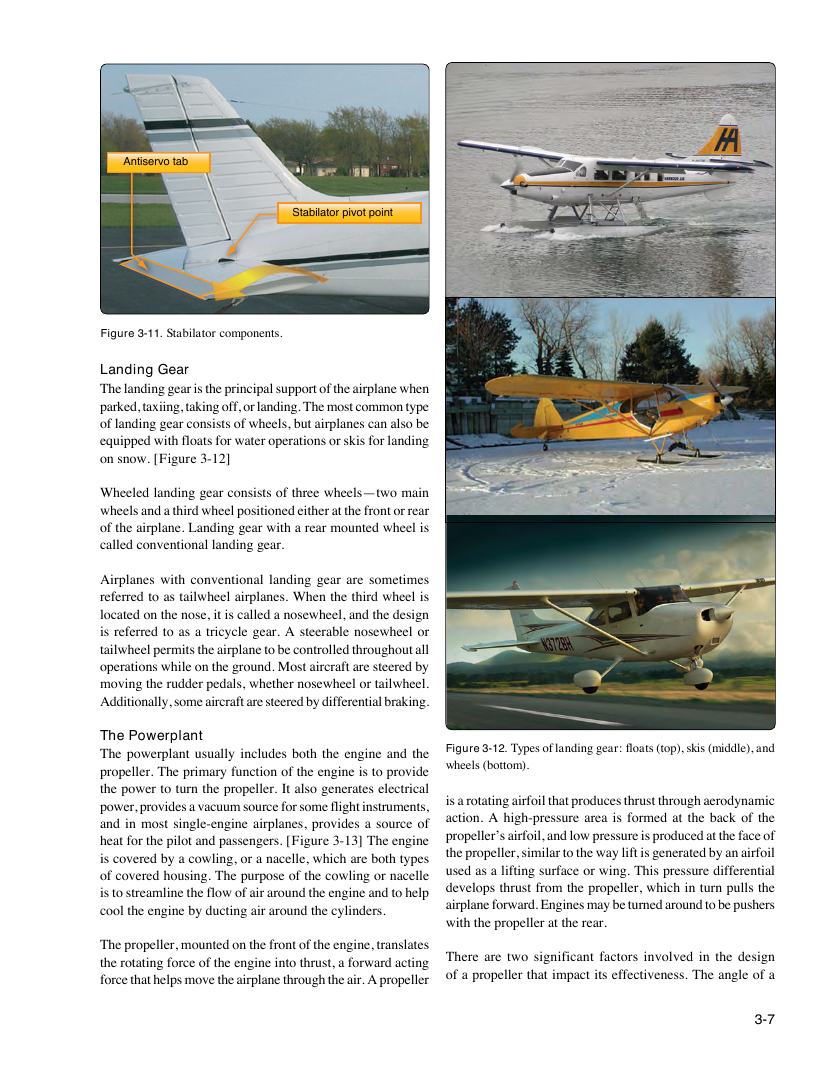
Searchable transcription
Antiservo tab
Stabilator pivot point
Figure 3-11. Stabilator components.
Landing Gear
The landing gear is the principal support of the airplane when
parked, taxiing, taking off, or landing. The most common type
of landing gear consists of wheels, but airplanes can also be
equipped with floats for water operations or skis for landing
on snow. [Figure 3-12]
Wheeled landing gear consists of three wheels—two main
wheels and a third wheel positioned either at the front or rear
of the airplane. Landing gear with a rear mounted wheel is
called conventional landing gear.
Airplanes with conventional landing gear are sometimes
referred to as tailwheel airplanes. When the third wheel is
located on the nose, it is called a nosewheel, and the design
is referred to as a tricycle gear. A steerable nosewheel or
tailwheel permits the airplane to be controlled throughout all
operations while on the ground. Most aircraft are steered by
moving the rudder pedals, whether nosewheel or tailwheel.
Additionally, some aircraft are steered by differential braking.
The Powerplant
The powerplant usually includes both the engine and the Figure 3-12. Types of landing gear: floats (top), skis (middle), and
wheels (bottom).
propeller. The primary function of the engine is to provide
the power to turn the propeller. It also generates electrical
is a rotating airfoil that produces thrust through aerodynamic
power, provides a vacuum source for some flight instruments,
action. A high-pressure area is formed at the back of the
and in most single-engine airplanes, provides a source of
propeller’s airfoil, and low pressure is produced at the face of
heat for the pilot and passengers. [Figure 3-13] The engine
the propeller, similar to the way lift is generated by an airfoil
is covered by a cowling, or a nacelle, which are both types
used as a lifting surface or wing. This pressure differential
of covered housing. The purpose of the cowling or nacelle
develops thrust from the propeller, which in turn pulls the
is to streamline the flow of air around the engine and to help
airplane forward. Engines may be turned around to be pushers
cool the engine by ducting air around the cylinders.
with the propeller at the rear.
The propeller, mounted on the front of the engine, translates
There are two significant factors involved in the design
the rotating force of the engine into thrust, a forward acting
of a propeller that impact its effectiveness. The angle of a
force that helps move the airplane through the air. A propeller
3-7