FAA-H-8083-25C · Source PDF page 79
Aircraft Construction
Types of Aircraft Construction · PHAK page 3-8
Searchable transcription
operate the flight instruments, essential systems, such as
anti-icing, and passenger services, such as cabin lighting.
Engine
The flight controls are the devices and systems that govern
the attitude of an aircraft and, as a result, the flight path
Propeller followed by the aircraft. In the case of many conventional
airplanes, the primary flight controls utilize hinged, trailing-
edge surfaces called elevators for pitch, ailerons for roll, and
the rudder for yaw. These surfaces are operated by the pilot
in the flight deck or by an automatic pilot.
In the case of most modern airplanes, airplane brakes consist
of multiple pads (called caliper pads) that are hydraulically
squeezed toward each other with a rotating disk (called a
rotor) between them. The pads place pressure on the rotor
Cowling
which is turning with the wheels. As a result of the increased
friction on the rotor, the wheels inherently slow down and
stop turning. The disks and brake pads are made either from
steel, like those in a car, or from a carbon material that weighs
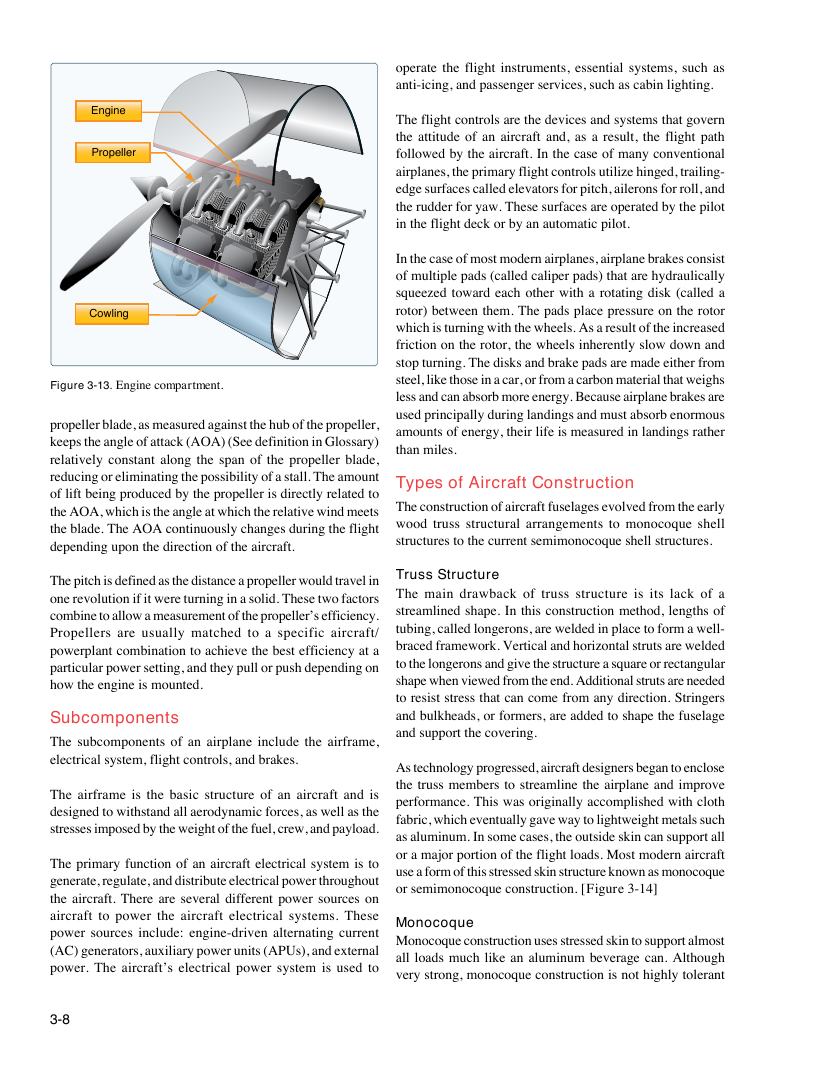
Figure 3-13. Engine compartment.
less and can absorb more energy. Because airplane brakes are
used principally during landings and must absorb enormous
propeller blade, as measured against the hub of the propeller,
amounts of energy, their life is measured in landings rather
keeps the angle of attack (AOA) (See definition in Glossary)
than miles.
relatively constant along the span of the propeller blade,
reducing or eliminating the possibility of a stall. The amount
Types of Aircraft Construction
of lift being produced by the propeller is directly related to
The construction of aircraft fuselages evolved from the early
the AOA, which is the angle at which the relative wind meets
wood truss structural arrangements to monocoque shell
the blade. The AOA continuously changes during the flight
structures to the current semimonocoque shell structures.
depending upon the direction of the aircraft.
Truss Structure
The pitch is defined as the distance a propeller would travel in
The main drawback of truss structure is its lack of a
one revolution if it were turning in a solid. These two factors
streamlined shape. In this construction method, lengths of
combine to allow a measurement of the propeller’s efficiency.
tubing, called longerons, are welded in place to form a well-
Propellers are usually matched to a specific aircraft/
braced framework. Vertical and horizontal struts are welded
powerplant combination to achieve the best efficiency at a
to the longerons and give the structure a square or rectangular
particular power setting, and they pull or push depending on
shape when viewed from the end. Additional struts are needed
how the engine is mounted.
to resist stress that can come from any direction. Stringers
Subcomponents and bulkheads, or formers, are added to shape the fuselage
and support the covering.
The subcomponents of an airplane include the airframe,
electrical system, flight controls, and brakes.
As technology progressed, aircraft designers began to enclose
the truss members to streamline the airplane and improve
The airframe is the basic structure of an aircraft and is
performance. This was originally accomplished with cloth
designed to withstand all aerodynamic forces, as well as the
fabric, which eventually gave way to lightweight metals such
stresses imposed by the weight of the fuel, crew, and payload.
as aluminum. In some cases, the outside skin can support all
or a major portion of the flight loads. Most modern aircraft
The primary function of an aircraft electrical system is to
use a form of this stressed skin structure known as monocoque
generate, regulate, and distribute electrical power throughout
or semimonocoque construction. [Figure 3-14]
the aircraft. There are several different power sources on
aircraft to power the aircraft electrical systems. These
Monocoque
power sources include: engine-driven alternating current
Monocoque construction uses stressed skin to support almost
(AC) generators, auxiliary power units (APUs), and external
all loads much like an aluminum beverage can. Although
power. The aircraft’s electrical power system is used to
very strong, monocoque construction is not highly tolerant
3-8