FAA-H-8083-25C · Source PDF page 80
Aircraft Construction
History · PHAK page 3-9
Searchable transcription
automobile manufacturing where the unibody is considered
Monocoque
standard in manufacturing.
Bulkhead
Semimonocoque
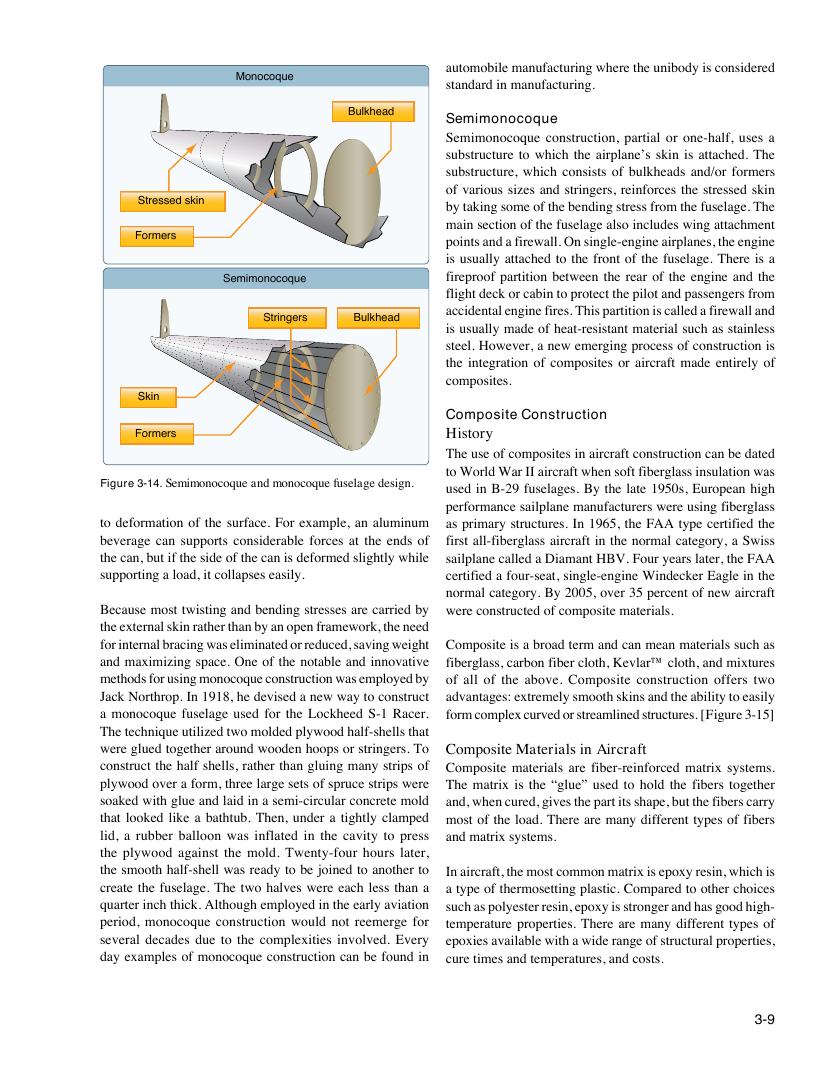
Semimonocoque construction, partial or one-half, uses a
substructure to which the airplane’s skin is attached. The
substructure, which consists of bulkheads and/or formers
of various sizes and stringers, reinforces the stressed skin
Stressed skin by taking some of the bending stress from the fuselage. The
main section of the fuselage also includes wing attachment
Formers
points and a firewall. On single-engine airplanes, the engine
is usually attached to the front of the fuselage. There is a
fireproof partition between the rear of the engine and the
Semimonocoque
flight deck or cabin to protect the pilot and passengers from
accidental engine fires. This partition is called a firewall and
Stringers Bulkhead
is usually made of heat-resistant material such as stainless
steel. However, a new emerging process of construction is
the integration of composites or aircraft made entirely of
composites.
Skin
Composite Construction
Formers History
The use of composites in aircraft construction can be dated
to World War II aircraft when soft fiberglass insulation was
Figure 3-14. Semimonocoque and monocoque fuselage design. used in B-29 fuselages. By the late 1950s, European high
performance sailplane manufacturers were using fiberglass
to deformation of the surface. For example, an aluminum as primary structures. In 1965, the FAA type certified the
beverage can supports considerable forces at the ends of first all-fiberglass aircraft in the normal category, a Swiss
the can, but if the side of the can is deformed slightly while sailplane called a Diamant HBV. Four years later, the FAA
supporting a load, it collapses easily. certified a four-seat, single-engine Windecker Eagle in the
normal category. By 2005, over 35 percent of new aircraft
Because most twisting and bending stresses are carried by were constructed of composite materials.
the external skin rather than by an open framework, the need
for internal bracing was eliminated or reduced, saving weight Composite is a broad term and can mean materials such as
and maximizing space. One of the notable and innovative fiberglass, carbon fiber cloth, Kevlar™ cloth, and mixtures
methods for using monocoque construction was employed by of all of the above. Composite construction offers two
Jack Northrop. In 1918, he devised a new way to construct advantages: extremely smooth skins and the ability to easily
a monocoque fuselage used for the Lockheed S-1 Racer. form complex curved or streamlined structures. [Figure 3-15]
The technique utilized two molded plywood half-shells that
were glued together around wooden hoops or stringers. To Composite Materials in Aircraft
construct the half shells, rather than gluing many strips of Composite materials are fiber-reinforced matrix systems.
plywood over a form, three large sets of spruce strips were The matrix is the “glue” used to hold the fibers together
soaked with glue and laid in a semi-circular concrete mold and, when cured, gives the part its shape, but the fibers carry
that looked like a bathtub. Then, under a tightly clamped most of the load. There are many different types of fibers
lid, a rubber balloon was inflated in the cavity to press and matrix systems.
the plywood against the mold. Twenty-four hours later,
the smooth half-shell was ready to be joined to another to In aircraft, the most common matrix is epoxy resin, which is
create the fuselage. The two halves were each less than a a type of thermosetting plastic. Compared to other choices
quarter inch thick. Although employed in the early aviation such as polyester resin, epoxy is stronger and has good high-
period, monocoque construction would not reemerge for temperature properties. There are many different types of
several decades due to the complexities involved. Every epoxies available with a wide range of structural properties,
day examples of monocoque construction can be found in cure times and temperatures, and costs.
3-9