FAA-H-8083-25C · Source PDF page 94
Principles of Flight
Airfoil Design · PHAK page 4-7
Searchable transcription
lift and is not suitable for high-speed flight. Advancements
in engineering have made it possible for today’s high-speed
Mean camber line Trailing edge
jets to take advantage of the concave airfoil’s high lift
Camber of upper surface characteristics. Leading edge (Kreuger) flaps and trailing
edge (Fowler) flaps, when extended from the basic wing
structure, literally change the airfoil shape into the classic
Camber of lower
surface
concave form, thereby generating much greater lift during
slow flight conditions.
Leading edge Chord line
On the other hand, an airfoil that is perfectly streamlined
and offers little wind resistance sometimes does not have
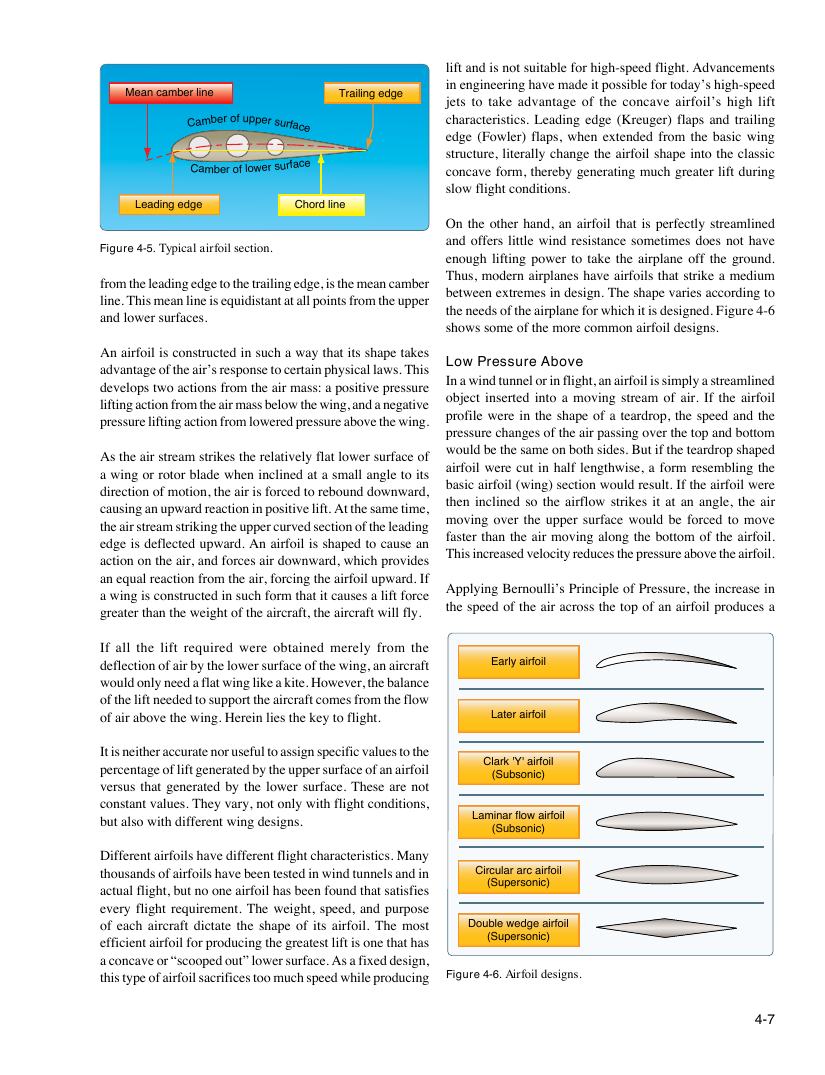
Figure 4-5. Typical airfoil section.
enough lifting power to take the airplane off the ground.
Thus, modern airplanes have airfoils that strike a medium
from the leading edge to the trailing edge, is the mean camber
between extremes in design. The shape varies according to
line. This mean line is equidistant at all points from the upper
the needs of the airplane for which it is designed. Figure 4-6
and lower surfaces.
shows some of the more common airfoil designs.
An airfoil is constructed in such a way that its shape takes
Low Pressure Above
advantage of the air’s response to certain physical laws. This
In a wind tunnel or in flight, an airfoil is simply a streamlined
develops two actions from the air mass: a positive pressure
object inserted into a moving stream of air. If the airfoil
lifting action from the air mass below the wing, and a negative
profile were in the shape of a teardrop, the speed and the
pressure lifting action from lowered pressure above the wing.
pressure changes of the air passing over the top and bottom
would be the same on both sides. But if the teardrop shaped
As the air stream strikes the relatively flat lower surface of
airfoil were cut in half lengthwise, a form resembling the
a wing or rotor blade when inclined at a small angle to its
basic airfoil (wing) section would result. If the airfoil were
direction of motion, the air is forced to rebound downward,
then inclined so the airflow strikes it at an angle, the air
causing an upward reaction in positive lift. At the same time,
moving over the upper surface would be forced to move
the air stream striking the upper curved section of the leading
faster than the air moving along the bottom of the airfoil.
edge is deflected upward. An airfoil is shaped to cause an
This increased velocity reduces the pressure above the airfoil.
action on the air, and forces air downward, which provides
an equal reaction from the air, forcing the airfoil upward. If
Applying Bernoulli’s Principle of Pressure, the increase in
a wing is constructed in such form that it causes a lift force
the speed of the air across the top of an airfoil produces a
greater than the weight of the aircraft, the aircraft will fly.
If all the lift required were obtained merely from the
deflection of air by the lower surface of the wing, an aircraft Early airfoil
would only need a flat wing like a kite. However, the balance
of the lift needed to support the aircraft comes from the flow
of air above the wing. Herein lies the key to flight. Later airfoil
It is neither accurate nor useful to assign specific values to the
Clark 'Y' airfoil
percentage of lift generated by the upper surface of an airfoil
(Subsonic)
versus that generated by the lower surface. These are not
constant values. They vary, not only with flight conditions,
but also with different wing designs. Laminar flow airfoil
(Subsonic)
Different airfoils have different flight characteristics. Many
thousands of airfoils have been tested in wind tunnels and in Circular arc airfoil
(Supersonic)
actual flight, but no one airfoil has been found that satisfies
every flight requirement. The weight, speed, and purpose
of each aircraft dictate the shape of its airfoil. The most Double wedge airfoil
(Supersonic)
efficient airfoil for producing the greatest lift is one that has
a concave or “scooped out” lower surface. As a fixed design,
this type of airfoil sacrifices too much speed while producing Figure 4-6. Airfoil designs.
4-7