FAA-H-8083-25C · Source PDF page 109
Aerodynamics of Flight
Axes of an Aircraft · PHAK page 5-12
Searchable transcription
During the takeoff phase of flight, ground effect produces establishing a positive rate of climb and only after achieving
some important relationships. An aircraft leaving ground a safe altitude.
effect after takeoff encounters just the reverse of an aircraft
entering ground effect during landing. The aircraft leaving If, during the landing phase of flight, the aircraft is brought
ground effect will: into ground effect with a constant AOA, the aircraft
experiences an increase in C and a reduction in the thrust
• Require an increase in AOA to maintain the same C L
L
required, and a “floating” effect may occur. Because of the
• Experience an increase in induced drag and thrust
reduced drag and lack of power-off deceleration in ground
required
effect, any excess speed at the point of flare may incur a
• Experience a decrease in stability and a nose-up considerable “float” distance. As the aircraft nears the point
change in moment of touchdown, ground effect is most realized at altitudes less
than the wingspan. During the final phases of the approach
• Experience a reduction in static source pressure and
as the aircraft nears the ground, a reduction of power is
increase in indicated airspeed
necessary to offset the increase in lift caused from ground
effect otherwise the aircraft will have a tendency to climb
Ground effect must be considered during takeoffs and landings.
above the desired glidepath (GP).
For example, if a pilot fails to understand the relationship
between the aircraft and ground effect during takeoff, a
Axes of an Aircraft
hazardous situation is possible because the recommended
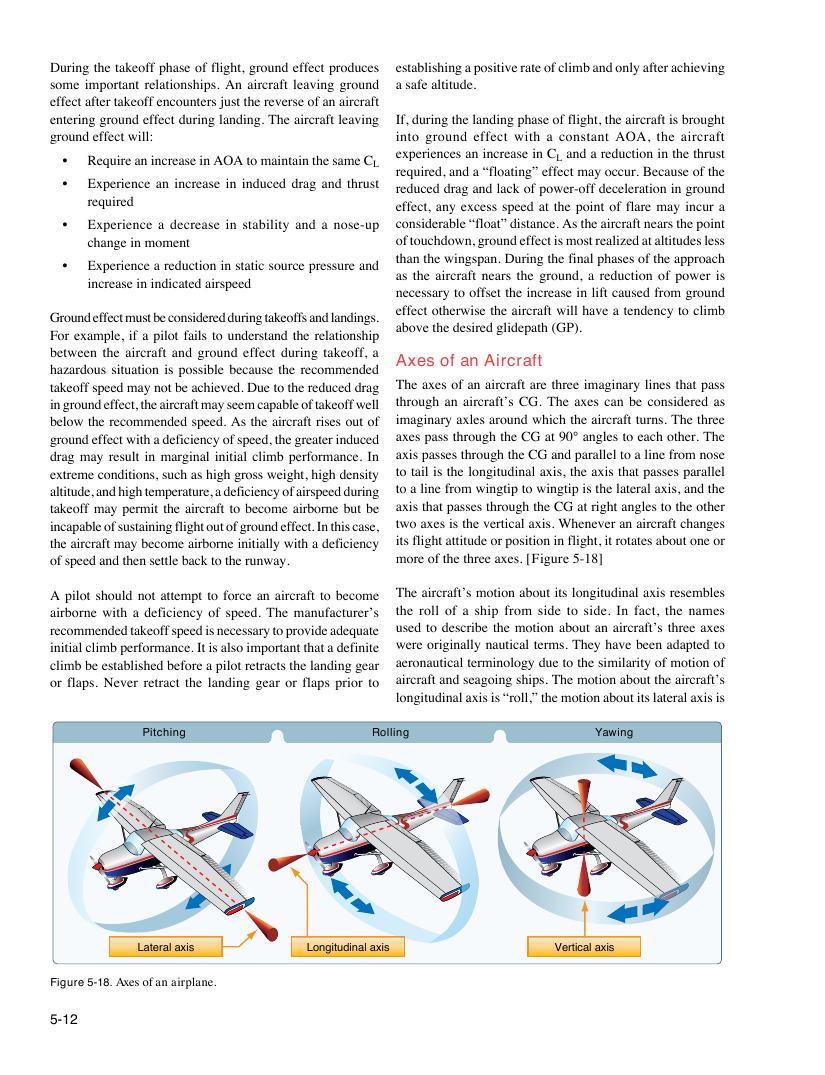
takeoff speed may not be achieved. Due to the reduced drag The axes of an aircraft are three imaginary lines that pass
in ground effect, the aircraft may seem capable of takeoff well through an aircraft’s CG. The axes can be considered as
below the recommended speed. As the aircraft rises out of imaginary axles around which the aircraft turns. The three
ground effect with a deficiency of speed, the greater induced axes pass through the CG at 90° angles to each other. The
drag may result in marginal initial climb performance. In axis passes through the CG and parallel to a line from nose
extreme conditions, such as high gross weight, high density to tail is the longitudinal axis, the axis that passes parallel
altitude, and high temperature, a deficiency of airspeed during to a line from wingtip to wingtip is the lateral axis, and the
takeoff may permit the aircraft to become airborne but be axis that passes through the CG at right angles to the other
incapable of sustaining flight out of ground effect. In this case, two axes is the vertical axis. Whenever an aircraft changes
the aircraft may become airborne initially with a deficiency its flight attitude or position in flight, it rotates about one or
of speed and then settle back to the runway. more of the three axes. [Figure 5-18]
A pilot should not attempt to force an aircraft to become The aircraft’s motion about its longitudinal axis resembles
airborne with a deficiency of speed. The manufacturer’s the roll of a ship from side to side. In fact, the names
recommended takeoff speed is necessary to provide adequate used to describe the motion about an aircraft’s three axes
initial climb performance. It is also important that a definite were originally nautical terms. They have been adapted to
climb be established before a pilot retracts the landing gear aeronautical terminology due to the similarity of motion of
or flaps. Never retract the landing gear or flaps prior to aircraft and seagoing ships. The motion about the aircraft’s
longitudinal axis is “roll,” the motion about its lateral axis is
Pitching Rolling Yawing
Lateral axis Longitudinal axis Vertical axis
Figure 5-18. Axes of an airplane.
5-12