FAA-H-8083-25C · Source PDF page 110
Aerodynamics of Flight
Moment and Moment Arm · PHAK page 5-13
Searchable transcription
“pitch,” and the motion about its vertical axis is “yaw.” Yaw
is the left and right movement of the aircraft’s nose.
The three motions of the conventional airplane (roll, pitch,
and yaw) are controlled by three control surfaces. Roll is
controlled by the ailerons; pitch is controlled by the elevators;
yaw is controlled by the rudder. The use of these controls
is explained in Chapter 6, Flight Controls. Other types of
aircraft may utilize different methods of controlling the
movements about the various axes.
For example, weight-shift control aircraft control two axes
(roll and pitch) using an “A” frame suspended from the
flexible wing attached to a three-wheeled carriage. These
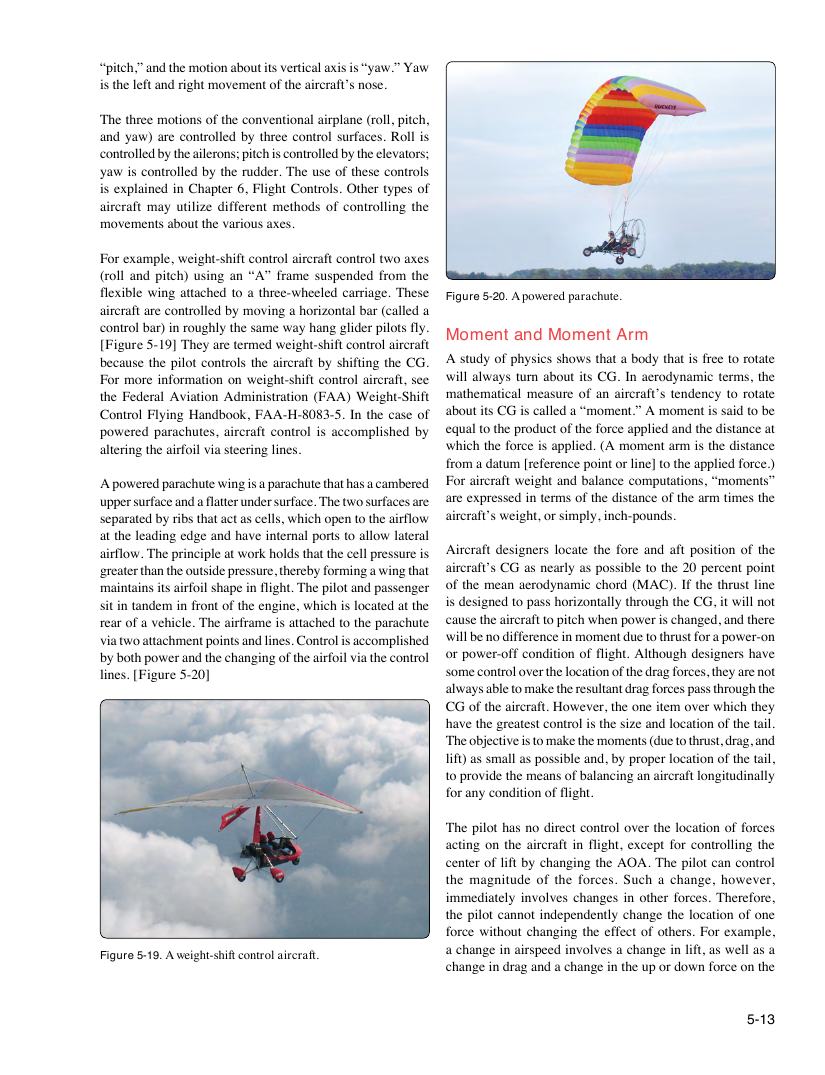
Figure 5-20. A powered parachute.
aircraft are controlled by moving a horizontal bar (called a
control bar) in roughly the same way hang glider pilots fly.
Moment and Moment Arm
[Figure 5-19] They are termed weight-shift control aircraft
because the pilot controls the aircraft by shifting the CG. A study of physics shows that a body that is free to rotate
For more information on weight-shift control aircraft, see will always turn about its CG. In aerodynamic terms, the
the Federal Aviation Administration (FAA) Weight-Shift mathematical measure of an aircraft’s tendency to rotate
Control Flying Handbook, FAA-H-8083-5. In the case of about its CG is called a “moment.” A moment is said to be
powered parachutes, aircraft control is accomplished by equal to the product of the force applied and the distance at
altering the airfoil via steering lines. which the force is applied. (A moment arm is the distance
from a datum [reference point or line] to the applied force.)
A powered parachute wing is a parachute that has a cambered For aircraft weight and balance computations, “moments”
upper surface and a flatter under surface. The two surfaces are are expressed in terms of the distance of the arm times the
separated by ribs that act as cells, which open to the airflow aircraft’s weight, or simply, inch-pounds.
at the leading edge and have internal ports to allow lateral
airflow. The principle at work holds that the cell pressure is Aircraft designers locate the fore and aft position of the
greater than the outside pressure, thereby forming a wing that aircraft’s CG as nearly as possible to the 20 percent point
maintains its airfoil shape in flight. The pilot and passenger of the mean aerodynamic chord (MAC). If the thrust line
sit in tandem in front of the engine, which is located at the is designed to pass horizontally through the CG, it will not
rear of a vehicle. The airframe is attached to the parachute cause the aircraft to pitch when power is changed, and there
via two attachment points and lines. Control is accomplished will be no difference in moment due to thrust for a power-on
by both power and the changing of the airfoil via the control or power-off condition of flight. Although designers have
lines. [Figure 5-20] some control over the location of the drag forces, they are not
always able to make the resultant drag forces pass through the
CG of the aircraft. However, the one item over which they
have the greatest control is the size and location of the tail.
The objective is to make the moments (due to thrust, drag, and
lift) as small as possible and, by proper location of the tail,
to provide the means of balancing an aircraft longitudinally
for any condition of flight.
The pilot has no direct control over the location of forces
acting on the aircraft in flight, except for controlling the
center of lift by changing the AOA. The pilot can control
the magnitude of the forces. Such a change, however,
immediately involves changes in other forces. Therefore,
the pilot cannot independently change the location of one
force without changing the effect of others. For example,
a change in airspeed involves a change in lift, as well as a
Figure 5-19. A weight-shift control aircraft.
change in drag and a change in the up or down force on the
5-13