FAA-H-8083-25C · Source PDF page 129
Aerodynamics of Flight
Coefficient of Lift Curve · PHAK page 5-32
Searchable transcription
Effective
Resultant force 90° force
Yaw
1. Intake
Applied force
Figure 5-49. Gyroscopic precession.
A
p
p lie
d
Re f s o u rc lt e a nt fo rc e
5-32
Y a w
E eff of cc r e vit e
Asymmetric Loading (P-Factor)
When an aircraft is flying with a high AOA, the “bite” of
the downward moving blade is greater than the “bite” of the
upward moving blade. This moves the center of thrust to the
right of the prop disc area, causing a yawing moment toward
the left around the vertical axis. Proving this explanation is
complex because it would be necessary to work wind vector
problems on each blade while considering both the AOA of
the aircraft and the AOA of each blade.
This asymmetric loading is caused by the resultant velocity,
gyroscope and thus has similar properties. Any time a force
which is generated by the combination of the velocity of the
is applied to deflect the propeller out of its plane of rotation,
propeller blade in its plane of rotation and the velocity of the
the resulting force is 90° ahead of and in the direction of
air passing horizontally through the propeller disc. With the
rotation and in the direction of application, causing a pitching
aircraft being flown at positive AOAs, the right (viewed from
moment, a yawing moment, or a combination of the two
the rear) or downswinging blade, is passing through an area of
depending upon the point at which the force was applied.
resultant velocity, which is greater than that affecting the left
or upswinging blade. Since the propeller blade is an airfoil,
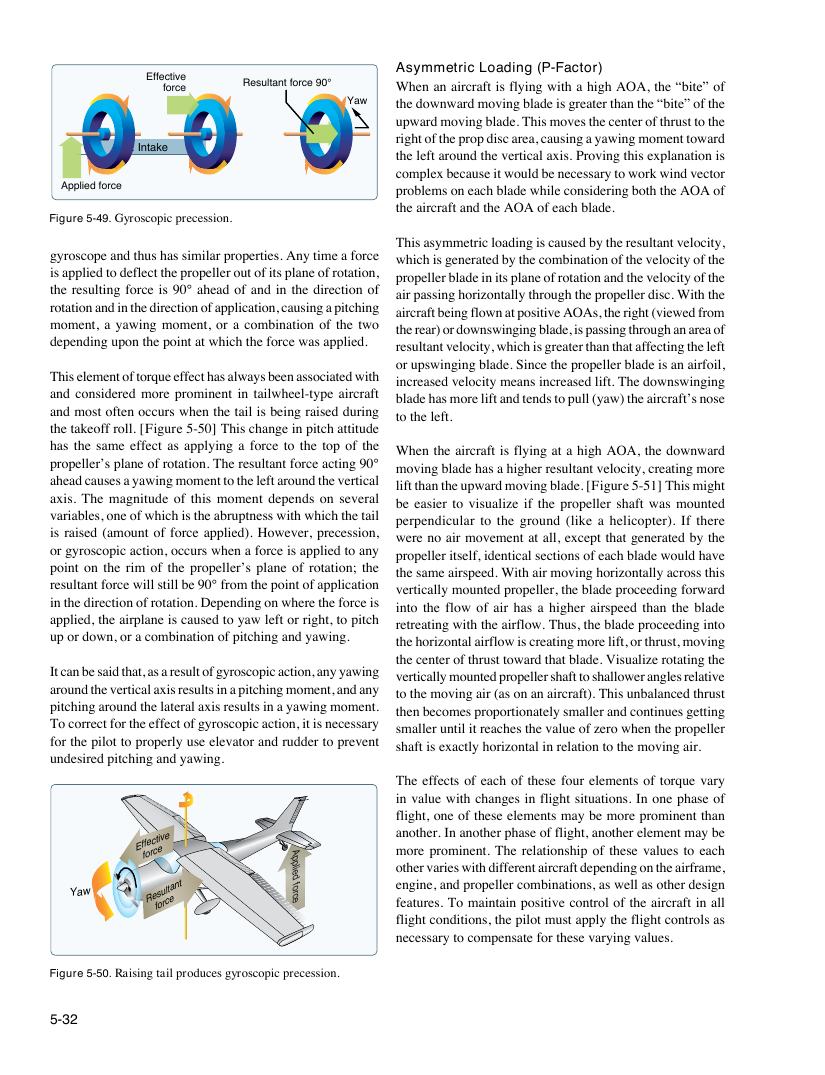
This element of torque effect has always been associated with
increased velocity means increased lift. The downswinging
and considered more prominent in tailwheel-type aircraft
blade has more lift and tends to pull (yaw) the aircraft’s nose
and most often occurs when the tail is being raised during
to the left.
the takeoff roll. [Figure 5-50] This change in pitch attitude
has the same effect as applying a force to the top of the
When the aircraft is flying at a high AOA, the downward
propeller’s plane of rotation. The resultant force acting 90°
moving blade has a higher resultant velocity, creating more
ahead causes a yawing moment to the left around the vertical
lift than the upward moving blade. [Figure 5-51] This might
axis. The magnitude of this moment depends on several
be easier to visualize if the propeller shaft was mounted
variables, one of which is the abruptness with which the tail
perpendicular to the ground (like a helicopter). If there
is raised (amount of force applied). However, precession,
were no air movement at all, except that generated by the
or gyroscopic action, occurs when a force is applied to any
propeller itself, identical sections of each blade would have
point on the rim of the propeller’s plane of rotation; the
the same airspeed. With air moving horizontally across this
resultant force will still be 90° from the point of application
vertically mounted propeller, the blade proceeding forward
in the direction of rotation. Depending on where the force is
into the flow of air has a higher airspeed than the blade
applied, the airplane is caused to yaw left or right, to pitch
retreating with the airflow. Thus, the blade proceeding into
up or down, or a combination of pitching and yawing.
the horizontal airflow is creating more lift, or thrust, moving
the center of thrust toward that blade. Visualize rotating the
It can be said that, as a result of gyroscopic action, any yawing
vertically mounted propeller shaft to shallower angles relative
around the vertical axis results in a pitching moment, and any
to the moving air (as on an aircraft). This unbalanced thrust
pitching around the lateral axis results in a yawing moment.
then becomes proportionately smaller and continues getting
To correct for the effect of gyroscopic action, it is necessary
smaller until it reaches the value of zero when the propeller
for the pilot to properly use elevator and rudder to prevent
shaft is exactly horizontal in relation to the moving air.
undesired pitching and yawing.
The effects of each of these four elements of torque vary
in value with changes in flight situations. In one phase of
flight, one of these elements may be more prominent than
another. In another phase of flight, another element may be more prominent. The relationship of these values to each
other varies with different aircraft depending on the airframe,
engine, and propeller combinations, as well as other design features. To maintain positive control of the aircraft in all
flight conditions, the pilot must apply the flight controls as
necessary to compensate for these varying values.
Figure 5-50. Raising tail produces gyroscopic precession.