FAA-H-8083-25C · Source PDF page 130
Aerodynamics of Flight
Load Factors · PHAK page 5-33
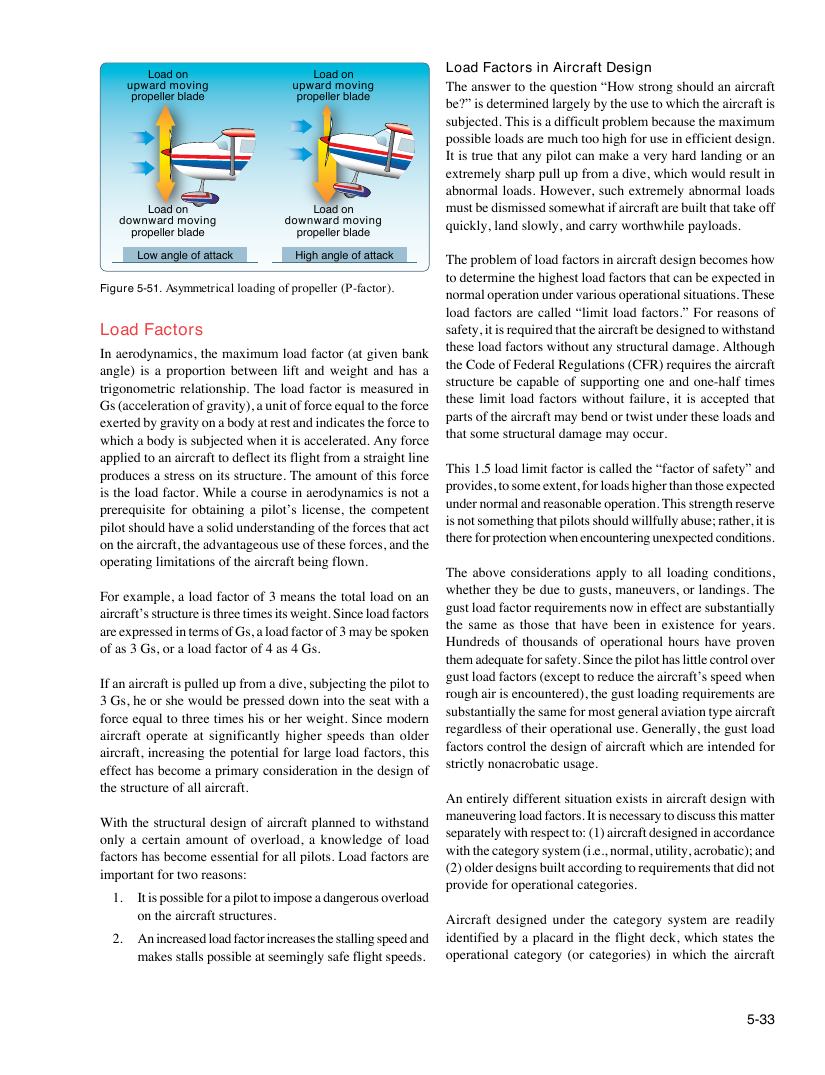
Searchable transcription
Load Factors in Aircraft Design
Load on Load on
upward moving upward moving The answer to the question “How strong should an aircraft
propeller blade propeller blade
be?” is determined largely by the use to which the aircraft is
subjected. This is a difficult problem because the maximum
possible loads are much too high for use in efficient design.
It is true that any pilot can make a very hard landing or an
extremely sharp pull up from a dive, which would result in
abnormal loads. However, such extremely abnormal loads
Load on Load on must be dismissed somewhat if aircraft are built that take off
downward moving downward moving quickly, land slowly, and carry worthwhile payloads.
propeller blade propeller blade
Low angle of attack High angle of attack The problem of load factors in aircraft design becomes how
to determine the highest load factors that can be expected in
Figure 5-51. Asymmetrical loading of propeller (P-factor). normal operation under various operational situations. These
load factors are called “limit load factors.” For reasons of
Load Factors safety, it is required that the aircraft be designed to withstand
these load factors without any structural damage. Although
In aerodynamics, the maximum load factor (at given bank
the Code of Federal Regulations (CFR) requires the aircraft
angle) is a proportion between lift and weight and has a
structure be capable of supporting one and one-half times
trigonometric relationship. The load factor is measured in
these limit load factors without failure, it is accepted that
Gs (acceleration of gravity), a unit of force equal to the force
parts of the aircraft may bend or twist under these loads and
exerted by gravity on a body at rest and indicates the force to
that some structural damage may occur.
which a body is subjected when it is accelerated. Any force
applied to an aircraft to deflect its flight from a straight line
This 1.5 load limit factor is called the “factor of safety” and
produces a stress on its structure. The amount of this force
provides, to some extent, for loads higher than those expected
is the load factor. While a course in aerodynamics is not a
under normal and reasonable operation. This strength reserve
prerequisite for obtaining a pilot’s license, the competent
is not something that pilots should willfully abuse; rather, it is
pilot should have a solid understanding of the forces that act
there for protection when encountering unexpected conditions.
on the aircraft, the advantageous use of these forces, and the
operating limitations of the aircraft being flown.
The above considerations apply to all loading conditions,
whether they be due to gusts, maneuvers, or landings. The
For example, a load factor of 3 means the total load on an
gust load factor requirements now in effect are substantially
aircraft’s structure is three times its weight. Since load factors
the same as those that have been in existence for years.
are expressed in terms of Gs, a load factor of 3 may be spoken
Hundreds of thousands of operational hours have proven
of as 3 Gs, or a load factor of 4 as 4 Gs.
them adequate for safety. Since the pilot has little control over
gust load factors (except to reduce the aircraft’s speed when
If an aircraft is pulled up from a dive, subjecting the pilot to
rough air is encountered), the gust loading requirements are
3 Gs, he or she would be pressed down into the seat with a
substantially the same for most general aviation type aircraft
force equal to three times his or her weight. Since modern
regardless of their operational use. Generally, the gust load
aircraft operate at significantly higher speeds than older
factors control the design of aircraft which are intended for
aircraft, increasing the potential for large load factors, this
strictly nonacrobatic usage.
effect has become a primary consideration in the design of
the structure of all aircraft.
An entirely different situation exists in aircraft design with
maneuvering load factors. It is necessary to discuss this matter
With the structural design of aircraft planned to withstand
separately with respect to: (1) aircraft designed in accordance
only a certain amount of overload, a knowledge of load
with the category system (i.e., normal, utility, acrobatic); and
factors has become essential for all pilots. Load factors are
(2) older designs built according to requirements that did not
important for two reasons:
provide for operational categories.
1. It is possible for a pilot to impose a dangerous overload
on the aircraft structures.
Aircraft designed under the category system are readily
2. An increased load factor increases the stalling speed and identified by a placard in the flight deck, which states the
makes stalls possible at seemingly safe flight speeds. operational category (or categories) in which the aircraft
5-33