FAA-H-8083-25C · Source PDF page 146
Aerodynamics of Flight
Laminar Boundary Layer Flow · PHAK page 5-49
Searchable transcription
to cause a low-speed Mach buffet. This very high AOA has
the effect of increasing airflow velocity over the upper surface
of the wing until the same effects of the shock waves and
buffet occur as in the high-speed buffet situation. The AOA
of the wing has the greatest effect on inducing the Mach
buffet at either the high-speed or low-speed boundaries for
the aircraft. The conditions that increase the AOA, the speed
of the airflow over the wing, and chances of Mach buffet are:
• High altitudes—the higher an aircraft flies, the thinner
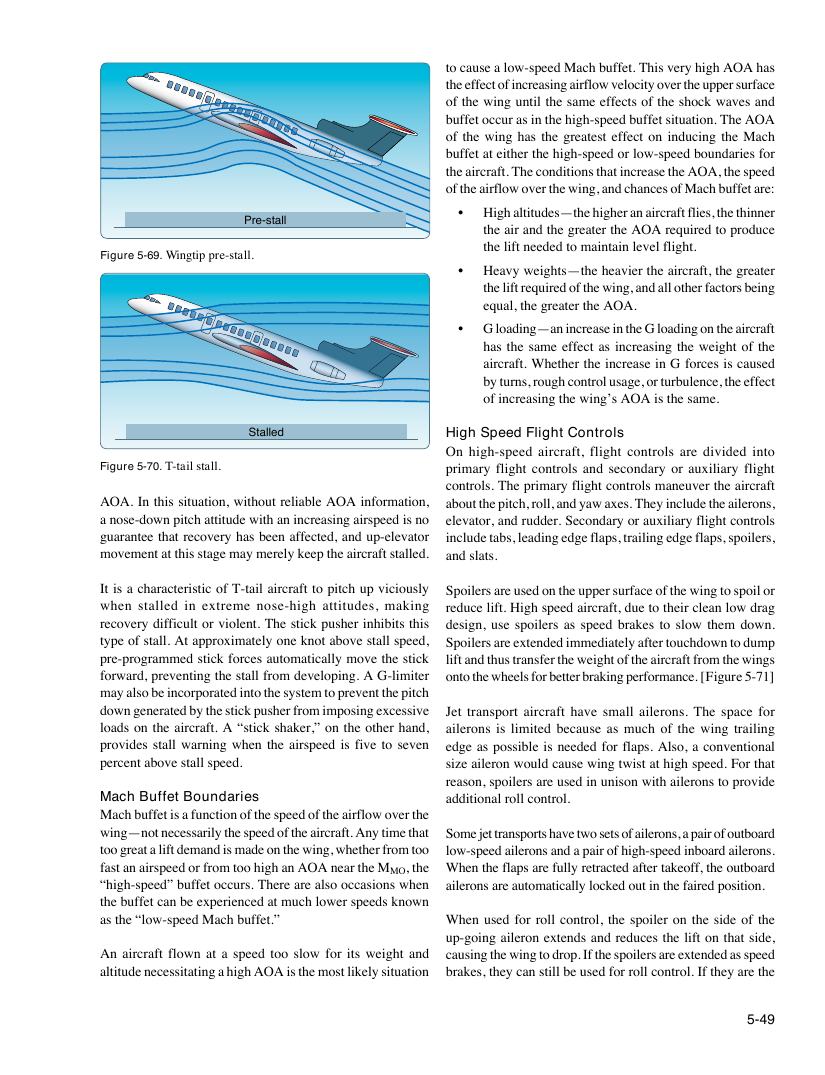
Pre-stall
the air and the greater the AOA required to produce
Prestall the lift needed to maintain level flight.
Figure 5-69. Wingtip pre-stall.
• Heavy weights—the heavier the aircraft, the greater
the lift required of the wing, and all other factors being
equal, the greater the AOA.
• G loading—an increase in the G loading on the aircraft
has the same effect as increasing the weight of the
aircraft. Whether the increase in G forces is caused
by turns, rough control usage, or turbulence, the effect
of increasing the wing’s AOA is the same.
Stalled
Stalled High Speed Flight Controls
On high-speed aircraft, flight controls are divided into
Figure 5-70. T-tail stall. primary flight controls and secondary or auxiliary flight
controls. The primary flight controls maneuver the aircraft
AOA. In this situation, without reliable AOA information, about the pitch, roll, and yaw axes. They include the ailerons,
a nose-down pitch attitude with an increasing airspeed is no elevator, and rudder. Secondary or auxiliary flight controls
guarantee that recovery has been affected, and up-elevator include tabs, leading edge flaps, trailing edge flaps, spoilers,
movement at this stage may merely keep the aircraft stalled. and slats.
It is a characteristic of T-tail aircraft to pitch up viciously Spoilers are used on the upper surface of the wing to spoil or
when stalled in extreme nose-high attitudes, making reduce lift. High speed aircraft, due to their clean low drag
recovery difficult or violent. The stick pusher inhibits this design, use spoilers as speed brakes to slow them down.
type of stall. At approximately one knot above stall speed, Spoilers are extended immediately after touchdown to dump
pre-programmed stick forces automatically move the stick lift and thus transfer the weight of the aircraft from the wings
forward, preventing the stall from developing. A G-limiter onto the wheels for better braking performance. [Figure 5-71]
may also be incorporated into the system to prevent the pitch
down generated by the stick pusher from imposing excessive Jet transport aircraft have small ailerons. The space for
loads on the aircraft. A “stick shaker,” on the other hand, ailerons is limited because as much of the wing trailing
provides stall warning when the airspeed is five to seven edge as possible is needed for flaps. Also, a conventional
percent above stall speed. size aileron would cause wing twist at high speed. For that
reason, spoilers are used in unison with ailerons to provide
Mach Buffet Boundaries additional roll control.
Mach buffet is a function of the speed of the airflow over the
wing—not necessarily the speed of the aircraft. Any time that Some jet transports have two sets of ailerons, a pair of outboard
too great a lift demand is made on the wing, whether from too low-speed ailerons and a pair of high-speed inboard ailerons.
fast an airspeed or from too high an AOA near the M , the When the flaps are fully retracted after takeoff, the outboard
MO
“high-speed” buffet occurs. There are also occasions when ailerons are automatically locked out in the faired position.
the buffet can be experienced at much lower speeds known
as the “low-speed Mach buffet.” When used for roll control, the spoiler on the side of the
up-going aileron extends and reduces the lift on that side,
An aircraft flown at a speed too slow for its weight and causing the wing to drop. If the spoilers are extended as speed
altitude necessitating a high AOA is the most likely situation brakes, they can still be used for roll control. If they are the
5-49