FAA-H-8083-25C · Source PDF page 137
Aerodynamics of Flight
Weight and Balance · PHAK page 5-40
Searchable transcription
of equal weight. Instead, do a full computation of all items
240 knots R =
V2
to be loaded on the aircraft, including baggage, as well as
11.26 x tangent of bank angle
the pilot and passenger. It is recommended that all bags be
2402
weighed to make a precise computation of how the aircraft
R =
11.26 x tangent of 30° CG is positioned.
57,600
R =
11.26 x 0.57735
The importance of the CG was stressed in the discussion
R = 8,861 feet of stability, controllability, and performance. Unequal load
(four times the radius at 120 knots)
distribution causes accidents. A competent pilot understands
The radius of a turn required by an aircraft traveling at 240 knots
and respects the effects of CG on an aircraft.
using the same bank angle in Figure 4-51 is 8,861 feet. Speed
is a major factor in a turn.
Weight and balance are critical components in the utilization
Figure 5-60. Radius at 240 knots. of an aircraft to its fullest potential. The pilot must know
how much fuel can be loaded onto the aircraft without
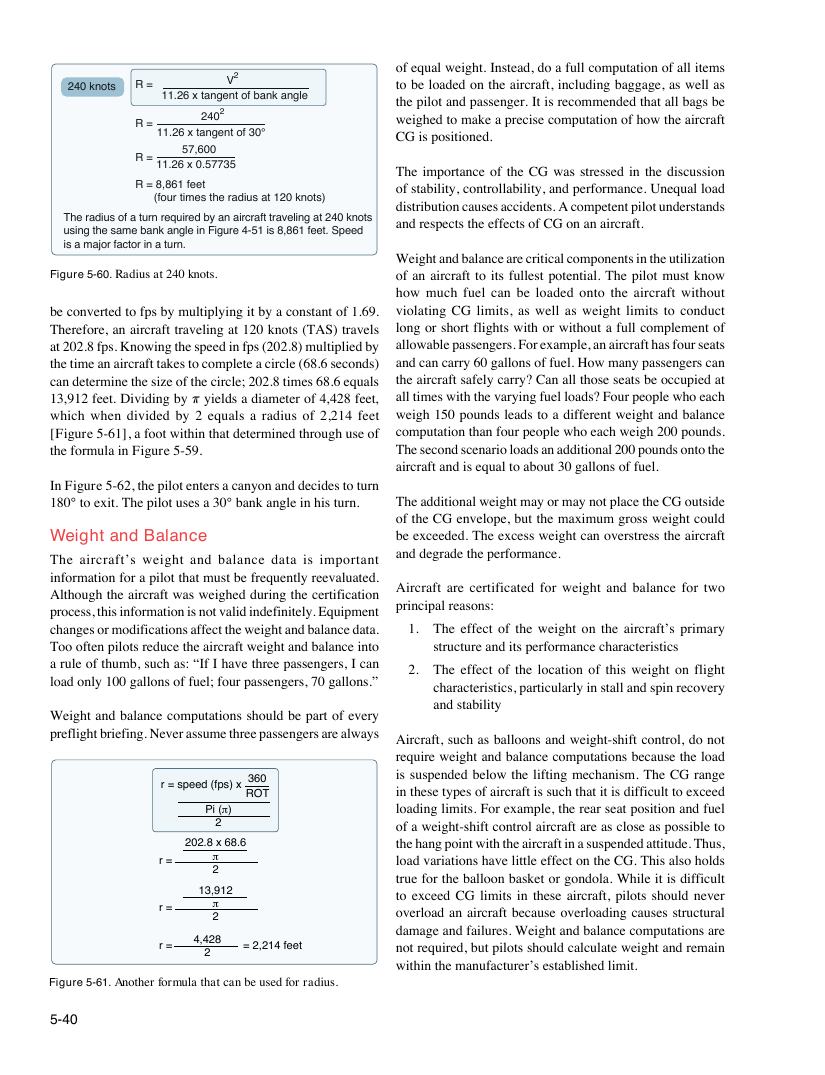
be converted to fps by multiplying it by a constant of 1.69. violating CG limits, as well as weight limits to conduct
Therefore, an aircraft traveling at 120 knots (TAS) travels long or short flights with or without a full complement of
at 202.8 fps. Knowing the speed in fps (202.8) multiplied by allowable passengers. For example, an aircraft has four seats
the time an aircraft takes to complete a circle (68.6 seconds) and can carry 60 gallons of fuel. How many passengers can
can determine the size of the circle; 202.8 times 68.6 equals the aircraft safely carry? Can all those seats be occupied at
13,912 feet. Dividing by π yields a diameter of 4,428 feet, all times with the varying fuel loads? Four people who each
which when divided by 2 equals a radius of 2,214 feet weigh 150 pounds leads to a different weight and balance
[Figure 5-61], a foot within that determined through use of computation than four people who each weigh 200 pounds.
the formula in Figure 5-59. The second scenario loads an additional 200 pounds onto the
aircraft and is equal to about 30 gallons of fuel.
In Figure 5-62, the pilot enters a canyon and decides to turn
180° to exit. The pilot uses a 30° bank angle in his turn. The additional weight may or may not place the CG outside
of the CG envelope, but the maximum gross weight could
Weight and Balance be exceeded. The excess weight can overstress the aircraft
and degrade the performance.
The aircraft’s weight and balance data is important
information for a pilot that must be frequently reevaluated.
Aircraft are certificated for weight and balance for two
Although the aircraft was weighed during the certification
principal reasons:
process, this information is not valid indefinitely. Equipment
changes or modifications affect the weight and balance data. 1. The effect of the weight on the aircraft’s primary
Too often pilots reduce the aircraft weight and balance into structure and its performance characteristics
a rule of thumb, such as: “If I have three passengers, I can
2. The effect of the location of this weight on flight
load only 100 gallons of fuel; four passengers, 70 gallons.”
characteristics, particularly in stall and spin recovery
and stability
Weight and balance computations should be part of every
preflight briefing. Never assume three passengers are always
Aircraft, such as balloons and weight-shift control, do not
require weight and balance computations because the load
is suspended below the lifting mechanism. The CG range
360
r = speed (fps) x
ROT in these types of aircraft is such that it is difficult to exceed
Pi (π) loading limits. For example, the rear seat position and fuel
2 of a weight-shift control aircraft are as close as possible to
202.8 x 68.6 the hang point with the aircraft in a suspended attitude. Thus,
r = π load variations have little effect on the CG. This also holds
2
true for the balloon basket or gondola. While it is difficult
13,912 to exceed CG limits in these aircraft, pilots should never
r = π overload an aircraft because overloading causes structural
2
damage and failures. Weight and balance computations are
4,428
r = = 2,214 feet not required, but pilots should calculate weight and remain
2
within the manufacturer’s established limit.
Figure 5-61. Another formula that can be used for radius.
5-40