FAA-H-8083-25C · Source PDF page 112
Aerodynamics of Flight
Longitudinal Stability (Pitching) · PHAK page 5-15
Searchable transcription
tnemecalpsiD
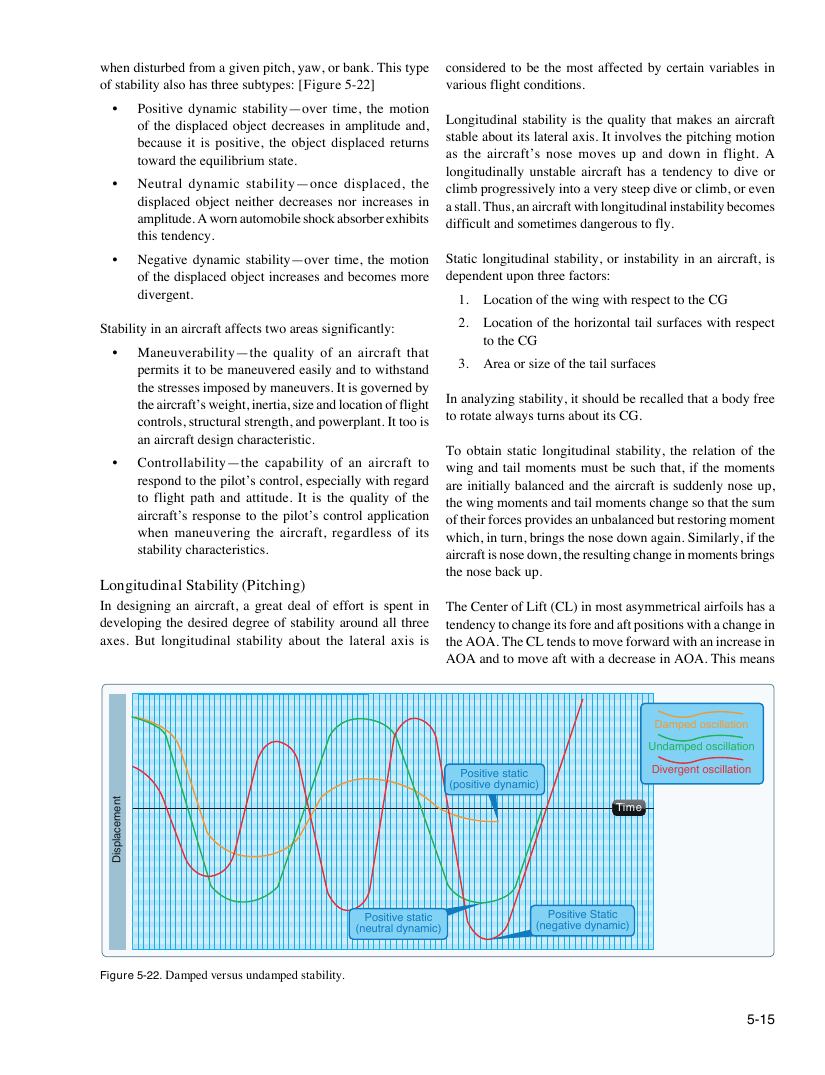
when disturbed from a given pitch, yaw, or bank. This type considered to be the most affected by certain variables in
of stability also has three subtypes: [Figure 5-22] various flight conditions.
• Positive dynamic stability—over time, the motion
Longitudinal stability is the quality that makes an aircraft
of the displaced object decreases in amplitude and,
stable about its lateral axis. It involves the pitching motion
because it is positive, the object displaced returns
as the aircraft’s nose moves up and down in flight. A
toward the equilibrium state.
longitudinally unstable aircraft has a tendency to dive or
• Neutral dynamic stability—once displaced, the
climb progressively into a very steep dive or climb, or even
displaced object neither decreases nor increases in
a stall. Thus, an aircraft with longitudinal instability becomes
amplitude. A worn automobile shock absorber exhibits
difficult and sometimes dangerous to fly.
this tendency.
• Negative dynamic stability—over time, the motion Static longitudinal stability, or instability in an aircraft, is
of the displaced object increases and becomes more dependent upon three factors:
divergent.
1. Location of the wing with respect to the CG
2. Location of the horizontal tail surfaces with respect
Stability in an aircraft affects two areas significantly:
to the CG
• Maneuverability—the quality of an aircraft that
3. Area or size of the tail surfaces
permits it to be maneuvered easily and to withstand
the stresses imposed by maneuvers. It is governed by
In analyzing stability, it should be recalled that a body free
the aircraft’s weight, inertia, size and location of flight
to rotate always turns about its CG.
controls, structural strength, and powerplant. It too is
an aircraft design characteristic.
To obtain static longitudinal stability, the relation of the
• Controllability—the capability of an aircraft to
wing and tail moments must be such that, if the moments
respond to the pilot’s control, especially with regard
are initially balanced and the aircraft is suddenly nose up,
to flight path and attitude. It is the quality of the
the wing moments and tail moments change so that the sum
aircraft’s response to the pilot’s control application
of their forces provides an unbalanced but restoring moment
when maneuvering the aircraft, regardless of its
which, in turn, brings the nose down again. Similarly, if the
stability characteristics.
aircraft is nose down, the resulting change in moments brings
the nose back up.
Longitudinal Stability (Pitching)
In designing an aircraft, a great deal of effort is spent in The Center of Lift (CL) in most asymmetrical airfoils has a
developing the desired degree of stability around all three tendency to change its fore and aft positions with a change in
axes. But longitudinal stability about the lateral axis is the AOA. The CL tends to move forward with an increase in
AOA and to move aft with a decrease in AOA. This means
Damped oscillation
Undamped oscillation
Positive static Divergent oscillation
(positive dynamic)
Time
Positive static Positive Static
(neutral dynamic) (negative dynamic)
Figure 5-22. Damped versus undamped stability.