FAA-H-8083-25C · Source PDF page 111
Aerodynamics of Flight
Static Stability · PHAK page 5-14
Searchable transcription
Positive Static Stability Neutral Static Stability Negative Static Stability
5-14
GC GC
GC
GC
tail. As forces such as turbulence and gusts act to displace maneuverability of the aircraft. If the aircraft is to provide
the aircraft, the pilot reacts by providing opposing control maximum utility, it must be safely controllable to the full
forces to counteract this displacement. extent of these limits without exceeding the pilot’s strength
or requiring exceptional flying ability. If an aircraft is to fly
Some aircraft are subject to changes in the location of the CG straight and steady along any arbitrary flight path, the forces
with variations of load. Trimming devices, such as elevator acting on it must be in static equilibrium. The reaction of
trim tabs and adjustable horizontal stabilizers, are used to any body when its equilibrium is disturbed is referred to as
counteract the moments set up by fuel burnoff and loading stability. The two types of stability are static and dynamic.
or off-loading of passengers or cargo.
Static Stability
Aircraft Design Characteristics
Static stability refers to the initial tendency, or direction of
Each aircraft handles somewhat differently because each movement, back to equilibrium. In aviation, it refers to the
resists or responds to control pressures in its own way. For aircraft’s initial response when disturbed from a given pitch,
example, a training aircraft is quick to respond to control yaw, or bank.
applications, while a transport aircraft feels heavy on the
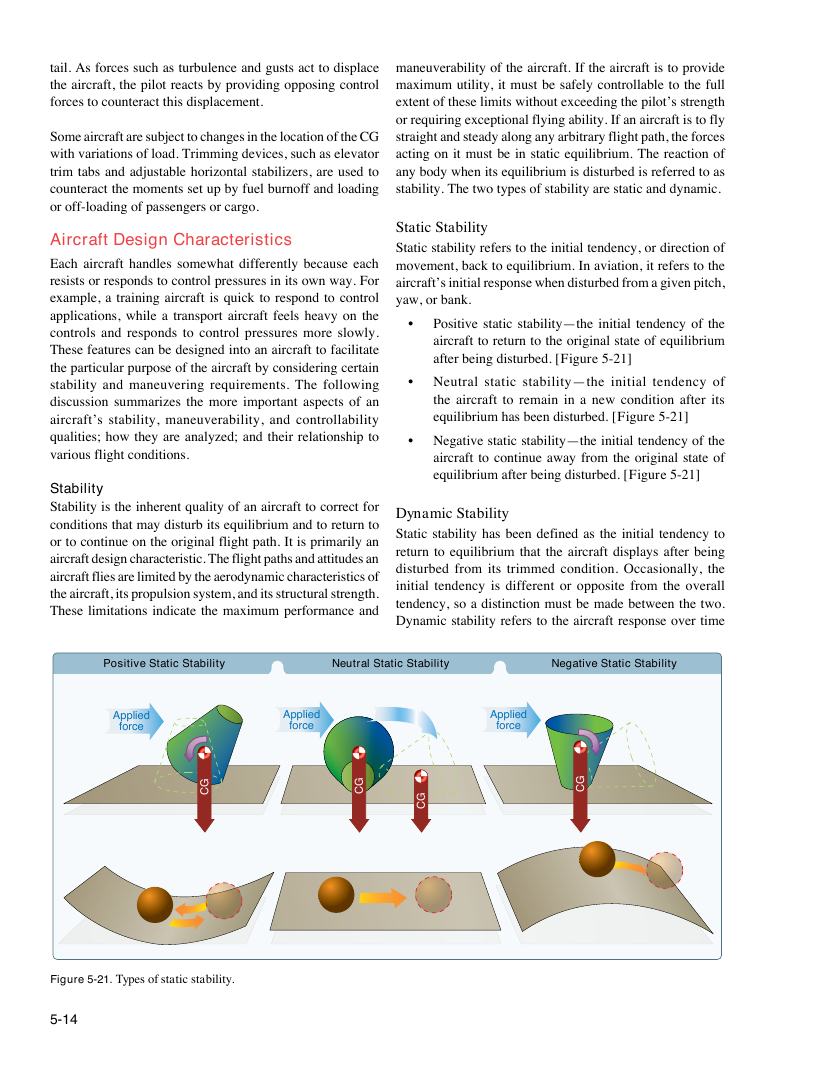
• Positive static stability—the initial tendency of the
controls and responds to control pressures more slowly.
aircraft to return to the original state of equilibrium
These features can be designed into an aircraft to facilitate
after being disturbed. [Figure 5-21]
the particular purpose of the aircraft by considering certain
stability and maneuvering requirements. The following • Neutral static stability—the initial tendency of
discussion summarizes the more important aspects of an the aircraft to remain in a new condition after its
aircraft’s stability, maneuverability, and controllability equilibrium has been disturbed. [Figure 5-21]
qualities; how they are analyzed; and their relationship to • Negative static stability—the initial tendency of the
various flight conditions. aircraft to continue away from the original state of
equilibrium after being disturbed. [Figure 5-21]
Stability
Stability is the inherent quality of an aircraft to correct for
Dynamic Stability
conditions that may disturb its equilibrium and to return to
Static stability has been defined as the initial tendency to
or to continue on the original flight path. It is primarily an
return to equilibrium that the aircraft displays after being
aircraft design characteristic. The flight paths and attitudes an
disturbed from its trimmed condition. Occasionally, the
aircraft flies are limited by the aerodynamic characteristics of
initial tendency is different or opposite from the overall
the aircraft, its propulsion system, and its structural strength.
tendency, so a distinction must be made between the two.
These limitations indicate the maximum performance and
Dynamic stability refers to the aircraft response over time
Applied Applied Applied
force force force
Figure 5-21. Types of static stability.