FAA-H-8083-25C · Source PDF page 152
Flight Controls
Ailerons · PHAK page 6-4
Searchable transcription
effectively maneuver the aircraft. As a result, the increase
i
y
n
a w
ai l
i
e
s
r o
es
n
p
d
e
e
c
f
i
l
a
e
l
c
ly
ti o
e
n
v i
c
d
a
e
u
n
s
t
e
i
s
n
a
a
n
i r
i
c
n
r
c
a
r
f
e
t
a
w
se
it h
in
l
a
o
d
n
v
g
e
w
rs
i
e
n g
y a
s
w
pa
.
n
T
s
h
.
e Aileron deflected
u p
Application of the rudder is used to counteract adverse
yaw. The amount of rudder control required is greatest at
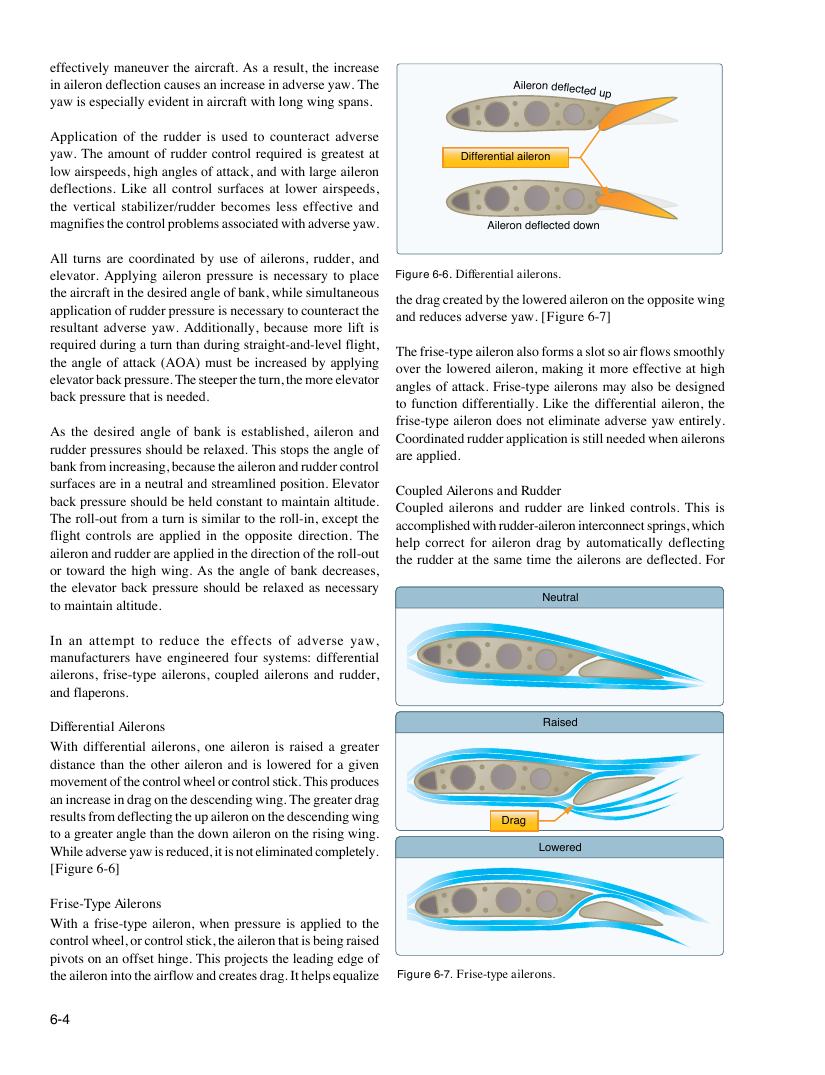
Differential aileron
low airspeeds, high angles of attack, and with large aileron
deflections. Like all control surfaces at lower airspeeds,
the vertical stabilizer/rudder becomes less effective and
magnifies the control problems associated with adverse yaw. Aileron deflected down
All turns are coordinated by use of ailerons, rudder, and
elevator. Applying aileron pressure is necessary to place Figure 6-6. Differential ailerons.
the aircraft in the desired angle of bank, while simultaneous
the drag created by the lowered aileron on the opposite wing
application of rudder pressure is necessary to counteract the
and reduces adverse yaw. [Figure 6-7]
resultant adverse yaw. Additionally, because more lift is
required during a turn than during straight-and-level flight,
The frise-type aileron also forms a slot so air flows smoothly
the angle of attack (AOA) must be increased by applying
over the lowered aileron, making it more effective at high
elevator back pressure. The steeper the turn, the more elevator
angles of attack. Frise-type ailerons may also be designed
back pressure that is needed.
to function differentially. Like the differential aileron, the
frise-type aileron does not eliminate adverse yaw entirely.
As the desired angle of bank is established, aileron and
Coordinated rudder application is still needed when ailerons
rudder pressures should be relaxed. This stops the angle of
are applied.
bank from increasing, because the aileron and rudder control
surfaces are in a neutral and streamlined position. Elevator
Coupled Ailerons and Rudder
back pressure should be held constant to maintain altitude.
Coupled ailerons and rudder are linked controls. This is
The roll-out from a turn is similar to the roll-in, except the
accomplished with rudder-aileron interconnect springs, which
flight controls are applied in the opposite direction. The
help correct for aileron drag by automatically deflecting
aileron and rudder are applied in the direction of the roll-out
the rudder at the same time the ailerons are deflected. For
or toward the high wing. As the angle of bank decreases,
the elevator back pressure should be relaxed as necessary
Neutral
to maintain altitude.
In an attempt to reduce the effects of adverse yaw,
manufacturers have engineered four systems: differential
ailerons, frise-type ailerons, coupled ailerons and rudder,
and flaperons.
Differential Ailerons Raised
With differential ailerons, one aileron is raised a greater
distance than the other aileron and is lowered for a given
movement of the control wheel or control stick. This produces
an increase in drag on the descending wing. The greater drag
results from deflecting the up aileron on the descending wing
Drag
to a greater angle than the down aileron on the rising wing.
While adverse yaw is reduced, it is not eliminated completely. Lowered
[Figure 6-6]
Frise-Type Ailerons
With a frise-type aileron, when pressure is applied to the
control wheel, or control stick, the aileron that is being raised
pivots on an offset hinge. This projects the leading edge of
the aileron into the airflow and creates drag. It helps equalize Figure 6-7. FrisFei-gtyupree a5i-l4er. o Fnrsis.e-type ailerons.
6-4