FAA-H-8083-25C · Source PDF page 156
Flight Controls
Rudder · PHAK page 6-8
Searchable transcription
Rudder
The rudder controls movement of the aircraft about its vertical
axis. This motion is called yaw. Like the other primary control
surfaces, the rudder is a movable surface hinged to a fixed
surface in this case, to the vertical stabilizer or fin. The rudder
is controlled by the left and right rudder pedals.
When the rudder is deflected into the airflow, a horizontal
force is exerted in the opposite direction. [Figure 6-15] By
pushing the left pedal, the rudder moves left. This alters the
airflow around the vertical stabilizer/rudder and creates a
sideward lift that moves the tail to the right and yaws the nose
of the airplane to the left. Rudder effectiveness increases with
speed; therefore, large deflections at low speeds and small
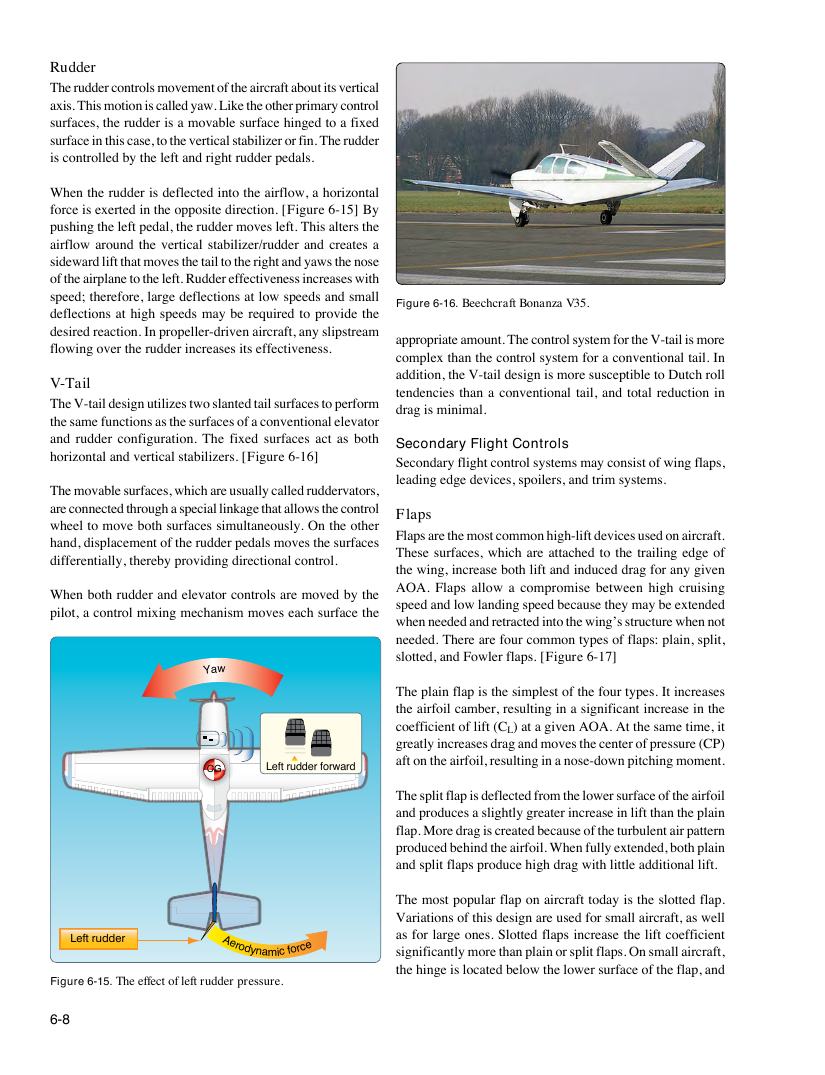
Figure 6-16. Beechcraft Bonanza V35.
deflections at high speeds may be required to provide the
desired reaction. In propeller-driven aircraft, any slipstream
appropriate amount. The control system for the V-tail is more
flowing over the rudder increases its effectiveness.
complex than the control system for a conventional tail. In
addition, the V-tail design is more susceptible to Dutch roll
V-Tail
tendencies than a conventional tail, and total reduction in
The V-tail design utilizes two slanted tail surfaces to perform
drag is minimal.
the same functions as the surfaces of a conventional elevator
and rudder configuration. The fixed surfaces act as both
Secondary Flight Controls
horizontal and vertical stabilizers. [Figure 6-16]
Secondary flight control systems may consist of wing flaps,
leading edge devices, spoilers, and trim systems.
The movable surfaces, which are usually called ruddervators,
are connected through a special linkage that allows the control
Flaps
wheel to move both surfaces simultaneously. On the other
Flaps are the most common high-lift devices used on aircraft.
hand, displacement of the rudder pedals moves the surfaces
These surfaces, which are attached to the trailing edge of
differentially, thereby providing directional control.
the wing, increase both lift and induced drag for any given
AOA. Flaps allow a compromise between high cruising
When both rudder and elevator controls are moved by the
speed and low landing speed because they may be extended
pilot, a control mixing mechanism moves each surface the
when needed and retracted into the wing’s structure when not
needed. There are four common types of flaps: plain, split,
slotted, and Fowler flaps. [Figure 6-17]
Yaw
The plain flap is the simplest of the four types. It increases
the airfoil camber, resulting in a significant increase in the
coefficient of lift (C ) at a given AOA. At the same time, it
L
greatly increases drag and moves the center of pressure (CP)
aft on the airfoil, resulting in a nose-down pitching moment.
CG Left rudder forward
The split flap is deflected from the lower surface of the airfoil
and produces a slightly greater increase in lift than the plain
flap. More drag is created because of the turbulent air pattern
produced behind the airfoil. When fully extended, both plain
and split flaps produce high drag with little additional lift.
The most popular flap on aircraft today is the slotted flap.
Variations of this design are used for small aircraft, as well
Left rudder Aerodynamic
fo
rce
a
si
s
g
f
n
o
if
r
i c
la
a
r
n
g
t
e
ly
o
m
n
o
es
re
. S
th
l
a
o
n
tt e
p
d
la
f
in
la
o
p
r
s
s
i
p
n
l
c
it
r e
fl
a
a
s
p
e
s .
t h
O
e
n
l
s
if
m
t
a
c
l
o
l
e
a
f
i
f
r
i
c
c
r
i
a
e
f
n
t
t
,
the hinge is located below the lower surface of the flap, and
Figure 6-15. The effect of left rudder pressure.
6-8