FAA-H-8083-25C · Source PDF page 154
Flight Controls
T-Tail · PHAK page 6-6
Searchable transcription
example, the horizontal tail surfaces may be attached near similar recovery problems are also found with conventional
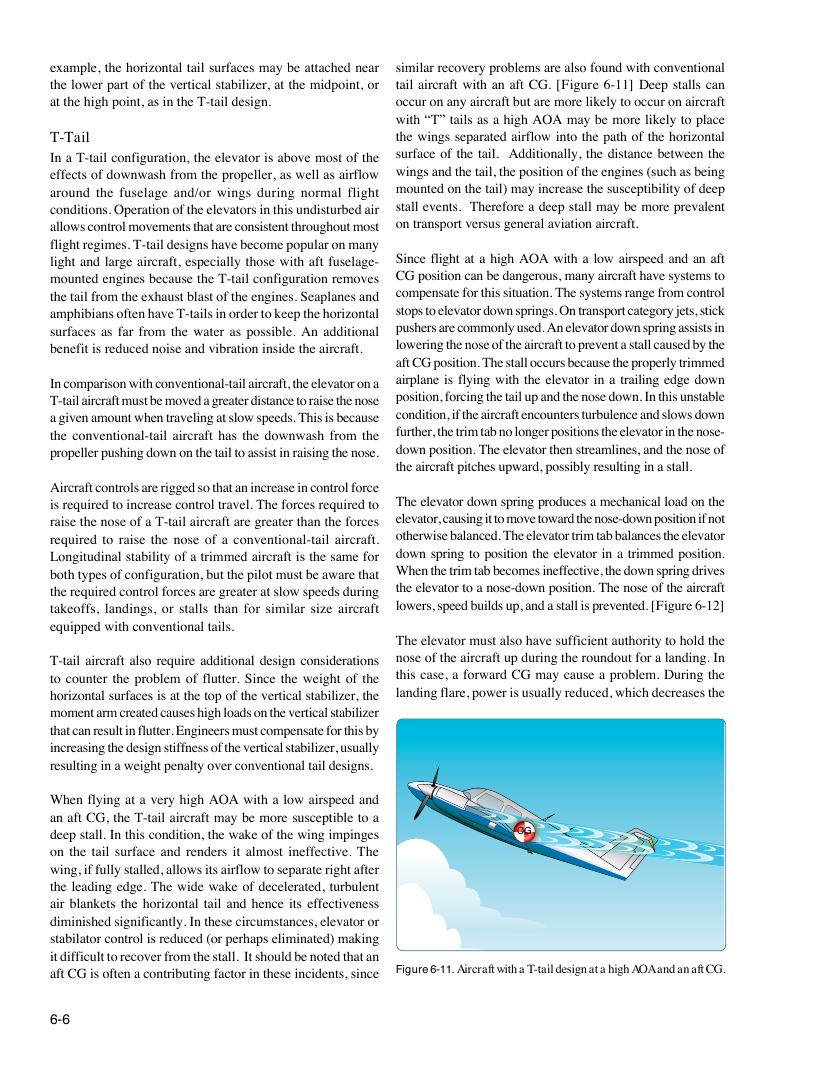
the lower part of the vertical stabilizer, at the midpoint, or tail aircraft with an aft CG. [Figure 6-11] Deep stalls can
at the high point, as in the T-tail design. occur on any aircraft but are more likely to occur on aircraft
with “T” tails as a high AOA may be more likely to place
T-Tail the wings separated airflow into the path of the horizontal
In a T-tail configuration, the elevator is above most of the surface of the tail. Additionally, the distance between the
effects of downwash from the propeller, as well as airflow wings and the tail, the position of the engines (such as being
around the fuselage and/or wings during normal flight mounted on the tail) may increase the susceptibility of deep
conditions. Operation of the elevators in this undisturbed air stall events. Therefore a deep stall may be more prevalent
allows control movements that are consistent throughout most on transport versus general aviation aircraft.
flight regimes. T-tail designs have become popular on many
light and large aircraft, especially those with aft fuselage- Since flight at a high AOA with a low airspeed and an aft
mounted engines because the T-tail configuration removes CG position can be dangerous, many aircraft have systems to
the tail from the exhaust blast of the engines. Seaplanes and compensate for this situation. The systems range from control
amphibians often have T-tails in order to keep the horizontal stops to elevator down springs. On transport category jets, stick
surfaces as far from the water as possible. An additional pushers are commonly used. An elevator down spring assists in
benefit is reduced noise and vibration inside the aircraft. lowering the nose of the aircraft to prevent a stall caused by the
aft CG position. The stall occurs because the properly trimmed
In comparison with conventional-tail aircraft, the elevator on a airplane is flying with the elevator in a trailing edge down
T-tail aircraft must be moved a greater distance to raise the nose position, forcing the tail up and the nose down. In this unstable
a given amount when traveling at slow speeds. This is because condition, if the aircraft encounters turbulence and slows down
the conventional-tail aircraft has the downwash from the further, the trim tab no longer positions the elevator in the nose-
propeller pushing down on the tail to assist in raising the nose. down position. The elevator then streamlines, and the nose of
the aircraft pitches upward, possibly resulting in a stall.
Aircraft controls are rigged so that an increase in control force
is required to increase control travel. The forces required to The elevator down spring produces a mechanical load on the
raise the nose of a T-tail aircraft are greater than the forces elevator, causing it to move toward the nose-down position if not
required to raise the nose of a conventional-tail aircraft. otherwise balanced. The elevator trim tab balances the elevator
Longitudinal stability of a trimmed aircraft is the same for down spring to position the elevator in a trimmed position.
both types of configuration, but the pilot must be aware that When the trim tab becomes ineffective, the down spring drives
the required control forces are greater at slow speeds during the elevator to a nose-down position. The nose of the aircraft
takeoffs, landings, or stalls than for similar size aircraft lowers, speed builds up, and a stall is prevented. [Figure 6-12]
equipped with conventional tails.
The elevator must also have sufficient authority to hold the
T-tail aircraft also require additional design considerations nose of the aircraft up during the roundout for a landing. In
to counter the problem of flutter. Since the weight of the this case, a forward CG may cause a problem. During the
horizontal surfaces is at the top of the vertical stabilizer, the landing flare, power is usually reduced, which decreases the
moment arm created causes high loads on the vertical stabilizer
that can result in flutter. Engineers must compensate for this by
increasing the design stiffness of the vertical stabilizer, usually
resulting in a weight penalty over conventional tail designs.
When flying at a very high AOA with a low airspeed and
an aft CG, the T-tail aircraft may be more susceptible to a
deep stall. In this condition, the wake of the wing impinges CG
on the tail surface and renders it almost ineffective. The
wing, if fully stalled, allows its airflow to separate right after
the leading edge. The wide wake of decelerated, turbulent
air blankets the horizontal tail and hence its effectiveness
diminished significantly. In these circumstances, elevator or
stabilator control is reduced (or perhaps eliminated) making
it difficult to recover from the stall. It should be noted that an
aft CG is often a contributing factor in these incidents, since Figure 6-11. Aircraft with a T-tail design at a high AOA and an aft CG.
6-6