FAA-H-8083-25C · Source PDF page 194
Aircraft Systems
Pressurized Aircraft · PHAK page 7-34
Searchable transcription
allows adequate ground clearance for a larger propeller maintenance. Retractable landing gear is designed to
and is more desirable for operations on unimproved fields. streamline the airplane by allowing the landing gear to
[Figure 7-38] be stowed inside the structure during cruising flight.
[Figure 7-39]
With the CG located behind the main landing gear, directional
control using this type of landing gear is more difficult while Brakes
on the ground. This is the main disadvantage of the tailwheel Airplane brakes are located on the main wheels and are
landing gear. For example, if the pilot allows the aircraft to applied by either a hand control or by foot pedals (toe or heel).
swerve while rolling on the ground at a low speed, he or Foot pedals operate independently and allow for differential
she may not have sufficient rudder control and the CG will braking. During ground operations, differential braking can
attempt to get ahead of the main gear, which may cause the supplement nosewheel/tailwheel steering.
airplane to ground loop.
Pressurized Aircraft
Diminished forward visibility when the tailwheel is on or near
Aircraft are flown at high altitudes for two reasons. First, an
the ground is a second disadvantage of tailwheel landing gear
aircraft flown at high altitude consumes less fuel for a given
airplanes. Because of these disadvantages, specific training
airspeed than it does for the same speed at a lower altitude
is required to operate tailwheel airplanes.
because the aircraft is more efficient at a high altitude.
Second, bad weather and turbulence may be avoided by flying
Fixed and Retractable Landing Gear
in relatively smooth air above the storms. Many modern
Landing gear can also be classified as either fixed or aircraft are being designed to operate at high altitudes,
retractable. Fixed landing gear always remains extended taking advantage of that environment. In order to fly at
and has the advantage of simplicity combined with low higher altitudes, the aircraft must be pressurized or suitable
supplemental oxygen must be provided for each occupant.
It is important for pilots who fly these aircraft to be familiar
with the basic operating principles.
In a typical pressurization system, the cabin, flight
compartment, and baggage compartments are incorporated
into a sealed unit capable of containing air under a pressure
higher than outside atmospheric pressure. On aircraft powered
by turbine engines, bleed air from the engine compressor
section is used to pressurize the cabin. Superchargers may
be used on older model turbine-powered aircraft to pump
air into the sealed fuselage. Piston-powered aircraft may use
air supplied from each engine turbocharger through a sonic
venturi (flow limiter). Air is released from the fuselage by
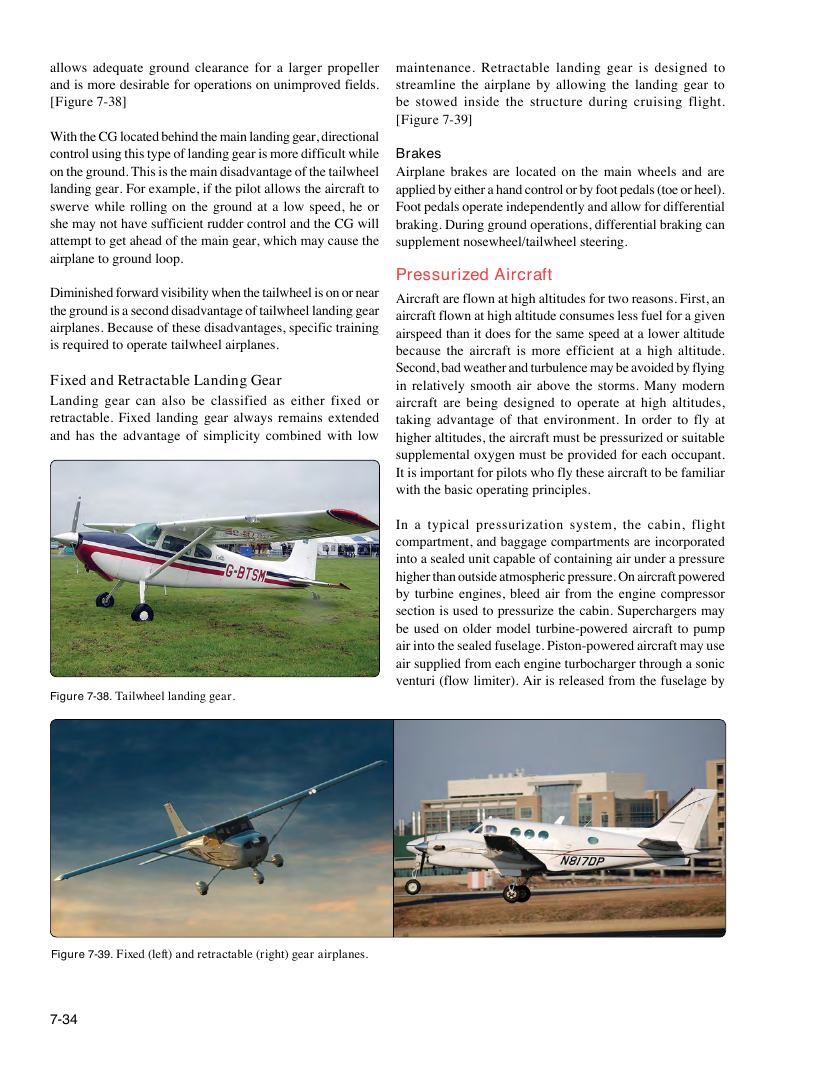
Figure 7-38. Tailwheel landing gear.
Figure 7-39. Fixed (left) and retractable (right) gear airplanes.
7-34