FAA-H-8083-25C · Source PDF page 180
Aircraft Systems
Turbine Engines · PHAK page 7-20
Searchable transcription
Detonation and preignition often occur simultaneously and Turbine Engines
one may cause the other. Since either condition causes high
An aircraft turbine engine consists of an air inlet, compressor,
engine temperature accompanied by a decrease in engine
combustion chambers, a turbine section, and exhaust. Thrust
performance, it is often difficult to distinguish between the
is produced by increasing the velocity of the air flowing
two. Using the recommended grade of fuel and operating
through the engine. Turbine engines are highly desirable
the engine within its proper temperature, pressure, and rpm
aircraft powerplants. They are characterized by smooth
ranges reduce the chance of detonation or preignition.
operation and a high power-to-weight ratio, and they
use readily available jet fuel. Prior to recent advances in
Full Authority Digital Engine Control
material, engine design, and manufacturing processes, the
(FADEC)
use of turbine engines in small/light production aircraft was
FADEC is a system consisting of a digital computer and cost prohibitive. Today, several aviation manufacturers are
ancillary components that control an aircraft’s engine producing or plan to produce small/light turbine-powered
and propeller. First used in turbine-powered aircraft, and aircraft. These smaller turbine-powered aircraft typically
referred to as full authority digital electronic control, these seat between three and seven passengers and are referred to
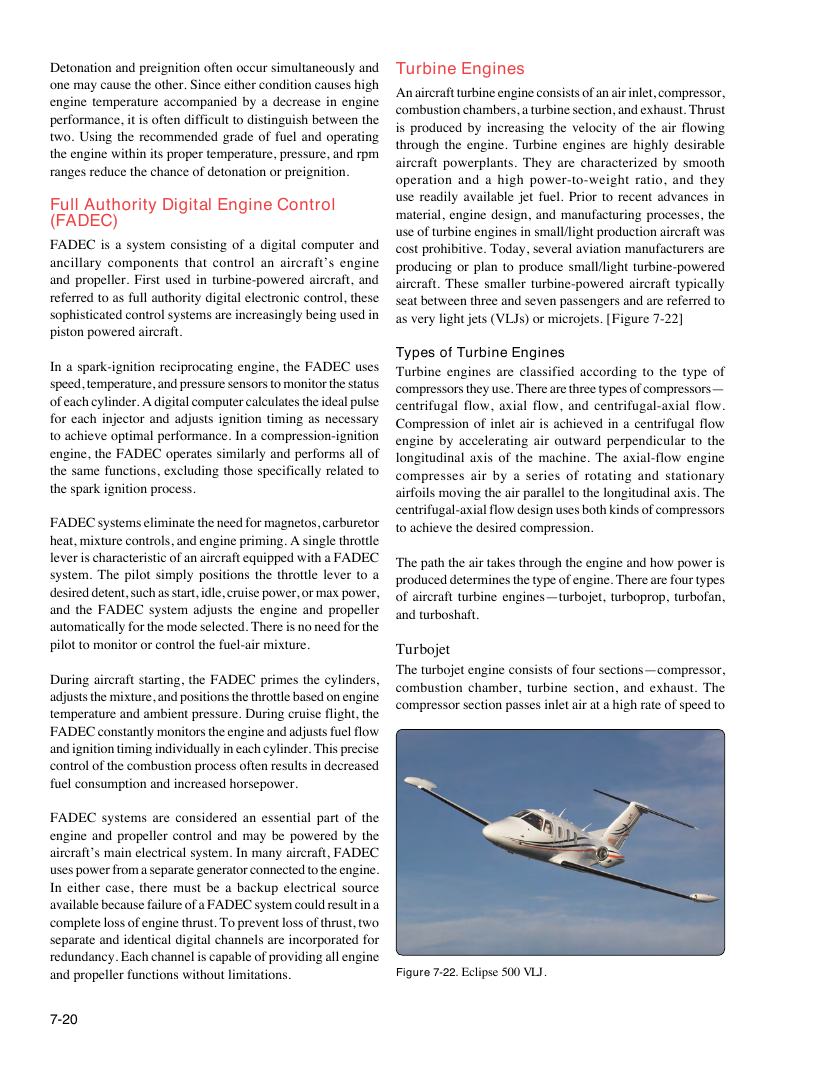
sophisticated control systems are increasingly being used in as very light jets (VLJs) or microjets. [Figure 7-22]
piston powered aircraft.
Types of Turbine Engines
In a spark-ignition reciprocating engine, the FADEC uses
Turbine engines are classified according to the type of
speed, temperature, and pressure sensors to monitor the status
compressors they use. There are three types of compressors—
of each cylinder. A digital computer calculates the ideal pulse
centrifugal flow, axial flow, and centrifugal-axial flow.
for each injector and adjusts ignition timing as necessary
Compression of inlet air is achieved in a centrifugal flow
to achieve optimal performance. In a compression-ignition
engine by accelerating air outward perpendicular to the
engine, the FADEC operates similarly and performs all of
longitudinal axis of the machine. The axial-flow engine
the same functions, excluding those specifically related to
compresses air by a series of rotating and stationary
the spark ignition process.
airfoils moving the air parallel to the longitudinal axis. The
centrifugal-axial flow design uses both kinds of compressors
FADEC systems eliminate the need for magnetos, carburetor
to achieve the desired compression.
heat, mixture controls, and engine priming. A single throttle
lever is characteristic of an aircraft equipped with a FADEC
The path the air takes through the engine and how power is
system. The pilot simply positions the throttle lever to a
produced determines the type of engine. There are four types
desired detent, such as start, idle, cruise power, or max power,
of aircraft turbine engines—turbojet, turboprop, turbofan,
and the FADEC system adjusts the engine and propeller
and turboshaft.
automatically for the mode selected. There is no need for the
pilot to monitor or control the fuel-air mixture.
Turbojet
The turbojet engine consists of four sections—compressor,
During aircraft starting, the FADEC primes the cylinders,
combustion chamber, turbine section, and exhaust. The
adjusts the mixture, and positions the throttle based on engine
compressor section passes inlet air at a high rate of speed to
temperature and ambient pressure. During cruise flight, the
FADEC constantly monitors the engine and adjusts fuel flow
and ignition timing individually in each cylinder. This precise
control of the combustion process often results in decreased
fuel consumption and increased horsepower.
FADEC systems are considered an essential part of the
engine and propeller control and may be powered by the
aircraft’s main electrical system. In many aircraft, FADEC
uses power from a separate generator connected to the engine.
In either case, there must be a backup electrical source
available because failure of a FADEC system could result in a
complete loss of engine thrust. To prevent loss of thrust, two
separate and identical digital channels are incorporated for
redundancy. Each channel is capable of providing all engine
and propeller functions without limitations. Figure 7-22. Eclipse 500 VLJ.
7-20