FAA-H-8083-25C · Source PDF page 213
Flight Instruments
Blocked Static System · PHAK page 8-11
Searchable transcription
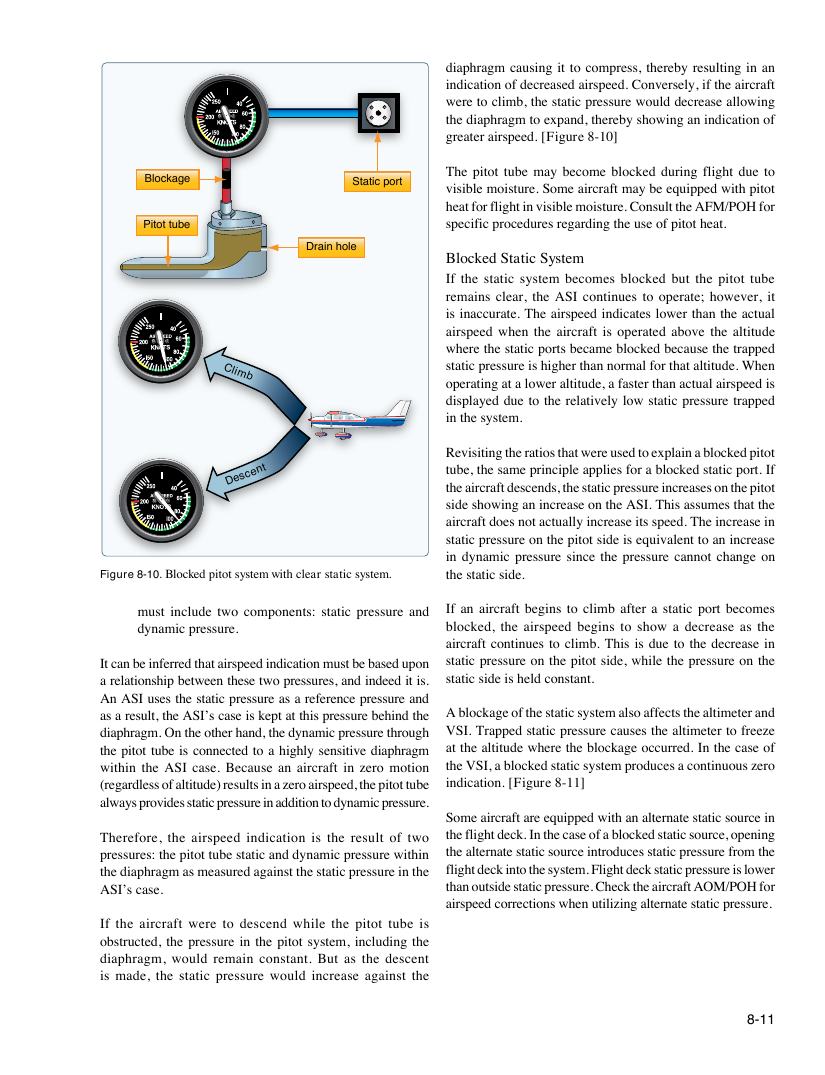
diaphragm causing it to compress, thereby resulting in an
indication of decreased airspeed. Conversely, if the aircraft
were to climb, the static pressure would decrease allowing
the diaphragm to expand, thereby showing an indication of
greater airspeed. [Figure 8-10]
The pitot tube may become blocked during flight due to
Blockage Static port
visible moisture. Some aircraft may be equipped with pitot
heat for flight in visible moisture. Consult the AFM/POH for
Pitot tube specific procedures regarding the use of pitot heat.
Drain hole
Blocked Static System
If the static system becomes blocked but the pitot tube
remains clear, the ASI continues to operate; however, it
is inaccurate. The airspeed indicates lower than the actual
airspeed when the aircraft is operated above the altitude
where the static ports became blocked because the trapped
Climb static pressure is higher than normal for that altitude. When
operating at a lower altitude, a faster than actual airspeed is
displayed due to the relatively low static pressure trapped
in the system.
Revisiting the ratios that were used to explain a blocked pitot
Descent tube, the same principle applies for a blocked static port. If
the aircraft descends, the static pressure increases on the pitot
side showing an increase on the ASI. This assumes that the
aircraft does not actually increase its speed. The increase in
static pressure on the pitot side is equivalent to an increase
in dynamic pressure since the pressure cannot change on
Figure 8-10. Blocked pitot system with clear static system. the static side.
must include two components: static pressure and If an aircraft begins to climb after a static port becomes
dynamic pressure. blocked, the airspeed begins to show a decrease as the
aircraft continues to climb. This is due to the decrease in
It can be inferred that airspeed indication must be based upon static pressure on the pitot side, while the pressure on the
a relationship between these two pressures, and indeed it is. static side is held constant.
An ASI uses the static pressure as a reference pressure and
as a result, the ASI’s case is kept at this pressure behind the A blockage of the static system also affects the altimeter and
diaphragm. On the other hand, the dynamic pressure through VSI. Trapped static pressure causes the altimeter to freeze
the pitot tube is connected to a highly sensitive diaphragm at the altitude where the blockage occurred. In the case of
within the ASI case. Because an aircraft in zero motion the VSI, a blocked static system produces a continuous zero
(regardless of altitude) results in a zero airspeed, the pitot tube indication. [Figure 8-11]
always provides static pressure in addition to dynamic pressure.
Some aircraft are equipped with an alternate static source in
Therefore, the airspeed indication is the result of two the flight deck. In the case of a blocked static source, opening
pressures: the pitot tube static and dynamic pressure within the alternate static source introduces static pressure from the
the diaphragm as measured against the static pressure in the flight deck into the system. Flight deck static pressure is lower
ASI’s case. than outside static pressure. Check the aircraft AOM/POH for
airspeed corrections when utilizing alternate static pressure.
If the aircraft were to descend while the pitot tube is
obstructed, the pressure in the pitot system, including the
diaphragm, would remain constant. But as the descent
is made, the static pressure would increase against the
8-11