FAA-H-8083-25C · Source PDF page 212
Flight Instruments
Instrument Check · PHAK page 8-10
Searchable transcription
• Design maneuvering speed (V )—the maximum already in the system vents through the drain hole, and the
A
speed at which the structural design’s limit load can remaining pressure drops to ambient (outside) air pressure.
be imposed (either by gusts or full deflection of the Under these circumstances, the ASI reading decreases to
control surfaces) without causing structural damage. zero because the ASI senses no difference between ram and
It is important to consider weight when referencing static air pressure. The ASI no longer operates since dynamic
this speed. For example, V may be 100 knots when pressure cannot enter the pitot tube opening. Static pressure
A
an airplane is heavily loaded, but only 90 knots when is able to equalize on both sides since the pitot drain hole
the load is light. is still open. The apparent loss of airspeed is not usually
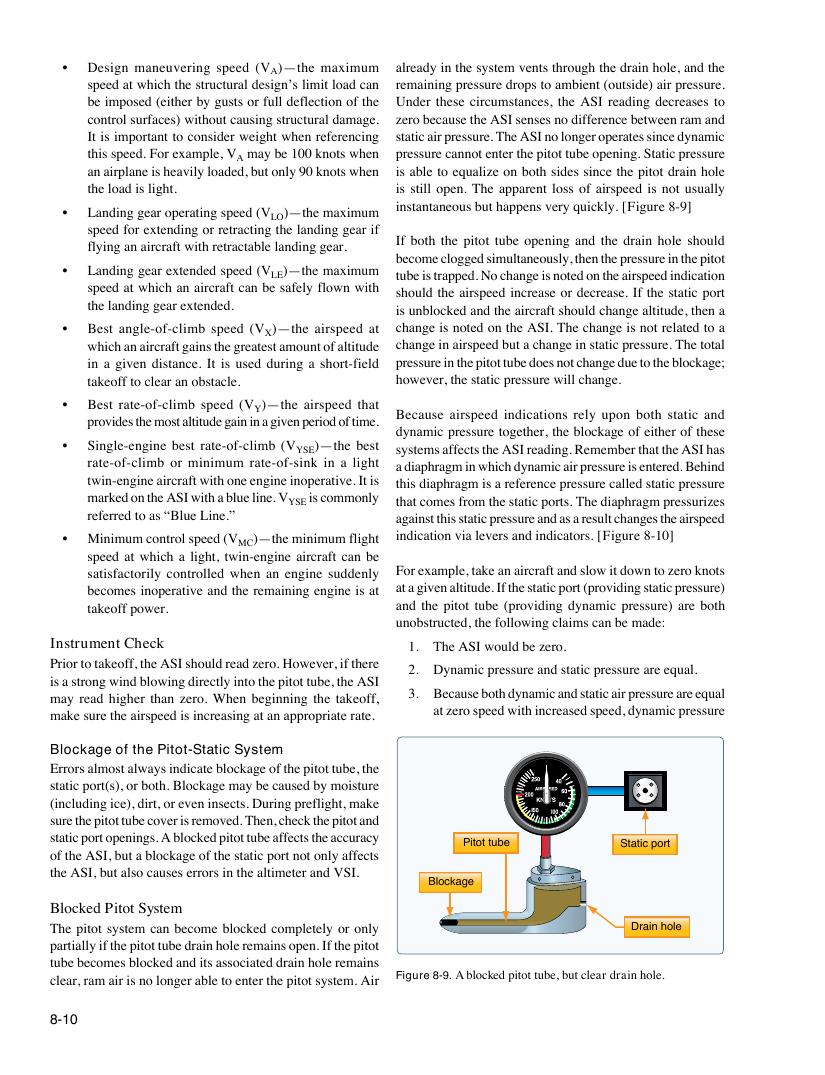
instantaneous but happens very quickly. [Figure 8-9]
• Landing gear operating speed (V )—the maximum
LO
speed for extending or retracting the landing gear if
If both the pitot tube opening and the drain hole should
flying an aircraft with retractable landing gear.
become clogged simultaneously, then the pressure in the pitot
• Landing gear extended speed (V )—the maximum
LE tube is trapped. No change is noted on the airspeed indication
speed at which an aircraft can be safely flown with
should the airspeed increase or decrease. If the static port
the landing gear extended.
is unblocked and the aircraft should change altitude, then a
• Best angle-of-climb speed (V )—the airspeed at change is noted on the ASI. The change is not related to a
X
which an aircraft gains the greatest amount of altitude change in airspeed but a change in static pressure. The total
in a given distance. It is used during a short-field pressure in the pitot tube does not change due to the blockage;
takeoff to clear an obstacle. however, the static pressure will change.
• Best rate-of-climb speed (V )—the airspeed that
Y Because airspeed indications rely upon both static and
provides the most altitude gain in a given period of time.
dynamic pressure together, the blockage of either of these
• Single-engine best rate-of-climb (V YSE )—the best systems affects the ASI reading. Remember that the ASI has
rate-of-climb or minimum rate-of-sink in a light a diaphragm in which dynamic air pressure is entered. Behind
twin-engine aircraft with one engine inoperative. It is this diaphragm is a reference pressure called static pressure
marked on the ASI with a blue line. V YSE is commonly that comes from the static ports. The diaphragm pressurizes
referred to as “Blue Line.” against this static pressure and as a result changes the airspeed
• Minimum control speed (V )—the minimum flight indication via levers and indicators. [Figure 8-10]
MC
speed at which a light, twin-engine aircraft can be
satisfactorily controlled when an engine suddenly For example, take an aircraft and slow it down to zero knots
becomes inoperative and the remaining engine is at at a given altitude. If the static port (providing static pressure)
takeoff power. and the pitot tube (providing dynamic pressure) are both
unobstructed, the following claims can be made:
Instrument Check 1. The ASI would be zero.
Prior to takeoff, the ASI should read zero. However, if there
2. Dynamic pressure and static pressure are equal.
is a strong wind blowing directly into the pitot tube, the ASI
3. Because both dynamic and static air pressure are equal
may read higher than zero. When beginning the takeoff,
at zero speed with increased speed, dynamic pressure
make sure the airspeed is increasing at an appropriate rate.
Blockage of the Pitot-Static System
Errors almost always indicate blockage of the pitot tube, the
static port(s), or both. Blockage may be caused by moisture
(including ice), dirt, or even insects. During preflight, make
sure the pitot tube cover is removed. Then, check the pitot and
static port openings. A blocked pitot tube affects the accuracy
Pitot tube Static port
of the ASI, but a blockage of the static port not only affects
the ASI, but also causes errors in the altimeter and VSI.
Blockage
Blocked Pitot System
The pitot system can become blocked completely or only Drain hole
partially if the pitot tube drain hole remains open. If the pitot
tube becomes blocked and its associated drain hole remains
clear, ram air is no longer able to enter the pitot system. Air Figure 8-9. A blocked pitot tube, but clear drain hole.
8-10