FAA-H-8083-25C · Source PDF page 227
Flight Instruments
Magnetic Compass Induced Errors · PHAK page 8-25
Searchable transcription
To swing the compass, an AMT positions the aircraft
on a series of known headings, usually at a compass
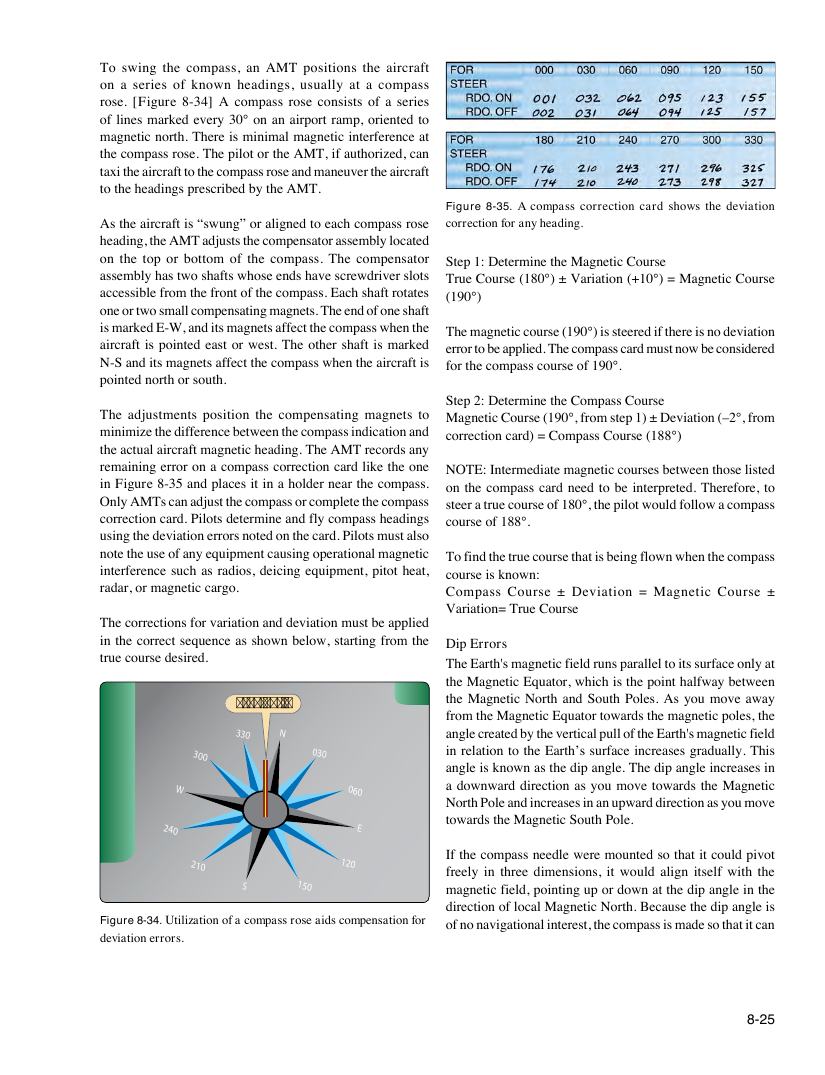
rose. [Figure 8-34] A compass rose consists of a series
of lines marked every 30° on an airport ramp, oriented to
magnetic north. There is minimal magnetic interference at
the compass rose. The pilot or the AMT, if authorized, can
taxi the aircraft to the compass rose and maneuver the aircraft
to the headings prescribed by the AMT.
Figure 8-35. A compass correction card shows the deviation
As the aircraft is “swung” or aligned to each compass rose correction for any heading.
heading, the AMT adjusts the compensator assembly located
on the top or bottom of the compass. The compensator Step 1: Determine the Magnetic Course
assembly has two shafts whose ends have screwdriver slots True Course (180°) ± Variation (+10°) = Magnetic Course
accessible from the front of the compass. Each shaft rotates (190°)
one or two small compensating magnets. The end of one shaft
is marked E-W, and its magnets affect the compass when the The magnetic course (190°) is steered if there is no deviation
aircraft is pointed east or west. The other shaft is marked error to be applied. The compass card must now be considered
N-S and its magnets affect the compass when the aircraft is for the compass course of 190°.
pointed north or south.
Step 2: Determine the Compass Course
The adjustments position the compensating magnets to Magnetic Course (190°, from step 1) ± Deviation (–2°, from
minimize the difference between the compass indication and correction card) = Compass Course (188°)
the actual aircraft magnetic heading. The AMT records any
remaining error on a compass correction card like the one NOTE: Intermediate magnetic courses between those listed
in Figure 8-35 and places it in a holder near the compass. on the compass card need to be interpreted. Therefore, to
Only AMTs can adjust the compass or complete the compass steer a true course of 180°, the pilot would follow a compass
correction card. Pilots determine and fly compass headings course of 188°.
using the deviation errors noted on the card. Pilots must also
note the use of any equipment causing operational magnetic To find the true course that is being flown when the compass
interference such as radios, deicing equipment, pitot heat, course is known:
radar, or magnetic cargo. Compass Course ± Deviation = Magnetic Course ±
Variation= True Course
The corrections for variation and deviation must be applied
in the correct sequence as shown below, starting from the Dip Errors
true course desired.
The Earth's magnetic field runs parallel to its surface only at
the Magnetic Equator, which is the point halfway between
the Magnetic North and South Poles. As you move away
True north
from the Magnetic Equator towards the magnetic poles, the
330 N angle created by the vertical pull of the Earth's magnetic field
300 030 in relation to the Earth’s surface increases gradually. This
angle is known as the dip angle. The dip angle increases in
a downward direction as you move towards the Magnetic
W 060
North Pole and increases in an upward direction as you move
towards the Magnetic South Pole.
240 E
If the compass needle were mounted so that it could pivot
210 120
freely in three dimensions, it would align itself with the
S 150 magnetic field, pointing up or down at the dip angle in the
direction of local Magnetic North. Because the dip angle is
Figure 8-34. Utilization of a compass rose aids compensation for of no navigational interest, the compass is made so that it can
deviation errors.
8-25