FAA-H-8083-25C · Source PDF page 228
Flight Instruments
Magnetic Compass Induced Errors · PHAK page 8-26
Searchable transcription
21
21 S 15 12 S 15 12
8-26
2 1
3 30
N 33
B
Left turn No error Right turn
DIP DIP DIP
2
1
S
15
CAR D Dip eff e
ct D
ip e ffe ct C A R D
3
rotate only in the horizontal plane. This is done by lowering Southerly Turning Errors
the center of gravity below the pivot point and making the When turning in a southerly direction, the forces are such that
assembly heavy enough that the vertical component of the the compass float assembly lags rather than leads. The result
magnetic force is too weak to tilt it significantly out of the is a false southerly turn indication. The compass card, or float
horizontal plane. The compass can then work effectively at assembly, should be allowed to pass the desired heading prior
all latitudes without specific compensation for dip. However, to stopping the turn. As with the northerly error, this error
close to the magnetic poles, the horizontal component of is amplified with the proximity to either magnetic pole. To
the Earth’s field is too small to align the compass which correct this lagging error, the aircraft should be allowed to
makes the compass unusable for navigation. Because of this pass the desired heading prior to stopping the turn. The same
constraint, the compass only indicates correctly if the card rule of 15 degrees plus half of the latitude applies here (i.e.,
is horizontal. Once tilted out of the horizontal plane, it will if the aircraft is being operated in a position near 30 degrees
be affected by the vertical component of the Earth’s field latitude, the turn should be stopped 15+15=30 degrees after
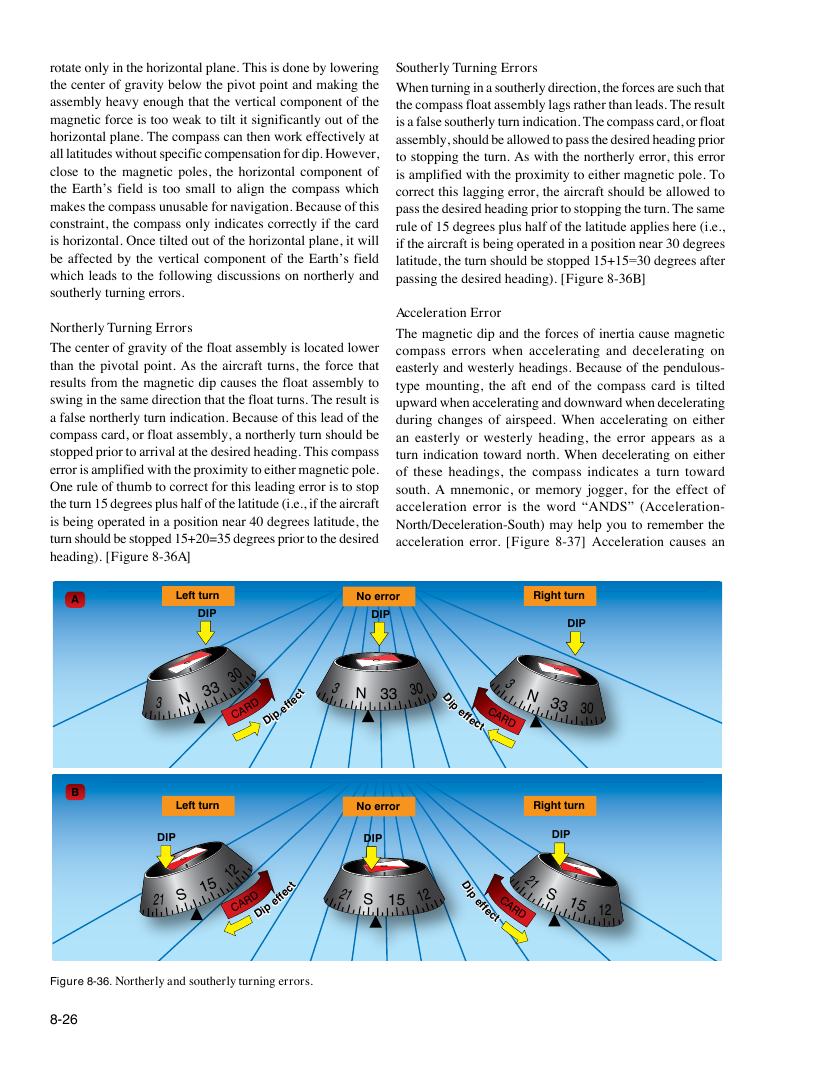
which leads to the following discussions on northerly and passing the desired heading). [Figure 8-36B]
southerly turning errors.
Acceleration Error
Northerly Turning Errors
The magnetic dip and the forces of inertia cause magnetic
The center of gravity of the float assembly is located lower compass errors when accelerating and decelerating on
than the pivotal point. As the aircraft turns, the force that easterly and westerly headings. Because of the pendulous-
results from the magnetic dip causes the float assembly to type mounting, the aft end of the compass card is tilted
swing in the same direction that the float turns. The result is upward when accelerating and downward when decelerating
a false northerly turn indication. Because of this lead of the during changes of airspeed. When accelerating on either
compass card, or float assembly, a northerly turn should be an easterly or westerly heading, the error appears as a
stopped prior to arrival at the desired heading. This compass turn indication toward north. When decelerating on either
error is amplified with the proximity to either magnetic pole. of these headings, the compass indicates a turn toward
One rule of thumb to correct for this leading error is to stop south. A mnemonic, or memory jogger, for the effect of
the turn 15 degrees plus half of the latitude (i.e., if the aircraft acceleration error is the word “ANDS” (Acceleration-
is being operated in a position near 40 degrees latitude, the North/Deceleration-South) may help you to remember the
turn should be stopped 15+20=35 degrees prior to the desired acceleration error. [Figure 8-37] Acceleration causes an
heading). [Figure 8-36A]
A Left turn No error Right turn
DIP DIP
DIP
30
N
33
CAR D DDiipp eeffff ee cctt DD iipp eeffffeecctt C AR
3
D
N 33 30
Dip eff e
ct D
ip e ffe ct
Figure 8-36. Northerly and southerly turning errors.