FAA-H-8083-25C · Source PDF page 205
Flight Instruments
Principle of Operation · PHAK page 8-3
Searchable transcription
deck. Due to the venturi effect of the air flowing around the
100 ft. pointer
fuselage, the air pressure inside the flight deck is lower than
the exterior pressure.
10,000 ft. pointer
When the alternate static source pressure is used, the
Aneroid wafers 1,000 ft. pointer
following instrument indications are observed:
1. The altimeter indicates a slightly higher altitude than
actual.
2. The ASI indicates an airspeed greater than the actual
airspeed.
3. The VSI shows a momentary climb and then stabilizes
if the altitude is held constant.
Each pilot is responsible for consulting the Aircraft Flight
Manual (AFM) or the Pilot’s Operating Handbook (POH) Crosshatch flag
Static port
to determine the amount of error that is introduced into the A crosshatched area appears on
some altimeters when displaying
system when utilizing the alternate static source. In an aircraft an altitude below 10,000 feet MSL.
not equipped with an alternate static source, an alternate
method of introducing static pressure into the system should Barometric scale adjustment knob
a blockage occur is to break the glass face of the VSI. This
Altimeter setting window
most likely renders the VSI inoperative. The reason for
choosing the VSI as the instrument to break is that it is the
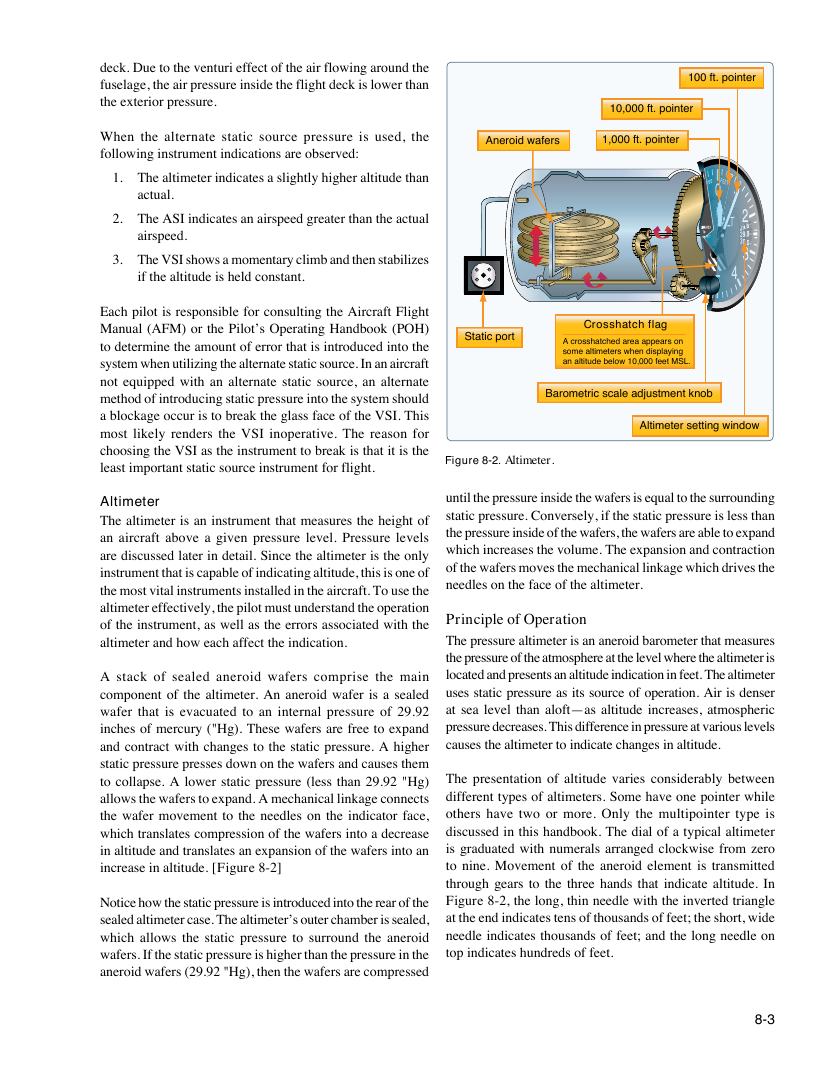
Figure 8-2. Altimeter.
least important static source instrument for flight.
until the pressure inside the wafers is equal to the surrounding
Altimeter
static pressure. Conversely, if the static pressure is less than
The altimeter is an instrument that measures the height of
the pressure inside of the wafers, the wafers are able to expand
an aircraft above a given pressure level. Pressure levels
which increases the volume. The expansion and contraction
are discussed later in detail. Since the altimeter is the only
of the wafers moves the mechanical linkage which drives the
instrument that is capable of indicating altitude, this is one of
needles on the face of the altimeter.
the most vital instruments installed in the aircraft. To use the
altimeter effectively, the pilot must understand the operation
Principle of Operation
of the instrument, as well as the errors associated with the
altimeter and how each affect the indication. The pressure altimeter is an aneroid barometer that measures
the pressure of the atmosphere at the level where the altimeter is
A stack of sealed aneroid wafers comprise the main located and presents an altitude indication in feet. The altimeter
component of the altimeter. An aneroid wafer is a sealed uses static pressure as its source of operation. Air is denser
wafer that is evacuated to an internal pressure of 29.92 at sea level than aloft—as altitude increases, atmospheric
inches of mercury ("Hg). These wafers are free to expand pressure decreases. This difference in pressure at various levels
and contract with changes to the static pressure. A higher causes the altimeter to indicate changes in altitude.
static pressure presses down on the wafers and causes them
to collapse. A lower static pressure (less than 29.92 "Hg) The presentation of altitude varies considerably between
allows the wafers to expand. A mechanical linkage connects different types of altimeters. Some have one pointer while
the wafer movement to the needles on the indicator face, others have two or more. Only the multipointer type is
which translates compression of the wafers into a decrease discussed in this handbook. The dial of a typical altimeter
in altitude and translates an expansion of the wafers into an is graduated with numerals arranged clockwise from zero
increase in altitude. [Figure 8-2] to nine. Movement of the aneroid element is transmitted
through gears to the three hands that indicate altitude. In
Notice how the static pressure is introduced into the rear of the Figure 8-2, the long, thin needle with the inverted triangle
sealed altimeter case. The altimeter’s outer chamber is sealed, at the end indicates tens of thousands of feet; the short, wide
which allows the static pressure to surround the aneroid needle indicates thousands of feet; and the long needle on
wafers. If the static pressure is higher than the pressure in the top indicates hundreds of feet.
aneroid wafers (29.92 "Hg), then the wafers are compressed
8-3