FAA-H-8083-25C · Source PDF page 358
Airport Operations
Air Traffic Control (ATC) Services · PHAK page 14-24
Searchable transcription
easily be aware of your presence when they are expecting
Character Morse Code Telephony Phonic Pronunciation
the standard radio calls.
AAa
BB Air Traffic Control (ATC) Services
b
C
C c Besides the services provided by an FSS as discussed in
DDd Chapter 12, “Aviation Weather Services,” numerous other
EEe services are provided by ATC. In many instances a pilot
is required to have contact with ATC, but even when not
FF
f
required, a pilot may find their services helpful.
GGg
hH h Primary Radar
II Radar is a device that provides information on range, azimuth,
i
JJj and/or elevation of objects in the path of the transmitted
pulses. It measures the time interval between transmission and
KKk
reception of radio pulses and correlates the angular orientation
LL
L of the radiated antenna beam or beams in azimuth and/or
MMm
elevation. Range is determined by measuring the time it takes
NNn for the radio wave to go out to the object and then return to the
OO receiving antenna. The direction of a detected object from a
o
radar site is determined by the position of the rotating antenna
P
Pp
when the reflected portion of the radio wave is received.
QQq
R
R r Modern radar is very reliable and there are seldom outages.
SSs This is due to reliable maintenance and improved equipment.
TTt There are, however, some limitations that may affect ATC
U services and prevent a controller from issuing advisories
Uu
concerning aircraft that are not under his or her control and
VVv
cannot be seen on radar.
WWw
XXx The characteristics of radio waves are such that they normally
YYy travel in a continuous straight line unless they are “bent” by
Z atmospheric phenomena, such as temperature inversions,
Z
z reflected or attenuated by dense objects such as heavy clouds
11
1 and precipitation, or screened by high terrain features. Radar
222
signals degrade over distance, cannot penetrate through solid
33 objects such as mountains, and the fastest radar updates every
3
444 4.7 seconds. By contrast, the satellite signals used with
Automatic Dependent Surveillance−Broadcast (ADS−B) do
555
not degrade over distance, provide better visibility around
N6n
mountainous terrain and allows equipped aircraft to update
O7
o their own position once a second with better accuracy.
P8p
Q 9q ATC Radar Beacon System (ATCRBS)
R0 The ATC radar beacon system (ATCRBS) is often referred to
r
as “secondary surveillance radar.” This system consists of three
components and helps in alleviating some of the limitations
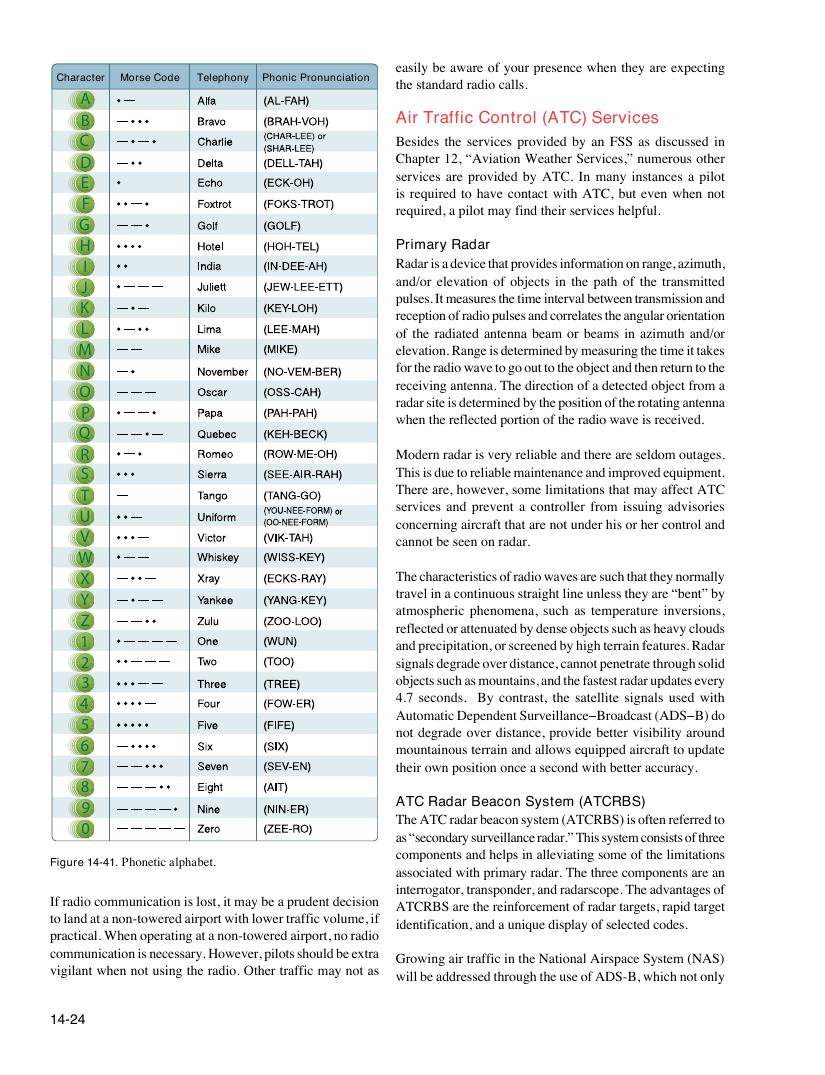
Figure 14-41. Phonetic alphabet.
associated with primary radar. The three components are an
interrogator, transponder, and radarscope. The advantages of
If radio communication is lost, it may be a prudent decision
ATCRBS are the reinforcement of radar targets, rapid target
to land at a non-towered airport with lower traffic volume, if
identification, and a unique display of selected codes.
practical. When operating at a non-towered airport, no radio
communication is necessary. However, pilots should be extra
Growing air traffic in the National Airspace System (NAS)
vigilant when not using the radio. Other traffic may not as
will be addressed through the use of ADS-B, which not only
14-24