FAA-H-8083-25C · Source PDF page 359
Airport Operations
Air Traffic Control (ATC) Services · PHAK page 14-25
Searchable transcription
Movement of Vehicles,
Color and Type of Signal Aircraft on the Ground Aircraft in Flight
Equipment and Personnel
Steady green Cleared to cross,
Cleared for takeoff Cleared to land
proceed or go
Flashing green Return for landing (to be followed
Not applicable Cleared for taxi
by steady green at the proper time)
Steady red Give way to other aircraft and
Stop Stop continue circling
Flashing red Clear the taxiway/runway Taxi clear of the runway Airport unsafe, do not land
in use
Flashing white Return to starting point Return to starting point Not applicable
on airport on airport
Alternating red and green
Exercise extreme caution!!!! Exercise extreme caution!!!! Exercise extreme caution!!!!
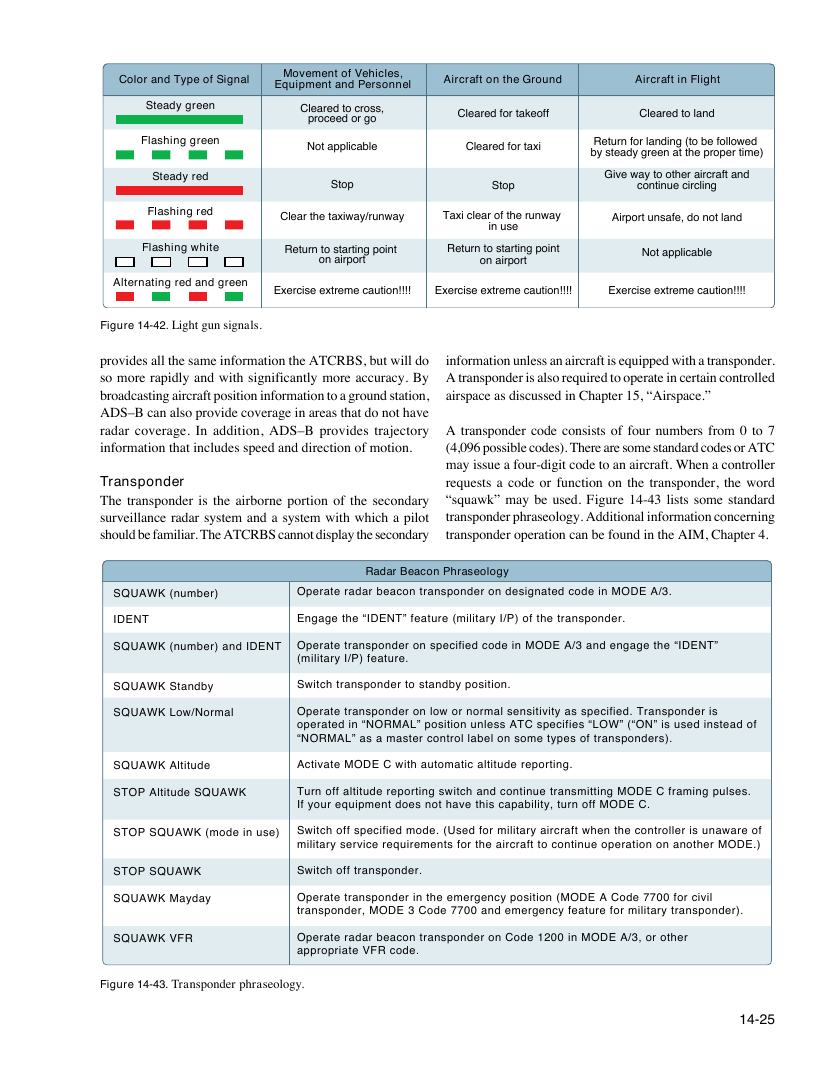
Figure 14-42. Light gun signals.
provides all the same information the ATCRBS, but will do information unless an aircraft is equipped with a transponder.
so more rapidly and with significantly more accuracy. By A transponder is also required to operate in certain controlled
broadcasting aircraft position information to a ground station, airspace as discussed in Chapter 15, “Airspace.”
ADS–B can also provide coverage in areas that do not have
radar coverage. In addition, ADS–B provides trajectory A transponder code consists of four numbers from 0 to 7
information that includes speed and direction of motion. (4,096 possible codes). There are some standard codes or ATC
may issue a four-digit code to an aircraft. When a controller
Transponder requests a code or function on the transponder, the word
The transponder is the airborne portion of the secondary “squawk” may be used. Figure 14-43 lists some standard
surveillance radar system and a system with which a pilot transponder phraseology. Additional information concerning
should be familiar. The ATCRBS cannot display the secondary transponder operation can be found in the AIM, Chapter 4.
Radar Beacon Phraseology
SQUAWK (number) Operate radar beacon transponder on designated code in MODE A/3.
IDENT Engage the “IDENT” feature (military I/P) of the transponder.
SQUAWK (number) and IDENT Operate transponder on specified code in MODE A/3 and engage the “IDENT”
(military I/P) feature.
SQUAWK Standby Switch transponder to standby position.
SQUAWK Low/Normal Operate transponder on low or normal sensitivity as specified. Transponder is
operated in “NORMAL” position unless ATC specifies “LOW” (“ON” is used instead of
“NORMAL” as a master control label on some types of transponders).
SQUAWK Altitude Activate MODE C with automatic altitude reporting.
STOP Altitude SQUAWK Turn off altitude reporting switch and continue transmitting MODE C framing pulses.
If your equipment does not have this capability, turn off MODE C.
STOP SQUAWK (mode in use) Switch off specified mode. (Used for military aircraft when the controller is unaware of
military service requirements for the aircraft to continue operation on another MODE.)
STOP SQUAWK Switch off transponder.
SQUAWK Mayday Operate transponder in the emergency position (MODE A Code 7700 for civil
transponder, MODE 3 Code 7700 and emergency feature for military transponder).
SQUAWK VFR Operate radar beacon transponder on Code 1200 in MODE A/3, or other
appropriate VFR code.
Figure 14-43. Transponder phraseology.
14-25