FAA-H-8083-25C · Source PDF page 360
Airport Operations
Wake Turbulence · PHAK page 14-26
Searchable transcription
Automatic Dependent Surveillance–Broadcast
(ADS-B) A B
Automatic Dependent Surveillance−Broadcast (ADS−B) is a
Wind
surveillance technology being deployed throughout the NAS
to facilitate improvements needed to increase the capacity
TRACK TRACK
and efficiency of the NAS, while maintaining safety. ADS-B
supports these improvements by providing a higher update rate
and enhanced accuracy of surveillance information over the
current radar-based surveillance system. In addition, ADS-B
enables the expansion of air traffic control (ATC) surveillance
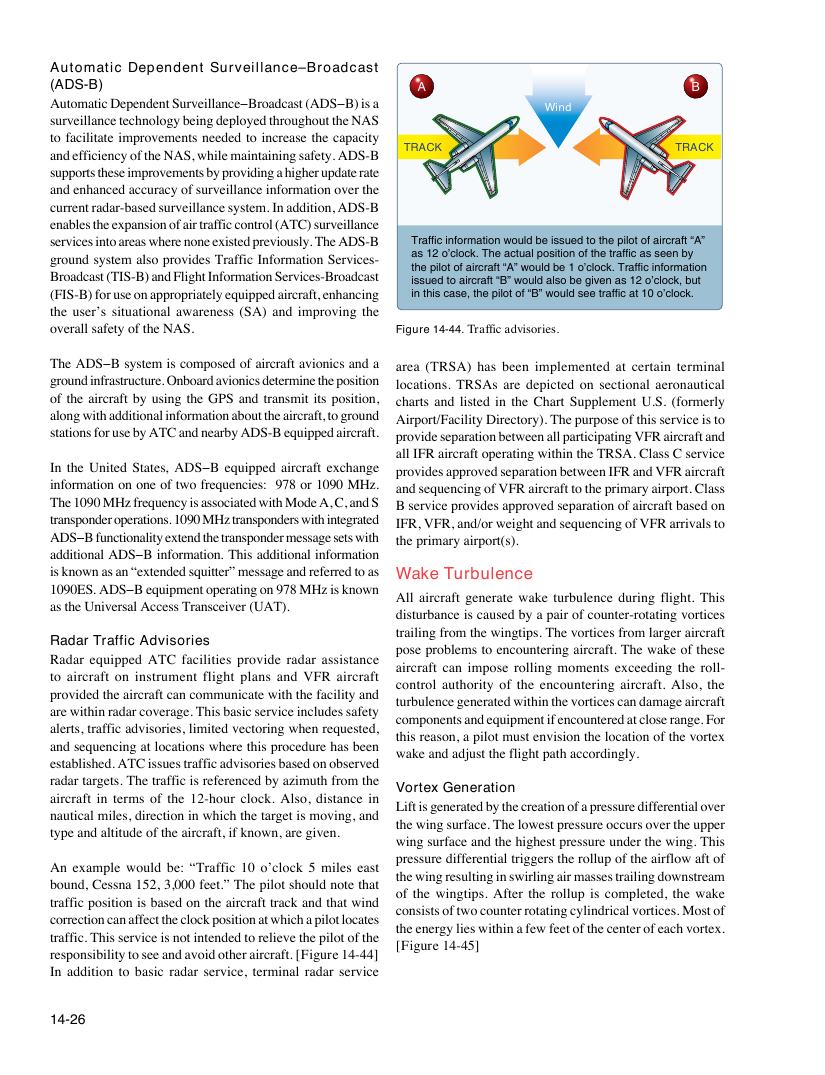
services into areas where none existed previously. The ADS-B Traffic information would be issued to the pilot of aircraft “A”
ground system also provides Traffic Information Services- as 12 o’clock. The actual position of the traffic as seen by
the pilot of aircraft “A” would be 1 o’clock. Traffic information
Broadcast (TIS-B) and Flight Information Services-Broadcast
issued to aircraft “B” would also be given as 12 o’clock, but
(FIS-B) for use on appropriately equipped aircraft, enhancing in this case, the pilot of “B” would see traffic at 10 o’clock.
the user’s situational awareness (SA) and improving the
overall safety of the NAS. Figure 14-44. Traffic advisories.
The ADS−B system is composed of aircraft avionics and a area (TRSA) has been implemented at certain terminal
ground infrastructure. Onboard avionics determine the position locations. TRSAs are depicted on sectional aeronautical
of the aircraft by using the GPS and transmit its position, charts and listed in the Chart Supplement U.S. (formerly
along with additional information about the aircraft, to ground Airport/Facility Directory). The purpose of this service is to
stations for use by ATC and nearby ADS-B equipped aircraft. provide separation between all participating VFR aircraft and
all IFR aircraft operating within the TRSA. Class C service
In the United States, ADS−B equipped aircraft exchange provides approved separation between IFR and VFR aircraft
information on one of two frequencies: 978 or 1090 MHz. and sequencing of VFR aircraft to the primary airport. Class
The 1090 MHz frequency is associated with Mode A, C, and S B service provides approved separation of aircraft based on
transponder operations. 1090 MHz transponders with integrated IFR, VFR, and/or weight and sequencing of VFR arrivals to
ADS−B functionality extend the transponder message sets with the primary airport(s).
additional ADS−B information. This additional information
is known as an “extended squitter” message and referred to as Wake Turbulence
1090ES. ADS−B equipment operating on 978 MHz is known
All aircraft generate wake turbulence during flight. This
as the Universal Access Transceiver (UAT).
disturbance is caused by a pair of counter-rotating vortices
trailing from the wingtips. The vortices from larger aircraft
Radar Traffic Advisories
pose problems to encountering aircraft. The wake of these
Radar equipped ATC facilities provide radar assistance
aircraft can impose rolling moments exceeding the roll-
to aircraft on instrument flight plans and VFR aircraft
control authority of the encountering aircraft. Also, the
provided the aircraft can communicate with the facility and
turbulence generated within the vortices can damage aircraft
are within radar coverage. This basic service includes safety
components and equipment if encountered at close range. For
alerts, traffic advisories, limited vectoring when requested,
this reason, a pilot must envision the location of the vortex
and sequencing at locations where this procedure has been
wake and adjust the flight path accordingly.
established. ATC issues traffic advisories based on observed
radar targets. The traffic is referenced by azimuth from the
Vortex Generation
aircraft in terms of the 12-hour clock. Also, distance in
Lift is generated by the creation of a pressure differential over
nautical miles, direction in which the target is moving, and
the wing surface. The lowest pressure occurs over the upper
type and altitude of the aircraft, if known, are given.
wing surface and the highest pressure under the wing. This
pressure differential triggers the rollup of the airflow aft of
An example would be: “Traffic 10 o’clock 5 miles east
the wing resulting in swirling air masses trailing downstream
bound, Cessna 152, 3,000 feet.” The pilot should note that
of the wingtips. After the rollup is completed, the wake
traffic position is based on the aircraft track and that wind
consists of two counter rotating cylindrical vortices. Most of
correction can affect the clock position at which a pilot locates
the energy lies within a few feet of the center of each vortex.
traffic. This service is not intended to relieve the pilot of the
[Figure 14-45]
responsibility to see and avoid other aircraft. [Figure 14-44]
In addition to basic radar service, terminal radar service
14-26