FAA-H-8083-25C · Source PDF page 396
Navigation
Effect of Wind · PHAK page 16-9
Searchable transcription
• Movement of the air mass in reference to the ground mass of air is moving westward at 20 knots, the airspeed of
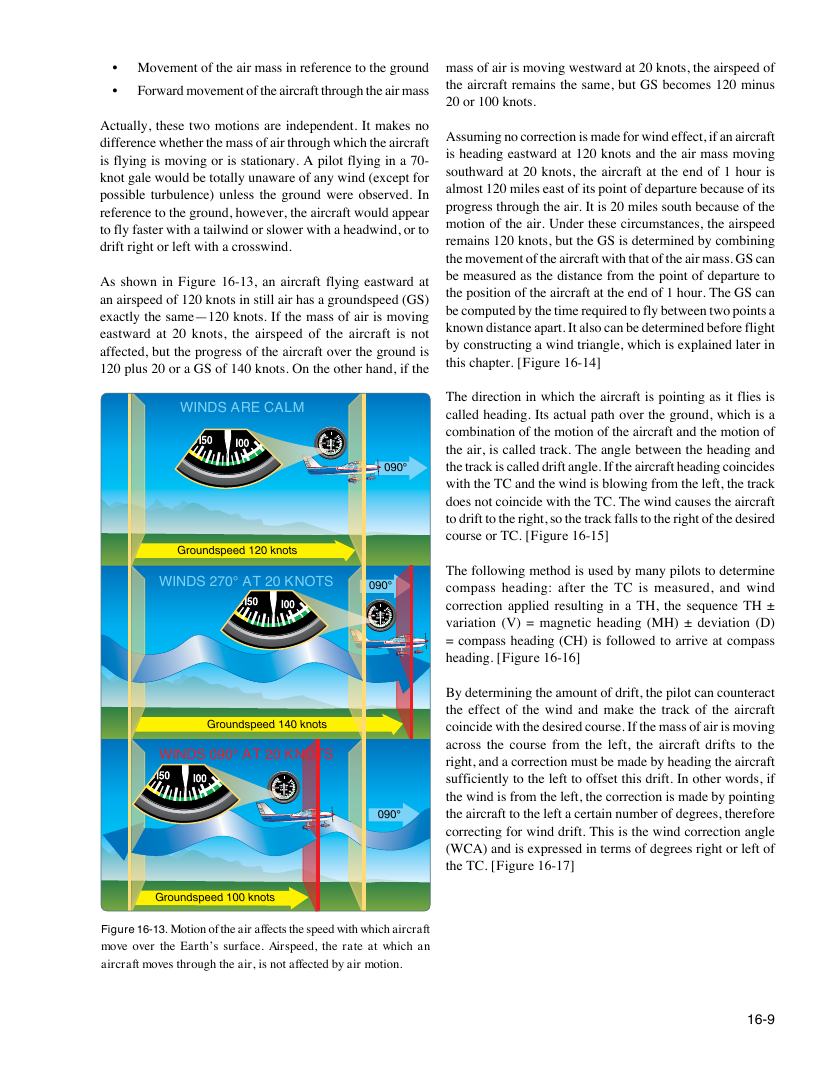
the aircraft remains the same, but GS becomes 120 minus
• Forward movement of the aircraft through the air mass
20 or 100 knots.
Actually, these two motions are independent. It makes no
Assuming no correction is made for wind effect, if an aircraft
difference whether the mass of air through which the aircraft
is heading eastward at 120 knots and the air mass moving
is flying is moving or is stationary. A pilot flying in a 70-
southward at 20 knots, the aircraft at the end of 1 hour is
knot gale would be totally unaware of any wind (except for
almost 120 miles east of its point of departure because of its
possible turbulence) unless the ground were observed. In
progress through the air. It is 20 miles south because of the
reference to the ground, however, the aircraft would appear
motion of the air. Under these circumstances, the airspeed
to fly faster with a tailwind or slower with a headwind, or to
remains 120 knots, but the GS is determined by combining
drift right or left with a crosswind.
the movement of the aircraft with that of the air mass. GS can
be measured as the distance from the point of departure to
As shown in Figure 16-13, an aircraft flying eastward at
the position of the aircraft at the end of 1 hour. The GS can
an airspeed of 120 knots in still air has a groundspeed (GS)
be computed by the time required to fly between two points a
exactly the same—120 knots. If the mass of air is moving
known distance apart. It also can be determined before flight
eastward at 20 knots, the airspeed of the aircraft is not
by constructing a wind triangle, which is explained later in
affected, but the progress of the aircraft over the ground is
this chapter. [Figure 16-14]
120 plus 20 or a GS of 140 knots. On the other hand, if the
The direction in which the aircraft is pointing as it flies is
WINDS ARE CALM
called heading. Its actual path over the ground, which is a
combination of the motion of the aircraft and the motion of
the air, is called track. The angle between the heading and
090° the track is called drift angle. If the aircraft heading coincides
with the TC and the wind is blowing from the left, the track
does not coincide with the TC. The wind causes the aircraft
to drift to the right, so the track falls to the right of the desired
course or TC. [Figure 16-15]
Groundspeed 120 knots
The following method is used by many pilots to determine
WINDS 270° AT 20 KNOTS
090° compass heading: after the TC is measured, and wind
correction applied resulting in a TH, the sequence TH ±
variation (V) = magnetic heading (MH) ± deviation (D)
= compass heading (CH) is followed to arrive at compass
heading. [Figure 16-16]
By determining the amount of drift, the pilot can counteract
the effect of the wind and make the track of the aircraft
Groundspeed 140 knots coincide with the desired course. If the mass of air is moving
across the course from the left, the aircraft drifts to the
WINDS 090° AT 20 KNOTS
right, and a correction must be made by heading the aircraft
sufficiently to the left to offset this drift. In other words, if
the wind is from the left, the correction is made by pointing
090° the aircraft to the left a certain number of degrees, therefore
correcting for wind drift. This is the wind correction angle
(WCA) and is expressed in terms of degrees right or left of
the TC. [Figure 16-17]
Groundspeed 100 knots
Figure 16-13. Motion of the air affects the speed with which aircraft
move over the Earth’s surface. Airspeed, the rate at which an
aircraft moves through the air, is not affected by air motion.
16-9